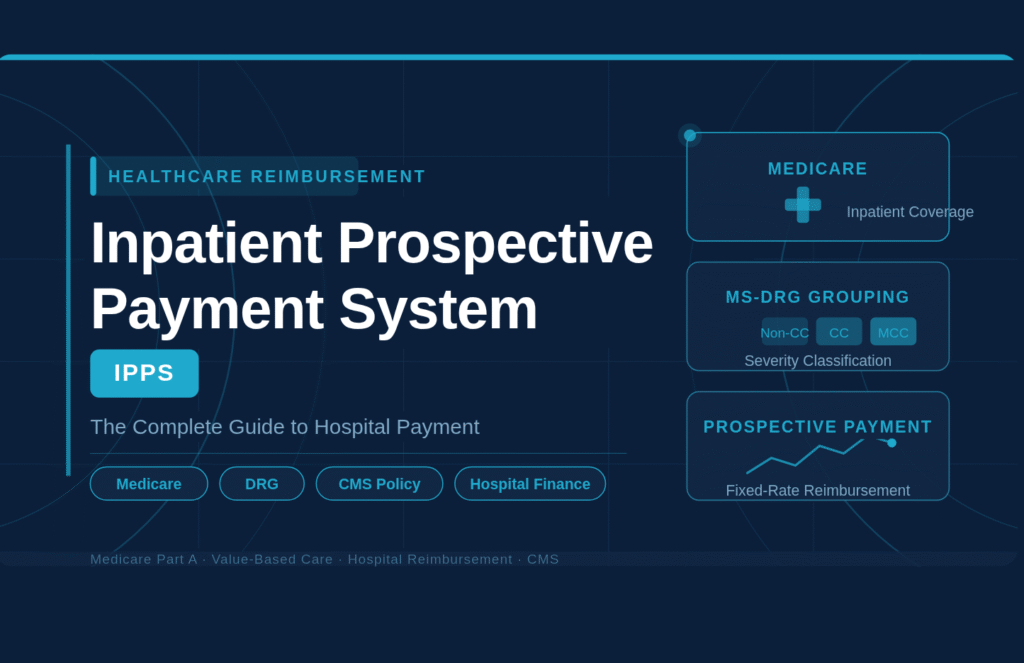
| Quick Summary: The Inpatient Prospective Payment System (IPPS) is the primary method Medicare uses to reimburse acute care hospitals for inpatient services. It pays a fixed, predetermined rate based on each patient’s Medicare Severity Diagnosis-Related Group (MS-DRG). For FY 2026, CMS finalized a 2.6% increase in operating payment rates, effective October 1, 2025. This comprehensive guide breaks down how IPPS works, what’s new, and what healthcare professionals need to know. |
What Is the Inpatient Prospective Payment System (IPPS)?
Picture this: A Medicare patient walks into a hospital with a serious pneumonia infection. The clinical team provides excellent care — lab tests, antibiotics, breathing treatments, and a four-day stay. When it’s time to settle the bill, how does Medicare decide what to pay?
The answer lies in a system that fundamentally transformed American healthcare finance over four decades ago: the Inpatient Prospective Payment System, or IPPS.
The IPPS is a Medicare reimbursement framework established under Section 1886(d) of the Social Security Act that pays acute care hospitals a flat, predetermined rate for each inpatient stay. Instead of reimbursing hospitals for whatever they happen to spend, CMS sets the payment in advance — based on the patient’s diagnosis, medical complexity, and the typical cost of treating similar cases nationwide.
Since its inception in October 1983, the IPPS has been the backbone of Medicare hospital reimbursement. It affects how thousands of US hospitals budget, staff, code, and deliver care. If you work in healthcare administration, medical coding, hospital finance, or health policy, understanding IPPS isn’t just useful — it’s essential.
This guide walks you through everything: how IPPS works, how payment is calculated, the latest FY 2026 updates, key quality programs tied to reimbursement, and what healthcare professionals should watch for in the coming years.
A Brief History of IPPS: Why Was It Created?
The Pre-IPPS Era: Cost-Based Reimbursement
Before 1983, Medicare paid hospitals using a cost-based reimbursement model. In simple terms: the more hospitals spent, the more they got paid. There was almost zero incentive to be efficient.
The results were predictable. Medicare inpatient hospital costs soared from $3 billion in 1967 to $37 billion by 1982. Researchers found a staggering six-fold variation in what Medicare paid individual hospitals for treating the same condition — like an acute heart attack — with no clinically justifiable reason for that disparity. The system was unsustainable.
The 1983 Reform: The Birth of DRG-Based Payment
Under President Reagan, Congress passed the Social Security Amendments of 1983, which included a sweeping overhaul of Medicare hospital reimbursement. Effective October 1, 1983, the IPPS replaced cost-based reimbursement with a prospective, per-discharge payment system based on Diagnosis-Related Groups (DRGs).
The core logic was elegant: group patients with similar diagnoses and resource needs together, calculate the average cost of treating them, set a standard payment for each group, and let hospitals keep any savings if they deliver care more efficiently.
The system had four chief objectives, as defined by Congress:
- Ensure fair compensation for services without compromising patient access
- Account for new medical technology in payment rate updates
- Promote hospital efficiency while maintaining quality
- Ensure the financial stability of the Medicare Hospital Insurance Trust Fund
Over 40 years later, IPPS remains the foundational payment model for Medicare inpatient care, though it has evolved substantially with quality incentives, value-based programs, and annual regulatory updates.
How Does IPPS Work? The Step-by-Step Payment Process
At its core, IPPS works by grouping each patient’s hospital stay into a standardized payment category and applying a predetermined rate. Here’s how the process unfolds:
Step 1: Patient Admission and Discharge
When a Medicare beneficiary is admitted to an acute care hospital as an inpatient, the clock starts. During the stay, the clinical team documents all diagnoses, procedures, and complicating conditions in the medical record.
Step 2: Medical Coding
At discharge, trained medical coders translate the clinical documentation into ICD-10-CM diagnosis codes and ICD-10-PCS procedure codes. This step is critically important: accurate and complete coding directly determines which MS-DRG the patient is assigned to — and therefore how much the hospital gets paid.
Key coding elements include:
- Principal diagnosis (the primary reason for admission)
- Secondary diagnoses (additional conditions that affect care)
- Procedures performed during the stay
- Patient age, sex, and discharge status
- Presence of complications or comorbidities (CCs or MCCs)
Step 3: MS-DRG Assignment via the Grouper
Once coded, the claim goes through an automated software called the “Grouper.” This program assigns the case to one of the Medicare Severity Diagnosis-Related Groups (MS-DRGs) — currently over 740 distinct categories. The Grouper first sorts cases into one of 25 Major Diagnostic Categories (MDCs), largely organized by body system. From there, it narrows down to a specific MS-DRG based on the full coding profile.
MS-DRGs are split by severity level:
- MCC (Major Complication or Comorbidity): Highest severity, highest payment
- CC (Complication or Comorbidity): Moderate severity, moderate payment
- Non-CC: Lowest severity, standard payment
Step 4: Payment Calculation
The hospital’s IPPS payment is calculated using the following formula:
| IPPS Payment Formula: IPPS Payment = MS-DRG Relative Weight × Hospital Base Rate Where the Hospital Base Rate is adjusted for: • Wage Index (reflecting local labor costs) • Disproportionate Share Hospital (DSH) Adjustment (if applicable) • Indirect Medical Education (IME) Adjustment (for teaching hospitals) • Outlier Payments (for extraordinarily costly cases) • New Technology Add-On Payments (NTAP) (for qualifying technologies) |
The MS-DRG relative weight is the key driver of payment variation. An MS-DRG with a weight of 2.0 means the hospital gets paid roughly double the base rate, reflecting that those cases are twice as resource-intensive as the average.
Step 5: Additional Adjustments
Beyond the basic formula, several special adjustments can increase IPPS payments:
- Disproportionate Share Hospital (DSH): Extra payment for hospitals serving large numbers of low-income patients.
- Indirect Medical Education (IME): Additional payment for teaching hospitals that train medical residents.
- Outlier Payments: For cases with unusually high costs, a supplemental payment kicks in to protect hospitals from catastrophic financial losses.
- New Technology Add-On Payments (NTAP): Temporary additional payments for approved new technologies until their costs are captured in DRG weights.
IPPS by the Numbers: Key Statistics at a Glance
| Metric | Value |
| IPPS Established | October 1983 |
| Number of MS-DRGs (approx.) | Over 740 |
| FY 2025 Hospital Payment Increase | $3.2 billion |
| FY 2025 Net Operating Rate Increase | 2.9% |
| FY 2026 Operating Rate Increase | 2.6% |
| Hospital VBP Withhold Rate | 2% of base DRG payments |
| HAC Reduction Program Penalty | 1% payment reduction for worst quartile |
| Medicare Part A Coverage (per episode) | 90 days + 60-day lifetime reserve |
| FY 2026 LTCH PPS Annual Update | 2.7% |
Which Hospitals Are Covered Under IPPS?
Not every hospital in America is paid under the IPPS. The system applies primarily to acute care general hospitals that accept Medicare patients. However, several categories of hospitals are explicitly excluded:
- Inpatient psychiatric facility hospitals and units
- Inpatient rehabilitation facility (IRF) hospitals and units
- Long-term care hospitals (LTCHs) — these are paid under the LTCH PPS
- Children’s hospitals
- Cancer hospitals exempt from IPPS (11 statutorily designated facilities)
- Hospitals outside the 50 states, Washington D.C., and Puerto Rico (e.g., US Virgin Islands, Guam)
Excluded hospital types have their own prospective payment frameworks tailored to their unique patient populations and care models.
IPPS and Quality-Based Payment Programs
Modern IPPS is not purely about volume or diagnosis codes. Over the past two decades, CMS has layered a suite of quality programs onto the IPPS framework that tie hospital payments directly to performance outcomes. These programs reflect the shift from fee-for-service toward value-based care.
1. Hospital Inpatient Quality Reporting (IQR) Program
The Hospital IQR Program requires hospitals to submit quality data on a range of clinical measures. In exchange, hospitals that comply receive the full annual market basket update. Hospitals that fail to participate face a one-quarter reduction to their annual payment update. For FY 2026, CMS finalized updates to the IQR measure set to align with current clinical priorities.
2. Hospital Value-Based Purchasing (VBP) Program
The Hospital VBP Program is a budget-neutral initiative that withholds 2% of base operating DRG payments from all participating hospitals, then redistributes the total pool back as value-based incentive payments based on performance scores. Hospitals that perform above national benchmarks can actually earn back more than the 2% withheld.
Performance domains include clinical outcomes, safety, efficiency, and patient experience (measured through the HCAHPS survey). In the FY 2025 final rule, CMS finalized modifications to HCAHPS survey scoring for FY 2027–2029.
3. Hospital Readmissions Reduction Program (HRRP)
The HRRP penalizes hospitals with excess readmission rates for specific conditions including heart failure, heart attack, pneumonia, hip/knee replacement, COPD, and coronary artery bypass grafting (CABG). Penalties can reduce base operating DRG payments by up to 3%. CMS publishes hospital-specific readmission ratios annually.
4. Hospital-Acquired Condition (HAC) Reduction Program
Hospitals in the worst-performing quartile for hospital-acquired conditions — like bloodstream infections, surgical site infections, and pressure injuries — receive a 1% payment reduction applied to all IPPS discharges for the fiscal year. This program creates a direct financial incentive to invest in patient safety and infection control.
5. Medicare Promoting Interoperability Program
Formerly known as Meaningful Use, this program requires hospitals to demonstrate meaningful use of certified electronic health record (EHR) technology. Hospitals that fail to qualify face a payment reduction. Effective for the CY 2025 EHR reporting period, CMS raised the performance-based scoring threshold from 60 to 70 points, and will further increase it to 80 points beginning with CY 2026.
FY 2025 IPPS Final Rule: Key Updates (Effective October 1, 2024)
The FY 2025 IPPS final rule, issued by CMS on August 1, 2024, brought a range of significant payment and policy changes. Here are the highlights:
Payment Rate Changes
- Net operating rate increase: 2.9% for hospitals successfully participating in the Hospital IQR Program and meaningfully using EHRs. This reflects a projected market basket increase of 3.4%, reduced by a 0.5 percentage point productivity adjustment.
- Overall payment impact: CMS expected operating and capital IPPS rate changes to increase total hospital payments by $3.2 billion in FY 2025.
- DSH uncompensated care payments: Projected to decrease by approximately $0.2 billion.
- New technology add-on payments: Increased by approximately $0.3 billion.
Drug Shortage Preparedness: Essential Medicine Buffer Stock
One of the more innovative FY 2025 policies established a new IPPS payment for small independent hospitals (100 beds or fewer) to maintain six-month buffer stocks of 86 essential medicines identified by the Advanced Regenerative Manufacturing Institute (ARMI). This policy aims to prevent future drug shortages and improve supply chain resilience.
Wage Index and Low-Wage Hospital Policy
CMS extended the temporary low-wage index hospital policy (originally finalized in FY 2020) for at least three additional years beginning in FY 2025. This policy helps rural and other low-wage hospitals by boosting their wage indexes, which in turn increases their IPPS payment rates. The extension was driven by the need to evaluate the policy’s effects using post-pandemic wage data.
However, a July 2024 D.C. Circuit Court ruling in Bridgeport Hosp. v. Becerra held that CMS lacked the legal authority to adopt the low-wage index hospital policy for FY 2020, requiring CMS to issue interim guidance and implement revised wage index values.
Graduate Medical Education (GME) Funding
The FY 2025 final rule included $74 million in funding for graduate medical education, supporting 200 additional Medicare-funded physician residency slots distributed from 2026 through 2036 — a meaningful investment in the future physician workforce.
FY 2026 IPPS Final Rule: What’s New (Effective October 1, 2025)
On July 31, 2025, CMS issued the FY 2026 IPPS/LTCH PPS final rule, which took effect October 1, 2025. Here is what changed:
Operating Payment Rate Update
CMS finalized a 2.6% increase in IPPS operating payment rates for hospitals that meet IQR and EHR requirements. This reflects a market basket increase of 3.3% reduced by a 0.7 percentage point productivity adjustment. Hospitals that fail to meet quality or EHR requirements receive a reduced update.
LTCH PPS Update
For long-term care hospitals, CMS finalized a 2.7% annual update to the LTCH standard payment rate for FY 2026. Total LTCH PPS payments for standard rate cases are projected to increase by approximately $72 million.
Discontinuation of Low Wage Index Hospital Policy
Following the Bridgeport Hosp. v. Becerra appellate court decision, CMS finalized the discontinuation of the low-wage index hospital policy for FY 2026 and beyond. To ease the transition for hospitals significantly impacted by this change, CMS adopted a budget-neutral transitional exception for FY 2026.
Quality Program Updates
The FY 2026 rule finalized several quality measure changes, including:
- Removal of the Hospital Commitment to Health Equity measure beginning with the CY 2024 reporting period/FY 2026 program year
- Removal of the Screening for Social Drivers of Health and Screen Positive Rate for Social Drivers of Health measures, beginning with the CY 2024 reporting period/FY 2026 program year
- Updates to the Extraordinary Circumstances Exception (ECE) policy, extending the ECE request window from 30 to 60 days
The Transforming Episode Accountability Model (TEAM)
Originally finalized in the FY 2025 rule, the TEAM model is a mandatory alternative payment model focused on episodes of care beginning with five specific procedures: coronary artery bypass graft (CABG), lower extremity joint replacement, major bowel procedure, surgical hip/femur fracture treatment, and spinal fusion. TEAM tests whether financial accountability for these surgical episodes reduces Medicare spending while maintaining or improving quality.
What IPPS Means for Hospital Finance and Operations
For hospital CFOs, revenue cycle managers, and healthcare administrators, IPPS isn’t an abstract policy concept — it’s a direct driver of financial performance. Here’s how IPPS shapes day-to-day hospital operations:
Revenue Cycle Management
Because IPPS pays a flat rate per discharge, a hospital’s financial performance under IPPS depends heavily on how efficiently it delivers care. If a hospital’s actual costs exceed the MS-DRG payment rate, the hospital absorbs the loss. If costs are below the payment rate, the hospital keeps the surplus. This “keep the savings, absorb the losses” dynamic is the core financial incentive built into IPPS.
Clinical Documentation Improvement (CDI)
One of the most important operational functions in any IPPS hospital is clinical documentation improvement (CDI). CDI specialists review medical records in real time to ensure that physicians’ documentation accurately reflects the severity of patient illness. Missing a documented MCC (major complication or comorbidity) can mean the difference between two very different MS-DRGs — and thousands of dollars in reimbursement.
Case Mix Index (CMI)
The case mix index is the average DRG relative weight for all Medicare discharges at a given hospital. A higher CMI signals that a hospital is treating sicker, more complex patients. IPPS creates a natural incentive for hospitals to accurately document complexity, because a higher CMI translates directly to higher average payments per case.
Length of Stay Management
Under the old cost-based reimbursement system, there was no incentive to discharge patients promptly. Under IPPS, a hospital is paid the same flat rate regardless of whether the patient stays two days or ten days. This created powerful incentives for utilization management, care coordination, and timely discharge planning — all of which benefit both the hospital’s bottom line and patients’ outcomes.
Challenges and Criticisms of IPPS
No payment system is perfect, and IPPS has faced legitimate criticism over the decades. Understanding these challenges helps healthcare leaders navigate the system more effectively.
- Rural Hospital Vulnerability: Small rural hospitals often operate with thin margins under IPPS because they serve lower volumes of Medicare patients and have higher per-case costs. Programs like Critical Access Hospital (CAH) designation and the low-volume hospital adjustment exist partly to address these disparities.
- Upcoding Concerns: Because payment is tied to MS-DRG assignment, there are financial incentives to code the most complex — and highest-paying — DRG. CMS and OIG actively monitor for inappropriate upcoding.
- Technology Lag: New medical technologies may take years to be reflected in MS-DRG weights. The New Technology Add-On Payment (NTAP) program helps bridge this gap, but it has a limited scope.
- Uncompensated Care: Hospitals treating large numbers of uninsured or Medicaid patients rely heavily on the DSH uncompensated care pool, which has faced fluctuating funding levels under different legislative environments.
- Wage Index Inequities: Geographic wage index differences have historically disadvantaged hospitals in lower-wage regions, a tension exemplified by the Bridgeport Hosp. v. Becerra litigation.
People Also Ask: Common Questions About IPPS
What is the difference between IPPS and OPPS?
The Inpatient Prospective Payment System (IPPS) governs Medicare reimbursement for inpatient hospital stays, while the Outpatient Prospective Payment System (OPPS) covers hospital outpatient services. IPPS uses MS-DRGs as its payment unit, while OPPS uses Ambulatory Payment Classifications (APCs). OPPS was introduced in 2000 and covers procedures, clinic visits, and other services delivered in a hospital outpatient setting.
How is the IPPS base rate determined each year?
CMS updates the IPPS base rate annually through a formal rulemaking process. The update is tied to the hospital market basket index, which tracks changes in the prices hospitals pay for labor, supplies, and other inputs. The raw market basket increase is then reduced by a productivity adjustment (and sometimes by legislative mandates). Hospitals that fail to meet IQR or EHR program requirements receive a further reduced update.
Who is excluded from IPPS?
Hospitals excluded from IPPS include inpatient psychiatric facilities, inpatient rehabilitation facilities, long-term care hospitals (which have their own LTCH PPS), children’s hospitals, 11 designated cancer hospitals, and hospitals located outside the 50 states, D.C., and Puerto Rico. These facilities are paid under separate Medicare payment systems appropriate to their care settings.
What is a Medicare Severity Diagnosis-Related Group (MS-DRG)?
An MS-DRG is a patient classification system used under IPPS to group inpatient hospital cases based on clinical similarity and resource use. Each MS-DRG has a relative weight that reflects the average resource intensity of treating patients in that group, compared to the overall average. Cases are assigned to MS-DRGs based on principal diagnosis, secondary diagnoses, procedures, and patient characteristics. There are over 740 MS-DRGs, and CMS recalibrates their weights annually.
What are IPPS outlier payments?
IPPS outlier payments are additional reimbursements for cases where the hospital’s costs significantly exceed the standard MS-DRG payment. To qualify, the cost of a case must exceed the MS-DRG payment plus a fixed-loss threshold (which CMS updates annually). Outlier payments are designed to protect hospitals from catastrophic financial losses on unusually expensive cases, such as patients who experience major complications or require extremely prolonged care.
How does the Hospital VBP Program relate to IPPS?
The Hospital Value-Based Purchasing (VBP) Program is embedded within the IPPS framework. CMS withholds 2% of each hospital’s base operating DRG payments and redistributes the total pool based on quality performance scores. Hospitals that score above the national benchmark can earn back more than the 2% withheld, while lower-performing hospitals may receive less than their withheld amount. This design links IPPS reimbursement directly to quality outcomes.
Does IPPS cover physician services?
No. Physicians are paid separately under the Medicare Physician Fee Schedule (PFS) for their professional services provided during an inpatient stay. IPPS covers the hospital’s operating and capital costs — including nursing care, room and board, diagnostic services, and hospital-based clinical staff — but does not include physician professional fees, which are billed independently.
The Future of IPPS: Trends to Watch
IPPS has always been a living system, adapting to changes in medical technology, policy priorities, and economic conditions. Looking ahead, several trends are likely to shape its evolution:
- Value-Based Care Expansion: CMS continues to move toward tying more IPPS dollars to quality outcomes, alternative payment models, and population health measures. Programs like TEAM signal a broader shift toward episode-based accountability.
- Health Equity Integration: While some health equity measures were removed in FY 2026, CMS has signaled long-term interest in using payment policy to reduce disparities. Future rules may introduce new equity-focused measures.
- Technology and AI: As AI-assisted diagnosis and new medical technologies proliferate, the NTAP process and MS-DRG recalibration will become increasingly critical to ensure that payment rates reflect actual care costs.
- Electronic Health Records and Interoperability: CMS continues to raise EHR performance thresholds under the Promoting Interoperability Program, pushing hospitals toward seamless data exchange and real-time patient information access.
- Supply Chain and Drug Shortage Preparedness: The FY 2025 buffer stock policy for essential medicines suggests that future IPPS rules may increasingly address supply chain resilience as a strategic priority.
Conclusion: Why IPPS Mastery Matters
The Inpatient Prospective Payment System is more than a billing mechanism — it is the financial architecture of American hospital care for tens of millions of Medicare patients. Every year, IPPS shapes how hospitals invest in technology, manage their workforce, train residents, control infections, and ultimately deliver care.
For healthcare professionals, staying current with IPPS isn’t optional. Annual rule changes directly affect reimbursement, compliance obligations, quality program performance, and strategic planning. Whether you’re a hospital CFO tracking the FY 2026 rate update, a medical coder mastering the latest MS-DRG reclassifications, or a CDI specialist ensuring documentation accuracy — IPPS is at the center of your work.
The good news is that understanding IPPS empowers hospitals to respond proactively rather than reactively: optimizing documentation, managing utilization, investing in quality, and aligning resources with where Medicare’s value-based programs are headed.