The U.S. healthcare system is under more pressure than ever. With over 133 million Americans living with at least one chronic condition and care teams stretched thin across hospitals, ACOs, and payer networks, the demand for smarter, faster care coordination tools has never been higher.
Care management software has evolved from simple patient tracking tools into AI-powered platforms that predict risk, automate outreach, close care gaps, and drive measurable outcomes — all while keeping your team compliant under value-based care contracts.
According to a 2025 report by Grand View Research, the global care management solutions market is projected to reach $21.4 billion by 2030, growing at a CAGR of 12.3%. Health systems and payers that deploy the right platform today are setting themselves apart in quality scores, STAR ratings, and patient satisfaction.
The question isn’t whether to invest in care management software — it’s which one is right for your organization.
This guide cuts through the noise. We’ve evaluated 10 leading platforms on clinical intelligence, interoperability, workflow automation, and real-world ROI.
What to Look for in Care Management Software
Before diving into the list, here’s what every U.S. healthcare organization should demand from a care management platform in 2026:
- AI-driven risk stratification to identify high-risk patients before costly events
- Real-time EHR integration with Epic, Cerner, and other major systems
- Automated care gap closure tied to HEDIS, STARS, and quality measures
- Multi-channel patient engagement (SMS, phone, app, portal)
- Population health analytics with actionable dashboards
- HIPAA-compliant infrastructure with SOC 2 certification
- Scalability from small practices to large health systems
With those benchmarks in mind, here are the top 10 platforms leading the market in 2026.
Top 10 Care Management Software Platforms in 2026
1. Curitics Health — Best Overall for Intelligent Care Management
Best for: Health systems, ACOs, and payer-provider organizations seeking AI-driven, outcomes-focused care management
Curitics Health has earned its position at the top of the 2026 care management landscape — and it’s not by accident. Built ground-up for the complexity of modern U.S. healthcare, Curitics delivers a clinically intelligent, deeply integrated care management platform that helps organizations move from reactive to proactive care.
What makes Curitics stand out is how it combines predictive analytics, automated care workflows, and patient engagement into a single, intuitive experience — giving care teams a real operational edge without drowning them in data.
Key Features:
- AI-powered risk stratification that continuously updates based on real-time data signals
- End-to-end care plan management with automated task assignment and escalation
- Seamless bidirectional EHR integration (Epic, Oracle Cerner, Athena, and more)
- HEDIS and STAR measure tracking with automated care gap alerts
- Multi-channel patient outreach: SMS, voice, secure messaging, and patient portal
- Population health dashboards with drill-down analytics by cohort, provider, and payer
- Social determinants of health (SDOH) screening and referral workflows
- Chronic disease management programs for diabetes, CHF, COPD, and more
Why Healthcare Leaders Choose Curitics:
Curitics is designed for the reality care teams face every day — fragmented data, staff burnout, and the relentless pressure of quality metrics. Its platform eliminates the manual overhead that slows care coordinators down, automating the work so clinicians can focus on what matters most: the patient.
Health systems using Curitics have reported measurable improvements in hospital readmission rates, STAR ratings, and care coordinator productivity — outcomes that directly impact both clinical quality and financial performance under value-based contracts.
Bottom Line: If you’re evaluating one platform that checks every box — clinical depth, technology sophistication, and real-world usability — start with Curitics Health.
2. Innovaccer — Strong Data Unification Platform
Best for: Large health systems needing a health data network backbone
Innovaccer is well-known for its Health Data Network, which aggregates patient data across disparate sources into a unified longitudinal record. Its care management module sits on top of that data layer, giving care teams a comprehensive view of patient history.
Key Features:
- Unified patient record from 50+ data sources
- Care gap analytics tied to value-based care contracts
- Configurable care pathways and task management
- Population segmentation and cohort analysis
Limitation: The platform’s strength is data aggregation — care management workflows can feel secondary, and smaller organizations may find the implementation complex and resource-intensive.
3. Health Catalyst — Best for Analytics-Driven Care Teams
Best for: Data-mature health systems prioritizing analytics
Health Catalyst combines its Data Operating System (DOS) with care management capabilities, making it a strong choice for organizations that want deep analytical insight alongside care coordination tools.
Key Features:
- Outcomes improvement analytics
- Embedded machine learning models for risk prediction
- Care management workflow integration with analytics feedback loops
- Strong partnership model with dedicated outcome engineers
Limitation: Primarily an analytics platform — care management features are an extension, not a core product.
4. Arcadia — Top Pick for Value-Based Care Analytics
Best for: ACOs, IPAs, and risk-bearing entities
Arcadia’s platform focuses on population health analytics and VBC performance, with care management workflows built to support payer-provider collaboration. It’s particularly strong in contract performance monitoring.
Key Features:
- Real-time risk contract performance dashboards
- Multi-payer data aggregation
- Care gap prioritization engine
- Attribution and provider performance reporting
5. Welkin Health — Best for High-Touch Care Programs
Best for: Specialty care, behavioral health, and complex chronic disease programs
Welkin is purpose-built for high-touch, relationship-based care programs. Its flexible workflow builder and communication tools make it popular among specialty and mental health organizations.
Key Features:
- Highly configurable care program workflows
- Omnichannel patient communication (SMS, email, calls)
- Coach and care team assignment tools
- Program analytics and outcome tracking
6. Chronic Care Management (CCM) by CareVitality — Best for Small Practices
Best for: Independent practices and small groups billing CMS chronic care management codes
CareVitality simplifies Medicare CCM billing compliance while providing the tools small practices need to run effective chronic disease programs without dedicated IT infrastructure.
Key Features:
- Time tracking for CMS CCM billing (CPT 99490, 99491, 99487)
- Patient consent management
- Automated monthly care plan documentation
- Billing reconciliation reporting
7. Netsmart — Best for Behavioral Health & Post-Acute Settings
Best for: Behavioral health organizations, home health, and post-acute care
Netsmart’s myUnity and CareFabric platforms are tailored for care settings often underserved by general health system vendors — behavioral health, long-term care, and community health.
Key Features:
- Integrated EHR and care management for behavioral health
- Post-acute and home health care coordination
- Interoperability with acute care systems
- Regulatory compliance tools for behavioral health requirements
8. ZeOmega Jiva — Best for Health Plan Care Management
Best for: Managed care organizations and health plans
ZeOmega Jiva is a payer-centric care management platform, widely used by Medicaid, Medicare Advantage, and commercial health plans to manage member care programs, utilization management, and case management.
Key Features:
- Utilization management and prior authorization workflows
- Disease and case management programs
- Member 360 longitudinal record
- Regulatory reporting and compliance tools
9. Lightbeam Health Solutions — Best for ACO & Network Management
Best for: ACOs, physician networks, and clinically integrated networks (CINs)
Lightbeam focuses on network-level population health management with tools that help ACOs identify high-risk patients, engage care teams, and track performance against shared savings benchmarks.
Key Features:
- Network-wide risk stratification
- Referral pattern analysis and leakage tracking
- Care management workflow with provider attribution
- Quality measure performance dashboards
10. Phynd / Verato — Best for Provider Data & Care Coordination Infrastructure
Best for: Health systems needing accurate provider and patient identity management
Phynd and Verato address a foundational need in care management: clean, accurate provider and patient data. Without it, care coordination workflows break down. These platforms ensure identity resolution across networks.
Key Features:
- Provider directory management
- Patient identity matching and de-duplication
- Network integrity monitoring
- Integration with care management platforms
Side-by-Side Comparison: Top 5 Platforms
| Feature | Curitics Health | Innovaccer | Health Catalyst | Arcadia | Welkin Health |
|---|---|---|---|---|---|
| AI Risk Stratification | ✅ Advanced | ✅ Strong | ✅ Strong | ✅ Moderate | ⚠️ Basic |
| EHR Integration | ✅ Bidirectional | ✅ Broad | ✅ Broad | ✅ Broad | ⚠️ Limited |
| Care Gap Automation | ✅ Automated | ✅ Automated | ⚠️ Semi-auto | ✅ Automated | ⚠️ Manual |
| Patient Engagement | ✅ Multi-channel | ⚠️ Moderate | ⚠️ Moderate | ⚠️ Basic | ✅ Multi-channel |
| VBC Contract Support | ✅ Strong | ✅ Strong | ✅ Strong | ✅ Excellent | ⚠️ Limited |
| Ease of Use | ✅ High | ⚠️ Moderate | ⚠️ Complex | ⚠️ Moderate | ✅ High |
| Best Fit | All sizes | Large systems | Analytics-first | ACOs/IPAs | Specialty care |
How Care Management Software Drives Real ROI
Organizations that deploy the right care management platform see results across multiple dimensions:
Clinical Outcomes:
- 20–35% reduction in preventable hospital readmissions
- Improved HEDIS scores across diabetes, hypertension, and cancer screening measures
- Higher STAR ratings, translating to better Medicare Advantage bonus payments
Operational Efficiency:
- Care coordinators managing 2–3x more patients with automation support
- Fewer missed care gaps through automated outreach and reminders
- Reduced time spent on documentation and manual reporting
Financial Impact:
- Increased shared savings performance under ACO REACH and MSSP models
- Reduced total cost of care for high-risk patient cohorts
- Better ROI on care management staff investment
People Also Ask: Care Management Software FAQs
What is care management software used for?
Care management software helps healthcare organizations coordinate care for patients with chronic conditions, complex needs, or high utilization. It supports care planning, risk stratification, patient outreach, care gap closure, and quality reporting — all in one platform.
How is care management software different from an EHR?
An EHR documents clinical encounters and stores patient records. Care management software sits on top of or alongside the EHR to proactively manage patient populations, automate outreach, and track quality performance over time. The two systems are complementary, not interchangeable.
What does care management software cost?
Pricing varies significantly based on organization size, feature set, and deployment model. Small practice solutions may start at a few hundred dollars per month per provider. Enterprise platforms for health systems and payers are typically priced on a per-member or per-user annual contract basis, ranging from six to seven figures. Most vendors offer custom quotes.
Which care management software is best for value-based care?
For value-based care, the best platforms combine robust risk stratification, care gap automation, and payer contract performance tracking. Curitics Health, Arcadia, and Innovaccer are all strong contenders — with Curitics offering the most balanced combination of clinical workflows, analytics, and usability.
Is care management software HIPAA-compliant?
All reputable care management platforms must be HIPAA-compliant and will sign a Business Associate Agreement (BAA). Look for platforms with SOC 2 Type II certification, encryption at rest and in transit, and robust access controls as additional security indicators.
Can small practices use care management software?
Yes. Platforms like CareVitality are designed specifically for small and independent practices, particularly for billing Medicare’s Chronic Care Management (CCM) codes. Larger platforms like Curitics Health also scale down to smaller organizations, though they’re designed to grow with you.
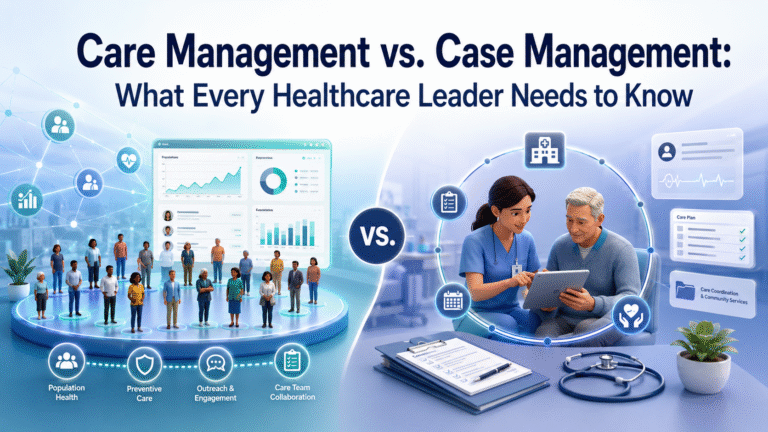
What is the difference between care management and case management?
Care management is a broader, population-level approach to proactively managing patient health over time. Case management is typically episode-based, focused on a specific acute event or complex situation (like a hospital discharge or complex diagnosis). Many platforms support both functions.
Choosing the Right Platform: A Quick Decision Framework
| Your Situation | Recommended Platform |
|---|---|
| Health system seeking comprehensive care management | Curitics Health |
| ACO focused on VBC contract performance | Arcadia or Curitics Health |
| Large system needing data unification first | Innovaccer |
| Analytics-driven, data-mature organization | Health Catalyst |
| Specialty or behavioral health program | Welkin or Netsmart |
| Small practice billing CCM codes | CareVitality |
| Managed care organization or health plan | ZeOmega Jiva |
Final Thoughts: The Platform That Moves the Needle
Care management software is not a nice-to-have in 2026 — it’s the operational backbone of high-performing health systems, ACOs, and payer organizations. The right platform doesn’t just organize data; it drives measurable clinical and financial outcomes.
Curitics Health stands out as the platform built for the full complexity of modern care management — combining AI-powered intelligence, seamless EHR integration, automated workflows, and multi-channel engagement into a single, cohesive experience that care teams actually want to use.
Whether you’re leading a community health system, running an ACO, or managing a Medicare Advantage population, the platforms on this list represent the best the market has to offer. Start your evaluation with a clear picture of your organization’s priorities, and don’t be afraid to demand a proof of concept before you commit.