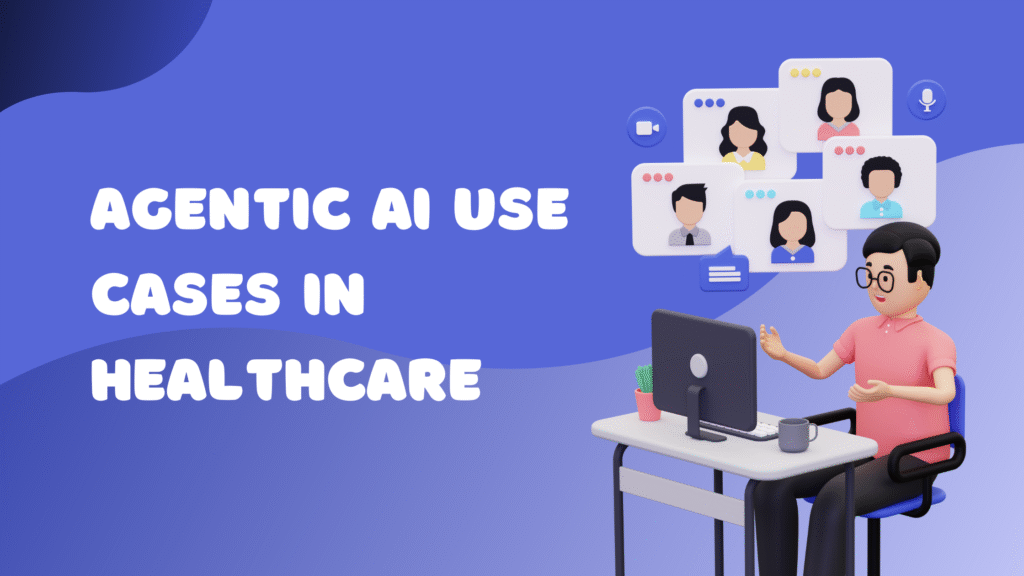
What Is Agentic AI in Healthcare?
Picture a typical morning in a busy academic medical center. A nurse practitioner orders a discharge summary. A prior auth request is sitting in limbo. A high-risk patient’s vitals are trending in the wrong direction. Under the old model, each of these demands a separate human intervention – a click here, a phone call there, a form somewhere else.
Now picture those same workflows being handled by an intelligent, autonomous system that reads context, reasons across data sources, takes action, and loops back for human oversight only when it matters most. That’s agentic AI in healthcare and it’s happening right now.
Unlike traditional AI tools that answer a single question or perform a fixed task, agentic AI systems operate with a degree of autonomy. They set sub-goals, orchestrate multi-step workflows, interact with EHRs, insurance portals, lab systems, and scheduling platforms – all without waiting for a prompt at every step. They don’t just process data; they act on it.
The distinction from conventional AI is important for health leaders to grasp. A standard clinical decision support tool might flag a drug interaction. An agentic AI system would flag the interaction, check formulary alternatives, generate a new order suggestion, notify the pharmacist, update the care plan, and document the change – all within seconds and with a traceable audit trail.
This leap from reactive to proactive intelligence is what is driving the explosive adoption we’re seeing across U.S. health systems in 2025 and 2026.
Why 2025–2026 Is the Inflection Point for Agentic AI in Healthcare
The forces pushing agentic AI adoption are no longer abstract. They’re existential pressures that every health system CFO, CMO, and CIO is feeling in real time.
The Twin Crises Driving Urgency
U.S. healthcare administrative spending has climbed to approximately $1 trillion annually, consuming between 15% and 30% of total healthcare expenditures. Simultaneously, analysis projects a shortage of up to 3.2 million healthcare workers by 2026. These twin pressures – runaway costs and a strained workforce — are pushing health systems to the breaking point.
What’s Changed in 2025
Several technical and regulatory tailwinds have converged to make agentic AI deployable at scale – not just in pilots:
- Mature LLM reasoning: Large language models now handle clinical nuance, ambiguity, and multi-step logic with sufficient accuracy for supervised deployment.
- EHR interoperability: HL7 FHIR APIs have opened doors for agents to read and write across Epic, Cerner, and Oracle Health environments.
- Regulatory clarity: The FDA and ONC have issued guidance that creates more predictable pathways for AI-driven clinical tools.
- Real-world validation: Early adopters like Stanford Health Care, Humana, and Sentara Health have published outcomes data demonstrating measurable returns.
The share of organizations investing in new technology for business and IT transformation jumped from 15% in 2024 to 52% in 2025, according to Gartner. Every respondent in their 2026 payer survey indicated they have already implemented or plan to deploy agentic AI by 2028. The question for most health systems is no longer whether to invest — it’s how fast and where first.
Top 10 Agentic AI Use Cases in Healthcare
Across clinical, operational, and administrative domains, the following use cases represent the highest-impact, highest-ROI applications of agentic AI in U.S. healthcare today. Each has moved from theory to deployment – some at scale.
Clinical & Diagnostic Applications
1. Autonomous Clinical Decision Support (CDS) – High Impact
Traditional CDS tools interrupt clinicians with alerts — many of which are dismissed as irrelevant. Agentic CDS goes further: it continuously monitors patient data streams, correlates findings against clinical literature and institutional protocols, and proactively surfaces recommendations — without waiting to be asked.
At Stanford Health Care, AI agents now access personalized real-world evidence during patient encounters, surfacing relevant treatment data before the physician even formulates a question. The Atropos Evidence Agent, launched in October 2025, analyzes patient-level data and generates evidence summaries that appear automatically in the physician’s workflow — dramatically reducing the cognitive load of staying current with clinical evidence.
Key capabilities: Sepsis early warning, drug-drug interaction detection, deterioration alerts, ICU triage optimization, and real-time order set suggestions based on current patient context.
📊 Reduces diagnostic errors by up to 40% in early pilots
2. AI-Powered Diagnostic Imaging Analysis – Expanding Fast
Agentic AI is transforming radiology from a reactive specialty to a proactive one. Multi-agent systems can ingest imaging data from PACS, cross-reference patient history from the EHR, apply computer vision models to detect anomalies, prioritize worklists by urgency, and draft preliminary radiology reports — all autonomously.
This doesn’t replace radiologists. It augments them profoundly. By handling routine reads and flagging urgent findings first, agentic systems enable radiologists to focus their expertise where it matters most: complex, ambiguous, high-stakes interpretation.
Real-world example: Oxford University Hospitals NHS Foundation Trust launched a pilot evaluation in Q1 2026 for an agentic imaging system, with plans to expand into live clinical pathways following successful validation.
📊 Up to 30% faster turnaround on imaging reads
3. Predictive Patient Monitoring & Deterioration Detection – Proven ROI
One of the clearest wins for agentic AI in healthcare is continuous, autonomous patient monitoring. Rather than nurses conducting scheduled vital checks, AI agents monitor physiological data streams 24/7 — detecting subtle patterns that precede clinical deterioration hours before they become emergencies.
These systems integrate data from bedside monitors, wearables, nursing notes, and lab results. When risk thresholds are crossed, the agent doesn’t just generate an alert — it can autonomously draft a response protocol, notify the rapid response team, and begin logging the clinical timeline.
In ICU settings, agentic monitoring has been associated with reductions in code blue events and shorter average ICU length of stay — translating directly to both improved outcomes and reduced costs.
📊 Fewer hospitalizations and earlier intervention in monitored populations
4. Robotic-Assisted Surgery with Agentic Coordination
While surgical robots themselves aren’t new, the integration of agentic AI into the surgical ecosystem is. AI agents now coordinate across pre-operative planning tools, intraoperative guidance systems, and post-operative monitoring platforms — creating a continuous, intelligent loop around the surgical event.
Before surgery, agents analyze imaging data to generate 3D procedural maps. During procedures, they provide real-time guidance on anatomical boundaries and instrument positioning. Post-operatively, they monitor for complications and manage the recovery protocol — adapting recommendations based on the patient’s specific trajectory.
📊 Reduced surgical complications and improved post-op care coordination
Administrative & Revenue Cycle Applications
If clinical applications are the headline, administrative automation is where health systems are seeing the fastest, most measurable financial returns today. The sheer volume of administrative waste in U.S. healthcare — estimated at hundreds of billions annually — makes this the most immediate ROI target for agentic AI.
1. Intelligent Prior Authorization & Utilization Management – Fastest Adoption
Prior authorization is the single biggest administrative pain point in U.S. healthcare — a manual, document-heavy process that delays care, frustrates providers, and costs the system billions. Agentic AI is dismantling it.
Platforms like Cohere Health deploy AI agents that autonomously gather clinical documentation, apply payer policy logic, generate authorization submissions, track status, and flag cases requiring human escalation — completing in minutes what once took days.
The results are striking: Cohere Health reports up to 8x ROI and 94% provider satisfaction with their agentic prior authorization platform. Health plans using these tools are processing prior auth requests at a fraction of the cost and time, while reducing provider abrasion that contributes to physician burnout.
2. Revenue Cycle Automation & Claims Processing
Revenue cycle management is laden with manual touchpoints — eligibility verification, coding, claims submission, denial management, and payment reconciliation. Each touchpoint is a potential error and a cost driver. Agentic AI addresses all of them.
AI agents can autonomously verify patient eligibility against payer databases in real time, flag coding discrepancies before submission, manage denial workflows, and reconcile payments — with 95% accuracy in payment reconciliation and $2–$5 saved per claim processed through automation.
Revenue Cycle AI by the Numbers
- 40–60% reduction in claims processing time
- 30–40% decrease in administrative costs
- $2–$5 saved per claim processed
- 80% reduction in payment posting time
- 95% accuracy in payment reconciliation
3. Intelligent Patient Intake & Scheduling
Administrative agents are taking over the full patient intake workflow: collecting intake forms, verifying insurance eligibility, pre-authorizing procedures, and scheduling appointments across complex multi-provider systems. Platforms like Simbie AI deploy autonomous agents that handle patient intake, insurance verification, and billing without human intervention for routine cases.
The operational impact is significant. A large healthcare organization managing 360,000 calls annually can automate a substantial portion of routine appointment changes — freeing the equivalent of four or more full-time staff positions without adding headcount.
Banner Health used intelligent automation to migrate millions of electronic medical records, bringing back 1.2 million hours to the business and deploying 43 digital workers across 20 departments.
Patient Engagement & Care Coordination
1. Personalized Care Management & Chronic Disease Monitoring – Rapidly Growing
For the 60% of American adults living with at least one chronic condition, agentic AI represents a fundamental shift in ongoing care management. Rather than relying on scheduled appointments to catch problems, AI agents continuously analyze data from remote monitoring devices, patient-reported outcomes, medication adherence records, and lab trends — and act on what they find.
When a diabetic patient’s continuous glucose monitor begins showing patterns consistent with impending hypoglycemia, an agentic system doesn’t wait for the next clinic visit. It alerts the care team, generates a medication adjustment recommendation, sends a patient notification, and schedules a telehealth touchpoint — autonomously and in sequence.
Humana rolled out an AI support tool for call centers in February 2026 that handles complex care coordination inquiries, routing high-risk member queries to clinical staff instantly while resolving routine questions autonomously.
📊 Significant reductions in hospitalizations and ER utilization in monitored populations
2. Virtual Nursing & Agentic Care Coordination Platforms
The nursing shortage has reached crisis proportions across U.S. hospitals. Agentic AI is stepping in not to replace nurses — but to dramatically extend what a nurse can manage safely and effectively.
Andor Health’s ThinkAI platform, deployed in partnership with Sentara Health across 12 hospitals in late 2025, provides a virtual nursing layer that handles routine monitoring, patient education, discharge planning, and escalation — with AI agents managing the coordination overhead so bedside nurses can focus on complex, high-acuity care.
This human-AI teaming model is increasingly seen as the most sustainable path forward for health systems facing both workforce shortages and rising patient complexity.
Challenges & Ethical Considerations in Deploying Agentic AI
The enthusiasm around agentic AI in healthcare is warranted — but responsible health leaders approach deployment with clear-eyed awareness of the challenges ahead. Agentic systems operating with greater autonomy raise the stakes on every dimension: clinical safety, data privacy, equity, and accountability.
| Challenge | Why It Matters | Mitigation Strategy |
|---|---|---|
| Hallucination & Accuracy | AI agents acting on incorrect clinical inferences could cause patient harm | Human-in-the-loop oversight for high-acuity decisions; continuous model monitoring |
| EHR Integration Complexity | Legacy systems create data siloes that limit agent effectiveness | FHIR-compliant APIs; phased integration roadmaps |
| Algorithmic Bias | Models trained on non-representative data may perpetuate health disparities | Diverse training datasets; equity audits; disparity monitoring dashboards |
| HIPAA & Data Governance | Autonomous agents accessing and acting on PHI create new compliance surface area | Role-based access controls; de-identification pipelines; BAA frameworks with vendors |
| Clinical Accountability | When an AI agent makes a clinical recommendation, who is legally responsible? | Clear accountability frameworks; audit trails; physician sign-off requirements |
| Clinician Trust & Adoption | Poorly designed AI tools increase cognitive burden and alert fatigue | Clinician co-design; explainable AI outputs; seamless EHR integration |
| Change Management | Organizational culture and workflow inertia slow adoption | Executive sponsorship; structured training programs; incremental rollouts |
The organizations succeeding with agentic AI in 2025 and 2026 share a common thread: they treat agent deployment like hiring, not like installing software. They define scope, set expectations, build in feedback loops, and iterate based on real-world performance — not just benchmark test results.
Implementation Roadmap for Healthcare Leaders
For health system executives moving beyond pilot programs, the path to scaled agentic AI deployment requires a structured, phased approach. Here is a battle-tested roadmap drawn from the experiences of early adopters across U.S. health systems.
Phase 1: Strategic Assessment & Use Case Prioritization (Months 1–3)
Identify your highest-pain, highest-volume workflows. Map data availability, EHR integration complexity, and existing automation infrastructure. Select one high-impact use case — prior auth, clinical documentation, or patient monitoring — and build the business case around it.
Phase 2: Governance & Infrastructure Preparation (Months 2–4)
Establish an AI governance committee with clinical, legal, compliance, and IT representation. Audit data quality and FHIR readiness. Define accountability frameworks and clinician oversight protocols. Engage vendor partners with proven healthcare-specific deployments.
Phase 3: Controlled Pilot Deployment (Months 4–8)
Deploy in a contained environment with defined success metrics: efficiency gains, error rates, clinician satisfaction, and patient outcomes. Build feedback loops with frontline users. Document every failure mode — they are as valuable as successes.
Phase 4: Validation & ROI Measurement (Months 8–12)
Measure against baseline KPIs established in Phase 1. Publish internal outcomes to build organizational confidence. Identify expansion opportunities. Validate ROI against the 18–24 month return timeline typical of agentic AI investments ($50K–$500K+ depending on scope).
Phase 5: Enterprise Scale & Operating Model Integration (Month 12+)
Expand to additional use cases and departments. Integrate agents into enterprise-wide operating model — moving from point solutions to end-to-end workflow transformation. Build internal AI literacy and a dedicated AI operations function to sustain and evolve the program.
Key Insight from Leading Adopters
- Pick one, prove it, then expand. The organizations seeing real value from agentic AI in 2026 resist the temptation to pilot everything simultaneously.
- Involve clinicians early. Tools designed without frontline input get abandoned. Tools designed with clinicians get adopted and improved.
- Budget for operations, not just implementation. Healthcare-grade AI has recurring costs tied to safety monitoring, compliance, and model updates.
- Treat AI governance as infrastructure. Not a one-time committee — an ongoing function as essential as IT security.
The Bottom Line: A Once-in-a-Generation Shift
Agentic AI in healthcare is not hype. It is a structural shift — one that is already delivering measurable results at Banner Health, Stanford Health Care, Sentara, Humana, and hundreds of other organizations across the United States. The global agentic AI healthcare market, valued at $538.51 million in 2024, is projected to reach $4.96 billion by 2030 at a CAGR of 45.56%. That is not speculation — it reflects contracts already signed, deployments already live, and outcomes already measured.
For health system leaders, the strategic choice is not whether to adopt agentic AI. It is how deliberately to lead the transformation — rather than scrambling to catch up with the organizations that committed earlier. The window for competitive advantage is open. The question is who walks through it.