The federal Independent Dispute Resolution platform has changed, giving providers, health plans and their representatives a new place to manage payment disputes. Organizations should now confirm that the people responsible for submissions can access the system and meet deadlines during the transition.
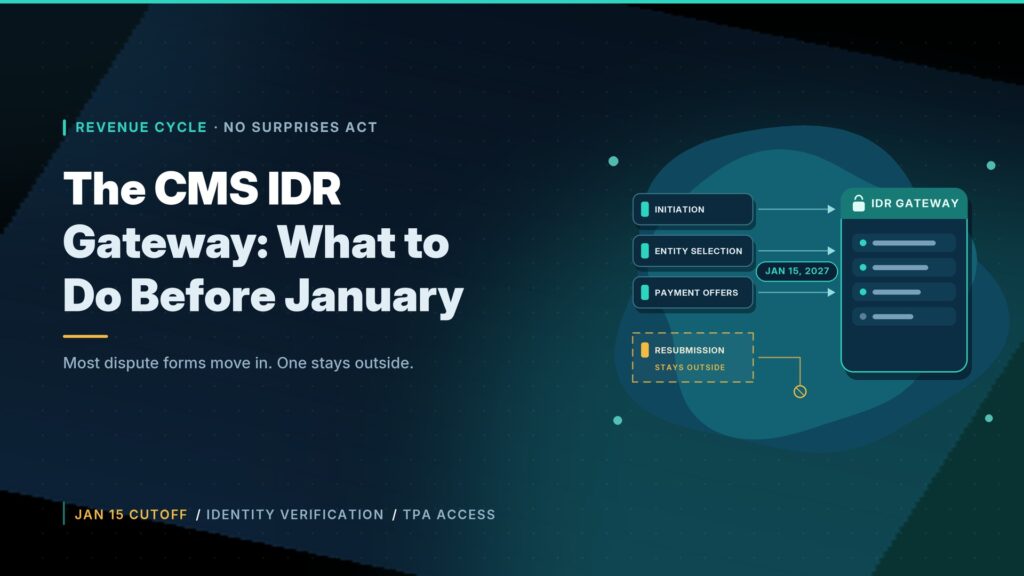
The Departments of Health and Human Services, Labor and the Treasury launched the IDR Gateway on November 13, 2026. CMS published a fact sheet explaining its features on November 20. The platform supports dispute initiation, certified IDR entity selection, payment offers, tracking and reporting.
The immediate planning date is January 15, 2027. Most standalone dispute forms will no longer be available outside the Gateway after that date, although a specific resubmission form remains an exception.
For revenue cycle and payer operations leaders, readiness means checking access, representative arrangements and responsibility for every active dispute.
What Does the CMS IDR Gateway Handle?
The Gateway brings several Federal IDR activities into one platform. Users can initiate disputes, respond to entity selection, submit offers and monitor cases associated with their organization.
Its dashboard, search tools, notifications and reports help teams identify disputes requiring action. CMS also plans to add functionality over time, including the IDR Registry. Organizations should distinguish features available now from those announced for later release.
The practical opportunity is better visibility across a dispute portfolio. A billing supervisor can use that visibility to assign work, identify overdue internal tasks and review whether staff have completed required steps.
However, a dashboard is useful only when organizational access and case assignments are correct. Teams should verify those connections before depending on the system for daily oversight.
Key Dates and the Remaining Exception
| Date or milestone | What it means | Recommended preparation |
|---|---|---|
| November 13, 2026 | The departments launched the IDR Gateway. | Review current workflows against available Gateway functions. |
| November 20, 2026 | CMS published its explanatory fact sheet. | Share the official guidance with dispute-processing teams. |
| After January 15, 2027 | Most standalone forms become unavailable outside the Gateway. | Complete access checks before the transition cutoff. |
| Resubmission exception | The “Notice of IDR Initiation – Resubmission” form remains outside the Gateway under the stated exception. | Maintain a separate workflow for qualifying resubmissions and monitor CMS updates. |
CMS states that the resubmission form will remain available until that functionality ends as finalized in the Federal IDR Operations final rule. Teams should avoid assuming every dispute activity moves into the Gateway on the same date.
Identity Verification and Organizational Access
CMS requires users to verify their identity through an approved credential service provider. Its guidance also describes security protocols permitting only U.S.-based users to access the Federal IDR process.
Organizations should therefore review who actually performs dispute work, including employees of outside billing companies.
An internal readiness review should answer:
- Who maintains organizational access and approves staff participation?
- Which staff members have completed identity verification?
- Can authorized users see the correct organization and disputes?
- Who handles urgent work when the primary processor is unavailable?
- How are access problems escalated before a filing deadline?
Creating an individual account is one step. Operational readiness also requires confirming that the user can perform the assigned work.
What If a Billing Company or TPA Handles Disputes?
CMS explains that a party using a third-party administrator or another organization to process disputes does not itself need to sign up, but must ensure the organization managing those activities obtains a Gateway account.
Providers and plans should request a concrete readiness confirmation from their representative. That confirmation should identify the responsible organization, authorized staff, backup coverage and method for reporting submission status.
A useful operating agreement should also establish who retains supporting documents and submission confirmations, who reviews notifications, and who escalates cases approaching a deadline.
These are recommended controls for managing delegated work. They help the provider or plan assess whether its representative is prepared.
Protect Dispute Deadlines During Migration
The transition should be managed alongside each dispute’s existing procedural requirements.
CMS’s initiation guide states that, when an agreement is not reached, the initiating party must generally start Federal IDR within four business days after the 30-business-day open negotiation period ends. The guide also directs users to check whether the dispute belongs in the federal process.
Teams should keep a central calendar showing negotiation dates, initiation deadlines, selection responses and offer submissions. Record the responsible person and a backup for each action.
For cases that began outside the Gateway, reconcile the internal case list against what authorized users can see. CMS says access to those records depends on successful mapping to an organization.
Do not assume every historical dispute has appeared correctly simply because the account works.
January 2027 Readiness Checklist
The following checklist translates the transition guidance into recommended operational steps.
| Workstream | Recommended action | Evidence to retain |
|---|---|---|
| Ownership | Assign a lead for Gateway readiness and escalation. | Named lead and backup |
| User access | Confirm required staff can sign in and work with the correct organization. | Completed access checklist |
| Outside representatives | Confirm the billing company or TPA has established access. | Written readiness confirmation |
| Active disputes | Reconcile internal records with accessible Gateway cases. | Reviewed case inventory |
| Deadlines | Assign each upcoming action to an accountable person. | Dispute calendar |
| Documentation | Keep negotiation records, supporting files and submission confirmations accessible. | Organized case files |
| Exceptions | Document the separate initiation-resubmission workflow. | Exception instructions |
| Monitoring | Review CMS notices for changes before the cutoff. | Dated guidance review |
This work fits within the broader challenge of digital transformation in healthcare: a new platform needs clear responsibilities, usable information and reliable handoffs.
What Leaders Should Measure
CMS describes the Gateway as improving dispute-management functionality, security and efficiency. The announcement does not establish that an individual organization will receive faster payments.
Organizations can evaluate their own experience by tracking:
- Time needed to prepare and submit a complete dispute.
- Missing-document and access problems.
- Actions completed before their deadlines.
- Staff time spent locating case information.
- Differences between internal records and Gateway status.
An early review of these measures can reveal whether access, staffing or documentation problems need attention before January.
Editorial note: This article is based on public CMS guidance. The readiness checklist and operational recommendations are US Health Insights analysis; no independent performance testing or interviews were conducted.