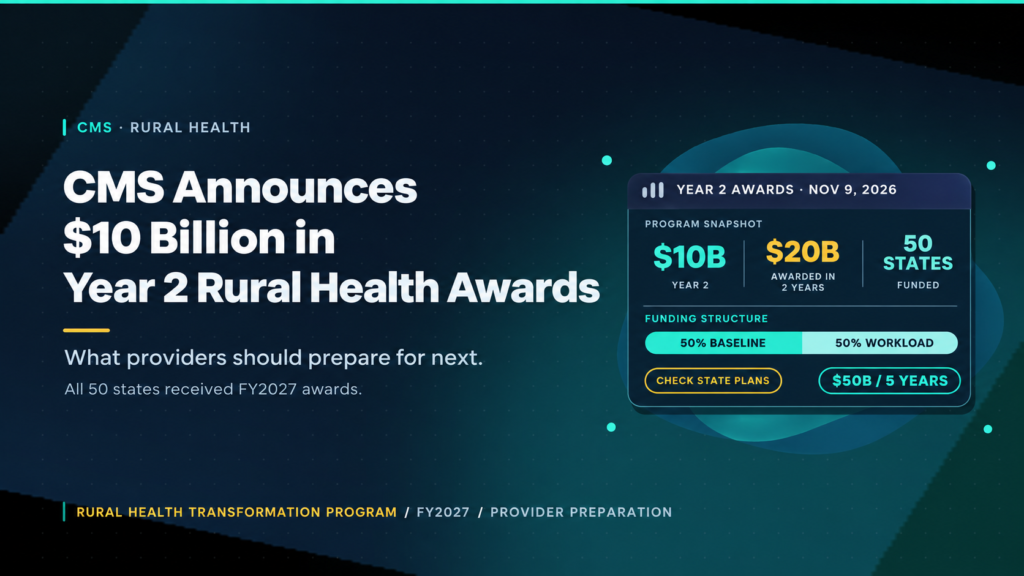
The Centers for Medicare & Medicaid Services announced $10 billion in second-year Rural Health Transformation Program awards on November 9, 2026, with funding going to all 50 states.
The FY2027 awards are part of the program’s existing $50 billion, five-year investment. CMS says the latest allocation brings total awards to $20 billion across the first two years.
For providers, the next step is to identify how their state will implement its approved plan and where a hospital, clinic, workforce partner or technology project could participate.
A federal award to a state does not establish an individual provider’s eligibility or guarantee a direct payment.
What the Year 2 announcement includes
CMS published the FY2027 allocation for every state. Selected awards illustrate the variation:
| State | FY2027 award |
|---|---|
| Texas | $281,976,026 |
| Alaska | $272,653,149 |
| California | $231,105,823 |
| New York | $207,750,071 |
| Florida | $203,828,071 |
These are state-level awards. Provider opportunities, selection processes and implementation schedules depend on the relevant state plan and funding arrangements. The complete allocation table is available in the CMS award announcement.
For the broader program structure, read our guide to the Rural Health Transformation Program and how providers can access opportunities.
How annual funding is divided
CMS describes two components:
- Baseline funding: Half of the annual $10 billion is distributed equally. With all 50 states participating, each receives $100 million.
- Workload funding: The remaining half follows the program’s methodology, including rural population and facility characteristics, state initiatives, specified policy actions and other technical factors.
The two components determine each state’s annual award.
What changes in the second year
CMS says subsequent awards are informed by progress implementing approved plans. All 50 states submitted annual reports.
For initiative-based funding, CMS assesses implementation checkpoints such as governance, approved project plans, launches, milestones, measurement methods and sustainability planning.
State awards can therefore rise, fall or remain similar from one year to the next. CMS also cautions that its published Year 1 obligation figures are a point-in-time snapshot and do not independently measure overall progress or determine Year 2 awards.
For providers preparing proposals, this makes a credible implementation plan especially useful. A strong description should explain what the organization can deliver, how progress will be documented and what happens after the initial funding period.
What providers should prepare now
The following checklist is US Health Insights’ operational analysis. It offers a preparation framework; the applicable state solicitation and award terms determine actual requirements.
1. Identify the state’s implementation pathway
Start with the state agency responsible for the program and its official procurement or funding pages.
Determine whether the relevant initiative will use a competitive application, procurement, partnership agreement or another selection process. Record the opportunity number, contact, eligibility criteria, deadlines and required documents.
A general program announcement should lead to a specific opportunity assessment before an organization commits substantial proposal resources.
2. Connect the project to a defined access problem
Describe the problem in operational terms.
For example, a project might address long specialty appointment waits, incomplete referrals, limited behavioral health access or difficulty retaining essential staff. Establish the local baseline and identify the population affected.
The proposal should explain how the planned work changes that baseline. A technology purchase or new position becomes more persuasive when its connection to patient access is clear.
3. Confirm partner responsibilities
Projects involving several organizations need an agreed division of work.
Before submission, establish who will lead, employ staff, purchase equipment, maintain technology, collect data and report results. Identify dependencies that could delay delivery.
Where information must move between partners, address data access, permissions, security and integration early. Our digital transformation in healthcare guide discusses these implementation considerations.
4. Build a complete operating budget
Estimate the resources needed to launch and maintain the project.
Depending on the proposed work, the budget may need to consider recruitment, training, integration, maintenance, cybersecurity, project management and evaluation.
Separate one-time expenses from recurring costs. Then identify which costs the solicitation allows, which require another funding source and which remain unresolved.
5. Choose a small set of useful measures
A project needs measures that show both delivery and results. The examples below are planning suggestions, not CMS-mandated metrics.
| Project focus | Possible implementation measure | Possible access or service measure |
|---|---|---|
| Specialty access | Referral pathway activated and staff trained | Appointment wait time and completed referrals |
| Workforce development | Recruitment or training milestones completed | Vacancy duration and staff retention |
| Behavioral health | Referral agreements and service capacity established | Time to first appointment and follow-up completion |
| Chronic disease management | Outreach and monitoring workflows launched | Engagement and appropriate follow-up |
| Health information exchange | Connections tested and participating teams trained | Successful information retrieval during care |
Specify who owns each measure, where the data come from and how frequently results will be reviewed.
6. Explain how the service will continue
A sustainability plan should identify the resources required after the initial project period.
Depending on the model, organizations may need to assess reimbursement, partner contributions, operating efficiencies or other continuing support. Assumptions should be documented and tested rather than presented as guaranteed revenue.
Keep funding dates separate
CMS states that states must obligate funds within the applicable budget period. Properly obligated funds generally remain available for expenditure through the following fiscal year, subject to program requirements. The program’s final expenditure limit is September 30, 2032.
Providers should therefore track several dates separately:
- The state application or procurement deadline.
- The project’s required start date.
- Contractual milestone and reporting dates.
- Obligation and expenditure deadlines specified in the agreement.
The final program-wide date should not be treated as a substitute for an earlier contractual deadline.
What the awards mean for provider planning
The Year 2 announcement gives providers a reason to revisit their state’s approved priorities and current opportunities.
A practical first step is a short readiness document covering the access problem, proposed work, partners, budget, measures and unresolved dependencies. That document can help leaders decide whether to apply, join a partnership or strengthen the project before a later opportunity.
Reporting basis: CMS’s November 9 announcement and Year 2 fact sheet. Provider preparation recommendations are US Health Insights’ analysis.