Humana and athenahealth announced an expansion of electronic prior authorization capabilities on November 3, 2026, bringing more of the process into athenaOne, athenahealth’s electronic health record platform.
The collaboration spans athenahealth’s nationwide network of more than 180,000 physicians and clinicians. It connects requirements discovery, documentation, electronic submission and health plan decisions within existing provider workflows. Company announcement
For provider organizations, the practical question is how much administrative work the integration removes—and which cases still require staff intervention. Preparation should focus on confirming availability, assigning responsibility for exceptions and measuring results against current workflows.
What the companies reported
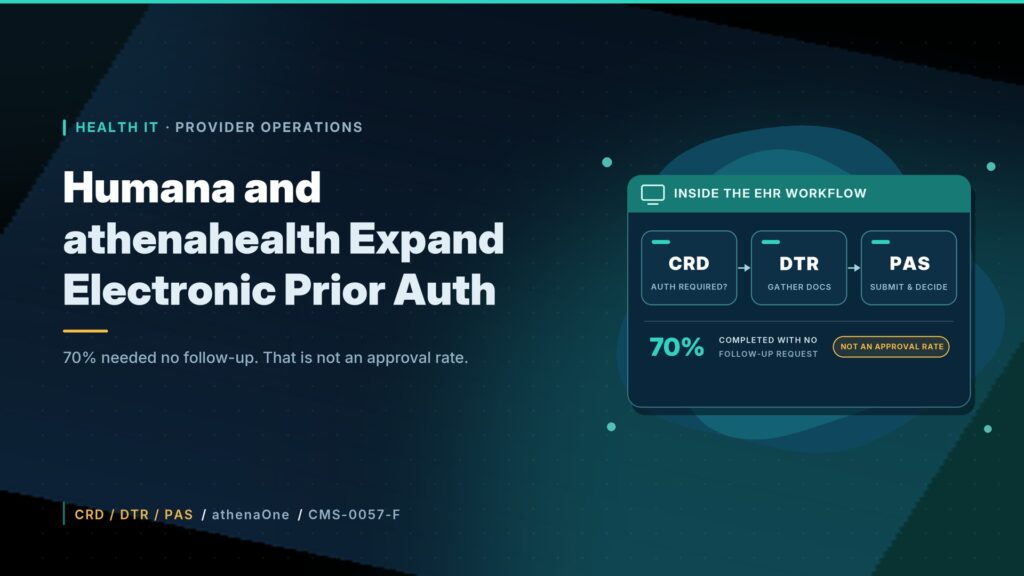
According to athenahealth’s internal data for September 1–30, 2026, more than 6,000 providers processed nearly 35,000 electronic prior authorization transactions with Humana. More than 70% were completed without requests for additional information from practice staff.
That percentage measures documentation follow-up. The completed transactions include approvals, denials and determinations that authorization was unnecessary. It should therefore not be described as a 70% approval rate or evidence that care was approved automatically. Company announcement and methodology footnote
The figures offer an early operational signal. Practices evaluating the expansion should also examine turnaround times, staff effort, unresolved requests and the experience of patients waiting for care.
How the electronic workflow works
The companies describe an approach using FHIR-based interoperability standards, including Coverage Requirements Discovery, Documentation Templates and Rules, and Prior Authorization Support.
These components support different stages of the process:
| Component | Role in the workflow |
|---|---|
| Coverage Requirements Discovery — CRD | Helps identify relevant coverage and authorization requirements. |
| Documentation Templates and Rules — DTR | Supports gathering the documentation required for a request. |
| Prior Authorization Support — PAS | Supports exchanging authorization requests and responses. |
Humana uses athenaPayer to connect with clinicians across the athenaOne network. Company announcement
For background on these connections, see our guide to HL7 standards for healthcare data exchange.
Why the timing matters for 2027
The announcement comes as affected payers prepare for API requirements under the CMS Interoperability and Prior Authorization Final Rule, CMS-0057-F.
CMS established API compliance dates generally beginning January 1, 2027, with exact timing depending on payer type. The rule covers specified Medicare Advantage, Medicaid, CHIP and federally facilitated Marketplace organizations. Its prior authorization API provisions concern medical items and services and exclude drugs. CMS final rule fact sheet
The Humana–athenahealth announcement is a company implementation development. Provider organizations should assess their applicable reporting requirements and payer arrangements separately when planning for 2027.
What providers should prepare for
The following checklist is US Health Insights’ operational analysis. It offers questions to use when assessing implementation; individual practices should confirm the answers with their payer and technology contacts.
1. Confirm which requests can use the workflow
Start with a written scope assessment. Ask which Humana products, services, locations and clinician groups are supported, whether activation is required, and how staff can identify an eligible request.
A network-wide announcement does not answer every practice-specific implementation question.
The assessment should also identify requests that must continue through another channel. Staff need clear instructions for those cases so that a partially supported workflow does not create duplicate submissions.
2. Map responsibility from order to decision
Document what happens after a clinician places an order:
- Who checks whether authorization is required?
- Who reviews documentation before submission?
- Who monitors requests for additional information?
- Who communicates the decision to scheduling staff and the patient?
- Who handles a denial or technical failure?
Embedding a request in the EHR can change where work appears. It still requires a named owner at each stage.
3. Review documentation quality
Electronic exchange depends on the information available in the record. Practices should check whether relevant diagnoses, clinical notes, prior treatment details and supporting results are complete and accessible.
A useful pilot would examine requests that still require follow-up. Determine whether the cause is missing clinical information, inconsistent documentation, an unsupported service or a technical problem.
This creates a more useful improvement plan than treating every delayed request as the same issue.
4. Create a clear exception process
Staff should know how to respond when a request cannot be completed electronically, information is missing or a response needs clinical review.
Assign an exception queue with defined ownership and escalation steps. Include a way to prevent duplicate requests and a process for communicating delays to patients.
An electronic submission confirmation should also be distinguishable from a final authorization decision in staff instructions.
5. Establish a baseline before measuring improvement
Capture current performance before expanding use. Otherwise, it will be difficult to determine whether changes reflect the integration, a different mix of services or unrelated staffing adjustments.
| Measure | What to record | Why it helps |
|---|---|---|
| Staff effort | Staff touches and time spent per request | Shows whether administrative work decreases |
| Documentation follow-up | Requests requiring additional information | Identifies recurring information gaps |
| Decision time | Submission-to-decision time, separated by request type | Shows where delays persist |
| Exceptions | Technical failures, manual transfers and duplicate submissions | Reveals work outside the main workflow |
| Outcomes | Approvals, denials and authorization-not-required results separately | Prevents misleading combined success rates |
| Patient impact | Scheduling delays or cancellations linked to authorization | Connects process performance with access |
These are suggested evaluation measures, not additional CMS requirements.
6. Train staff around the actual workflow
Training should cover where requests appear, how to interpret status messages, when to intervene and who owns unresolved cases.
Use representative scenarios during preparation: a complete request, missing documentation, a denial and an unavailable electronic route. Confirm that clinical, scheduling and revenue-cycle teams interpret each outcome consistently.
This approach fits the broader implementation principles discussed in our digital transformation in healthcare guide.
What healthcare leaders should take from the announcement
The expansion gives providers a timely reason to review how authorization work moves between their EHR, staff and health plans.
A practical starting point is a limited pilot with confirmed service eligibility, assigned exception handling and a documented baseline. Expansion decisions can then reflect observed staff workload, request completion and patient scheduling performance.
The goal is a workflow that helps teams understand what is required, submit complete information and act promptly on the resulting decision.