A federal clinical AI roadmap sets out priorities for health data exchange, technology evaluation and payment approaches. For providers and Medicaid leaders, its significance lies in the direction it signals for future policy and investment.
The document, titled A Clinical Super Intelligence Roadmap, was published November 13, according to Nextgov/FCW’s November 16 reporting. It combines existing initiatives with anticipated actions. Readers should distinguish those plans from implemented program requirements.
What the CMS clinical AI roadmap covers
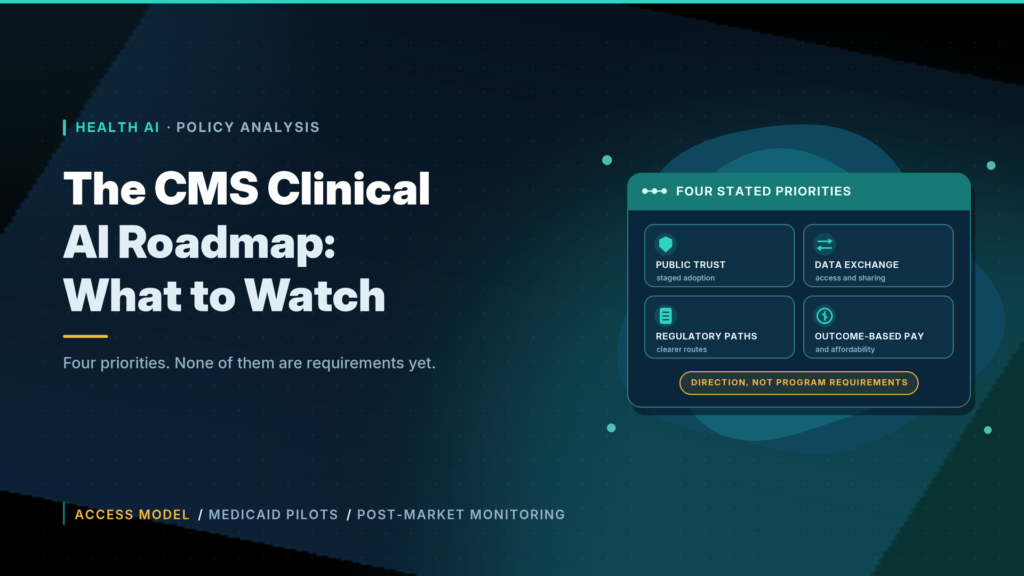
The roadmap identifies four priorities:
- Building public trust through staged adoption and monitoring.
- Improving access to and exchange of health data.
- Developing clearer regulatory pathways.
- Supporting payment approaches tied to outcomes and affordability.
It discusses potential state partnerships to test clinical AI payment models, including in Medicaid. It also describes possible ACCESS-related payment extensions and future accountable-care arrangements. These are stated directions, rather than evidence that every contemplated pathway is available today. Official CMS roadmap
Why the payment discussion matters
The roadmap’s emphasis on outcomes creates a practical question for healthcare organizations: what would count as success for a particular AI-supported service?
A procurement proposal might promise faster responses or fewer administrative tasks. Those measures can be useful, but an organization evaluating a clinical service should also examine whether patients receive appropriate care and whether total spending changes.
For example, a chronic-care pilot could assess clinical improvement, patient engagement, escalation to clinicians and the full cost of delivering the service. Counting automated interactions alone would provide an incomplete evaluation.
How ACCESS fits into the discussion
CMS’s existing Advancing Chronic Care with Effective, Scalable Solutions—ACCESS—Model provides relevant context. It tests recurring, outcome-aligned payments for managing qualifying conditions, with full payment tied to measurable health outcomes.
That model’s terms should be reviewed separately from the roadmap’s discussion of potential future extensions. Organizations should not assume that purchasing an AI product establishes eligibility for a model payment.
What providers should prepare for:
The following recommendations are US Health Insights’ editorial analysis, intended to help organizations evaluate opportunities as program details develop.
1. Start with a specific clinical problem
Define the problem before choosing a technology. A proposal to support hypertension management requires different evaluation criteria from a tool that prepares patients for appointments.
Document the intended users, patient population, clinical setting and decisions the tool may influence. Make the proposed role of clinicians explicit.
2. Establish a baseline before a pilot
Without a baseline, it becomes difficult to distinguish improvement from changes in patient mix, staffing or workflow.
Useful measures may include:
- Time to appropriate clinical assessment.
- Clinical outcomes relevant to the condition.
- Clinician review and correction time.
- Patient understanding and experience.
- Total service-delivery costs.
Choose measures that can reveal harm or additional work, as well as potential benefits.
3. Test the escalation process
A demonstration should show what happens when the tool encounters missing information, conflicting records or a situation outside its intended scope.
Identify who receives an escalation, how quickly it is reviewed and how the patient receives follow-up. A workflow should remain workable when automation cannot complete the task.
4. Connect deployment to broader technology planning
Assess how a proposed tool fits existing records, identity verification, clinical communication and incident-review processes.
This connects clinical AI evaluation with a broader digital transformation in healthcare strategy. A successful pilot needs operational ownership alongside technical integration.
What Medicaid leaders should watch
For Medicaid agencies and managed care organizations, the roadmap’s state-payment discussion is a reason to prepare questions about financing, evaluation and implementation. It does not establish a universal Medicaid AI benefit or a payment rate.
Before considering a pilot, leaders should identify the proposed service, target population, responsible clinical team and source of payment. They should then determine which approvals and contractual arrangements would apply to that specific design.
A useful planning framework is:
| Planning area | Questions to resolve |
|---|---|
| Clinical scope | What service would the tool support, and which decisions remain with clinicians? |
| Financing | Who would pay, for what service, and under which approved arrangement? |
| Evidence | What comparison would demonstrate better care or lower total costs? |
| Access | Could language, disability, connectivity or device requirements exclude intended users? |
| Accountability | Who handles complaints, clinical escalations, incidents and corrective action? |
| Vendor changes | How would model updates trigger testing, review or contract changes? |
For an illustrative diabetes-care pilot, the evaluation could examine clinical outcomes, access to human support and costs across participating groups. Higher application use would be only one part of that assessment.
Regulatory direction requires careful interpretation
The roadmap discusses risk-sensitive evaluation, post-market monitoring and partnerships with state testing environments. It also identifies clearer liability arrangements as an area for future work. CMS roadmap
Organizations should therefore ask vendors to identify the specific regulatory status and permitted use of their products. A general reference to the federal roadmap is insufficient evidence for a product’s authorization, coverage or reimbursement claims.
Contracts should also address responsibility for monitoring, reporting incidents, investigating errors and responding when a product changes.
What to monitor next
The most actionable developments will be documents that turn policy direction into defined opportunities: model specifications, application materials, payment methodologies, evaluation criteria and state-specific announcements.
Providers and Medicaid leaders can prepare now by selecting measurable use cases and establishing review processes. Investment decisions should then be matched to the terms of the actual program or payment pathway being considered.