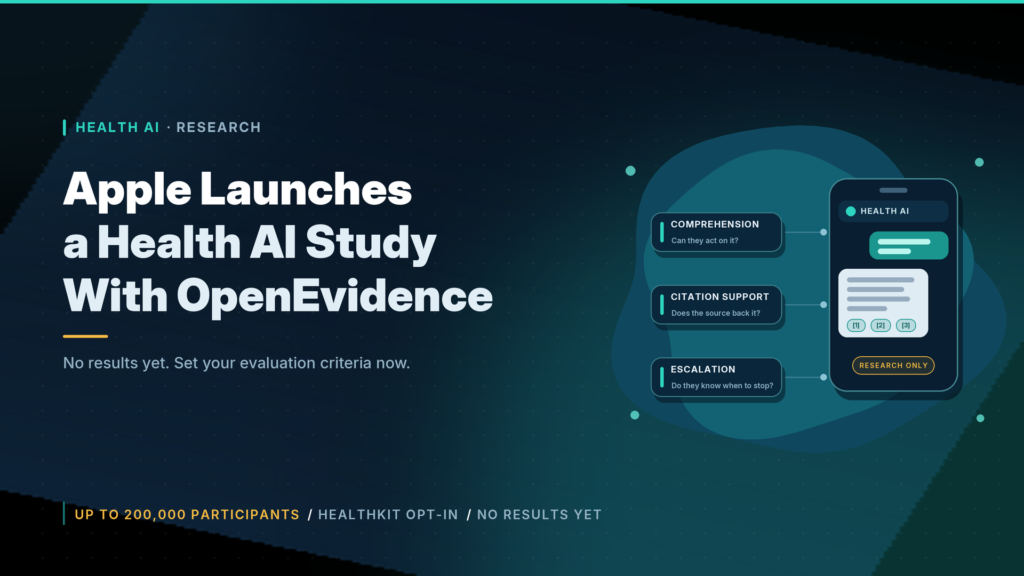
Apple announced the Apple Health AI Usage Study on November 15, 2026, in collaboration with OpenEvidence. The U.S. research initiative will examine how people understand, trust and use conversational health AI, including whether it helps them prepare for medical appointments. Apple announcement
For healthcare organizations, the announcement raises a practical question: what evidence should a patient-facing AI tool provide before an organization recommends it or incorporates it into care?
What Apple and OpenEvidence launched
The virtual study combines an Apple-designed research experience with OpenEvidence’s technology. Participants can ask health questions and view supporting clinical citations.
| Study detail | What Apple announced |
|---|---|
| Enrollment capacity | Up to 200,000 eligible U.S. participants; this is not a confirmed enrollment count |
| Minimum age | 21 |
| Device requirements | An Apple Intelligence-enabled iPhone, identified as iPhone 15 Pro or later, running iOS 26 or later |
| Optional data sharing | Selected HealthKit information, including activity, sleep, resting heart rate and laboratory results |
| Research focus | Trust, comprehension, response quality and everyday health-related actions |
Apple describes the app as a research experience rather than a service for diagnosing or treating conditions. Its announcement does not report completed study results.
What Apple says about privacy and safety
Apple says study data will not be used to train AI models. Participants control whether they share HealthKit metrics or survey responses. The company also describes safeguards intended to identify concerning questions and direct participants toward providers or other resources. These are stated design features, rather than published evidence of their effectiveness.
What healthcare organizations should evaluate
The following framework is US Health Insights’ editorial analysis. It identifies questions organizations can use when assessing patient-facing AI.
1. Does the user understand the answer?
A technically correct response can still be difficult to interpret. Evaluation should test whether users understand uncertainty, recognize important qualifications and know what action to take.
For example, a useful assessment would examine whether someone reading an explanation of a laboratory result understands when to discuss it with a clinician. Satisfaction scores alone would not answer that question.
2. Does the tool earn appropriate trust?
An evaluation should distinguish confidence from justified confidence.
Organizations should ask whether users can recognize incomplete answers, distinguish general information from individualized advice and understand the limitations of the information provided.
Clinical citations deserve scrutiny too. Reviewers should check whether each cited source supports the associated statement and applies to the question being asked.
3. Does appointment preparation improve the clinical conversation?
Useful measures could include whether patients arrive with clearer questions, more accurate medication information or a better understanding of the visit’s purpose.
Organizations should also measure clinician workload. A tool that generates lengthy summaries may require additional review without improving the conversation.
4. What happens when the tool cannot safely help?
Before recommending a patient-facing AI service, organizations should examine how it handles uncertainty, incomplete information and questions requiring professional assessment.
Testing should cover whether escalation advice is understandable and actionable. Reviewers should also examine whether users follow that advice, rather than evaluating the wording alone.
A practical comparison checklist
| Evaluation area | Questions for healthcare leaders |
|---|---|
| Answer quality | Are responses accurate, relevant and appropriately qualified? |
| Comprehension | Can users explain the answer and identify a reasonable next step? |
| Citation support | Do the references directly support the claims made? |
| Personalization | Does additional patient information improve relevance without creating misleading certainty? |
| Escalation | Can users recognize when professional assessment is needed? |
| Workflow impact | Does the tool improve preparation without increasing avoidable review work? |
| Accessibility | How does performance vary across literacy levels, languages and patient groups? |
| Governance | Who investigates complaints, reviews incidents and approves changes? |
These questions belong within a broader digital transformation in healthcare strategy that connects technology decisions with clinical accountability and measurable operational goals.
What to watch as the research develops
Healthcare organizations should look for a published protocol, clearly defined outcomes and transparent reporting of limitations.
Particularly useful information would include how researchers measure comprehension, assess inappropriate reassurance, evaluate differences between participant groups and distinguish reported usefulness from observed behavior.
Until those details and results are available, procurement and clinical leaders can use the announcement to sharpen their evaluation criteria. Claims about effectiveness should follow the evidence produced by the research.