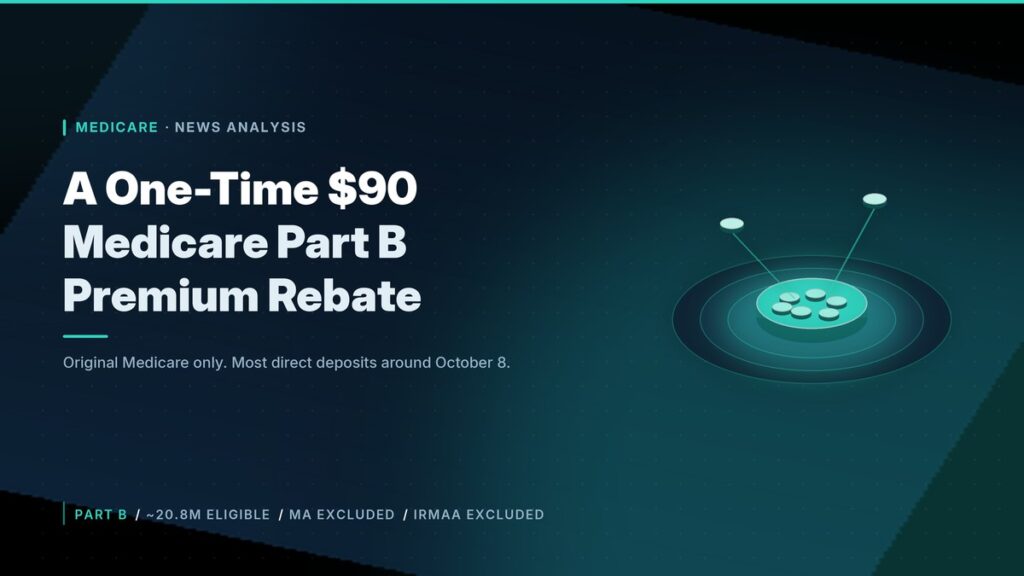
Some Medicare beneficiaries are scheduled to receive a one-time $90 payment toward their Part B premiums this October. The White House announced the payment on October 2, 2026, describing it as relief funded through the Medicare Improvement Fund. It is a single payment, not a recurring monthly premium reduction.
CMS estimates that approximately 20.8 million people will qualify. Its October 3 guidance identifies eligible recipients as certain beneficiaries enrolled in Original Medicare Part B who live in the United States. Medicare Advantage enrollees are excluded.
For beneficiaries, the practical questions are whether their coverage qualifies, how the payment will arrive and which agency can resolve a problem.
Who qualifies and who does not?
Having Medicare Part B does not, by itself, establish eligibility.
| Coverage or premium situation | What the announcement says |
|---|---|
| Original Medicare Part B, living in the United States | Potentially eligible, subject to the exclusions below |
| Medicare Advantage enrollment | Not eligible |
| Part B premiums already paid by Medicaid | Not eligible |
| Paying an Income-Related Monthly Adjustment Amount, or IRMAA | Not eligible |
The White House explicitly excludes both people whose premiums are paid by Medicaid and those paying IRMAA, the income-related premium adjustment. These are separate exclusions; a beneficiary does not need to meet both to be ineligible.
The distinction between Original Medicare and Medicare Advantage is particularly important. People enrolled in Medicare Advantage generally continue paying their Part B premium, but that does not make them eligible for this rebate.
When will payments arrive?
CMS gives the following expected timetable:
| Date or period | What beneficiaries should expect |
|---|---|
| On or around October 8, 2026 | Most direct deposits |
| Later in October 2026 | Paper checks for recipients without direct deposit |
| Beginning October 15, 2026 | Social Security payment-status inquiries |
Most payments will be delivered through Social Security direct deposit. Paper checks will use the mailing address registered with Medicare. These are expected dates; October 8 should not be treated as a guaranteed arrival date for every recipient.
Is an application required?
The published guidance describes payments through existing federal payment records and does not identify a separate application.
For eligibility questions, call 1-800-MEDICARE (1-800-633-4227). For payment-status questions, contact Social Security at 1-800-772-1213 beginning October 15.
Before calling, beneficiaries can make the conversation more useful by checking whether they have Original Medicare or Medicare Advantage and whether Medicaid assistance or an income-related adjustment appears in their premium records.
What does $90 mean for annual Medicare costs?
The standard Part B premium is $202.90 per month in 2026, although some beneficiaries pay more. At that standard rate, twelve months of premiums total $2,434.80. Medicare’s 2026 costs
US Health Insights calculation: A $90 payment equals approximately 44.4% of one standard monthly premium, or 3.7% of a full year’s standard premiums.
That comparison helps put the payment in perspective. It provides limited relief, while ongoing premiums and other healthcare expenses remain part of a beneficiary’s budget. Beneficiaries should continue following their regular premium-payment instructions.
The White House says the payment draws on a $2 billion congressional allocation to the Medicare Improvement Fund. The announcement does not establish a continuing $90 monthly benefit.
Keep the rebate separate from open-enrollment decisions
Medicare Open Enrollment runs from October 15 through December 7, with coverage changes generally taking effect January 1 of the following year.
A one-time payment should carry less weight than a plan’s continuing costs, prescription coverage and access to doctors. The cited rebate guidance does not specify an eligibility snapshot date or establish that changing coverage now would qualify someone for this October payment.
For healthcare organizations and benefits advisers, a useful next step is to prepare a short, dated explanation that separates three issues: rebate eligibility, payment tracking and annual coverage selection. Keeping those questions distinct can help beneficiaries reach the appropriate agency without mistaking a federal rebate for a change to their insurance benefits.