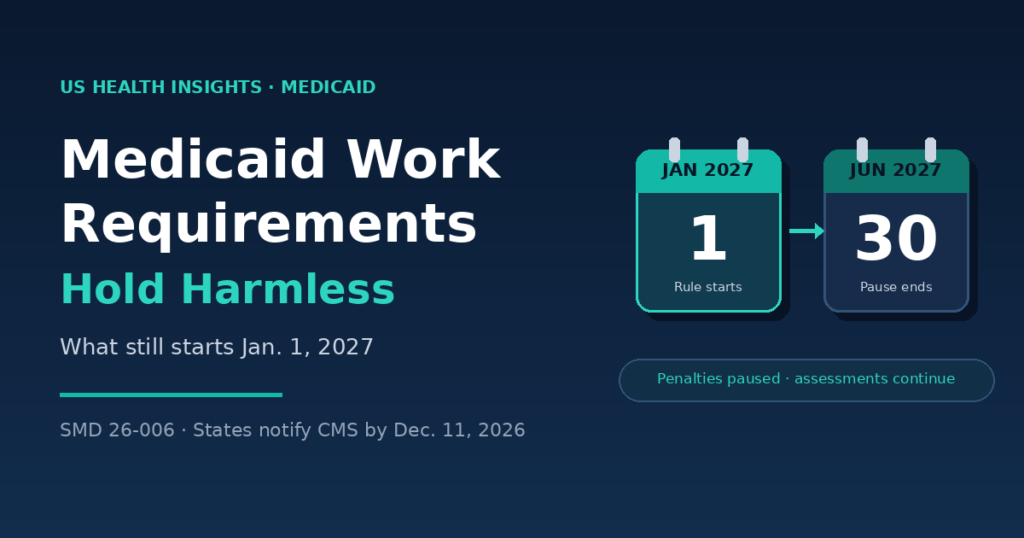
The Centers for Medicare & Medicaid Services (CMS) has given states an optional pause on Medicaid work-requirement penalties, not a delay of the requirement. In a November 13, 2026, letter to state Medicaid directors (SMD #26-006), CMS said opt-in states may stop denying and disenrolling people for failing to show compliance through June 30, 2027. States must still start the community engagement requirement by January 1, 2027. They must also keep checking compliance on relevant applications and renewals.
Key Takeaways
- SMD 26-006 pauses penalties, not the requirement. Opt-in states may suspend denials and disenrollments for noncompliance through June 30, 2027.
- Implementation is still due no later than January 1, 2027, and compliance checks continue during the pause.
- CMS asks states that want the pause from January 1 to notify it by December 11, 2026, and requires CMS approval of a mitigation plan first.
- Covered determinations will not count as errors in PERM, MEQC or other CMS eligibility audits.
- In states that do not opt in, denials and terminations for noncompliance can follow the standard 30-day notice process as applications and renewals are processed in 2027.
What does SMD 26-006 do?
SMD 26-006 lets any state suspend one consequence of the community engagement requirement for a limited time. CMS “is offering all states an optional ‘hold harmless’ period through June 30, 2027,” during which states “may suspend denials of eligibility and disenrollments when applicable individuals do not demonstrate compliance,” according to the CMS letter.
| Item | Key terms |
|---|---|
| Date and signer | November 13, 2026; Daniel Brillman, CMS Deputy Administrator and Director of the Center for Medicaid and CHIP Services |
| Who can use it | All states; use is optional |
| What it covers | Only the requirement at Social Security Act § 1902(xx)(1) and 42 C.F.R. § 435.559; other eligibility rules, such as age or income, still apply |
| Window | Applications received and renewals initiated “through and including June 30, 2027,” or a shorter period the state picks |
| Approval | States “must obtain CMS approval prior to implementing the hold harmless period or other mitigations” |
| Audits | Covered determinations are not errors for PERM, MEQC or other CMS Medicaid eligibility audits |
| After the window | The state “must deny or terminate eligibility (as applicable)” after following the procedures in 42 C.F.R. § 435.558 |
The window turns on when an application is received or a renewal is initiated, not on the decision date. Under that wording, a renewal initiated on June 30, 2027, falls inside the window even if the state decides it in July.
The requirement applies to non-pregnant adults ages 19 to 64 who are not entitled to or enrolled in Medicare and who are in the Medicaid adult group or certain section 1115 demonstrations, unless excluded, per the CMS interim final rule fact sheet. CMS says 43 states and the District of Columbia are affected. Our explainer on who is affected and who is exempt in 2027 covers qualifying activities and exclusions.
Delay vs. hold harmless: what still starts January 1
The January 1, 2027, implementation date has not moved. During the pause, states “still assess whether people meet the work requirement or are excluded,” the CMS press release says.
| Obligation | Changed by SMD 26-006? |
|---|---|
| Implement community engagement by January 1, 2027 | No |
| Assess compliance or exclusion on relevant applications and renewals | No |
| Use reliable data and automated processes to verify compliance | No; CMS encourages it |
| Deny or disenroll for community engagement noncompliance | Paused, only in opt-in states with an approved plan |
| Implement regulatory text a court vacated | Not required, per the letter’s footnote 3 |
Some early coverage framed the option as a delay. A November 16 KFF Health News morning briefing, summarizing STAT, ran under the headline “Trump Administration Lets States Delay Medicaid Work Requirements Until July 1.” July 1 is the first day outside the window, but the letter uses June 30, and compliance checks do not pause. In opt-in states, applicants from January 1, and existing enrollees at their first renewal on or after that date, may still be asked about work, school or an exemption, as our 2027 exemptions explainer describes for renewal timing.
A simple example shows the difference. Take an existing enrollee whose renewal is initiated in March 2027 and whose compliance the state cannot verify. In an opt-in state with an approved plan, the state records the finding but does not terminate coverage on that basis. In a state that does not opt in, the state sends a noncompliance notice with 30 calendar days to respond, and failure to respond may result in disenrollment.
The December 11 notification date and mitigation plans
CMS asks states that plan to start the pause on January 1 to notify it by December 11, 2026. The letter frames this as a request, and the pause works through an approved mitigation plan, not an automatic waiver:
- The plan comes first. States “should identify compliance deficiencies as well as mitigations and other strategies,” and need CMS approval before using the pause.
- Compliance is monitored. States must follow the approved plan to avoid formal compliance action under section 1904 and keep working toward full compliance. CMS may ask for plan updates.
- Shorter is allowed. A state can use the option for part of the period. States that already submitted a mitigation plan may update their request.
States said their IT systems were not ready for more frequent, intensive eligibility checks and that they lacked time and funding, Healthcare Dive reported on November 16.
What it means for managed care plans and vendors?
The letter does not mention managed care plans. The points below are US Health Insights’ operational analysis of how the pause affects plans and eligibility vendors.
- Two operating modes. In opt-in states, eligibility systems must record compliance findings without denying or terminating coverage for applications received and renewals initiated in the window. They then switch to the § 435.558 process. Both paths need testing well before June.
- Member messages. Members may get state requests for information while their coverage is protected. Plan scripts should match state notices, so members do not ignore a request that matters after the window.
- Timing of coverage losses. In opt-in states, losses tied to noncompliance shift to applications and renewals after the window, so membership effects are more likely in the second half of 2027. In states that do not opt in, losses can begin as 2027 applications and renewals are processed, once the 30-day noncompliance notice period runs out.
- Audit records. Audit protection applies only under an approved plan, so states should keep each CMS approval and plan version with the determinations it covers.
CMS’s separate CRUSH program-integrity proposed rule would replace MEQC with federally overseen eligibility audits, per the CMS fact sheet on CMS-6098-P. If that is finalized, states may want CMS to confirm that the letter’s “other CMS Medicaid beneficiary eligibility audits” language covers the new audits.
What to do now: checklist for states and plans
- By December 11, 2026: States decide whether to opt in from January 1 and, if so, notify CMS and submit or update a mitigation plan.
- Before January 1, 2027: Confirm eligibility logic records findings without triggering denials during the pause, and that notices describe the requirement accurately.
- In January: Plans align member outreach and call scripts with state notices and track how many members receive requests for information.
- By spring 2027: Test the post-window path, including the 30-day noncompliance notice, on renewals that will fall after June 30.
- Throughout: Keep CMS approvals and plan versions with eligibility records.
Two things to avoid: do not tell members their coverage is unaffected without the state’s approved notice language, and do not treat a state’s request to CMS as approval.
Litigation status and what to watch
Two federal cases bear on the timeline, and neither has stopped the January 1 date.
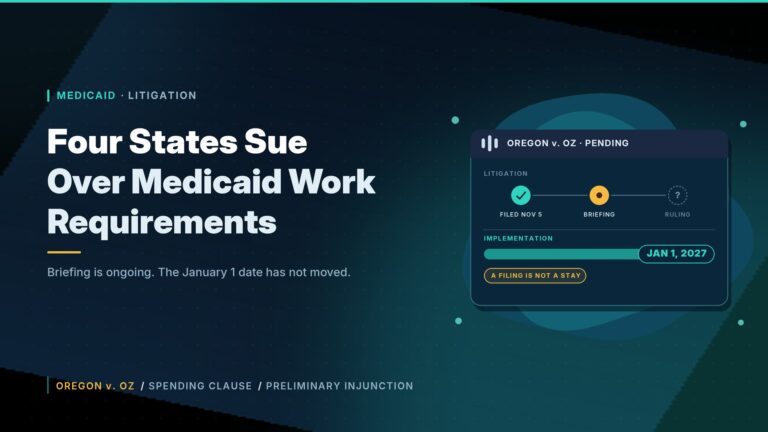
- Oregon v. Oz (D. Or.). Oregon, Minnesota, New Mexico and Washington sued on November 5, 2026, arguing the funding conditions are unconstitutional, as covered in our report on the four-state lawsuit. They moved for a preliminary injunction the same day. The federal response was due November 19. As of November 19, the Georgetown litigation tracker, last updated November 16, listed no response filing, hearing or ruling.
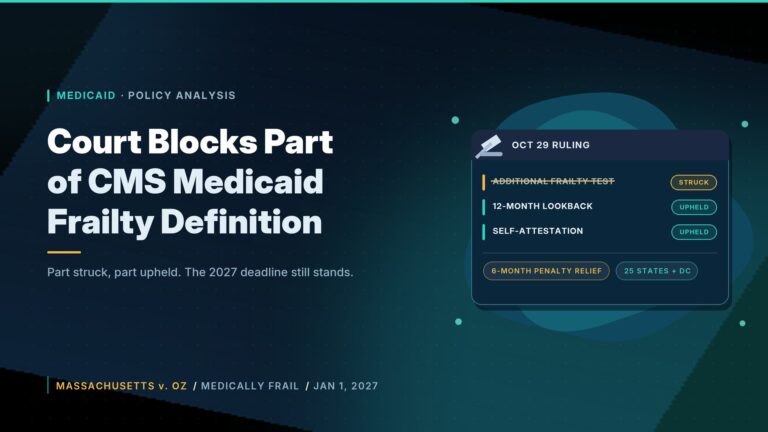
- Massachusetts v. Oz (D. Mass.). On October 29, 2026, a federal judge struck down an added medical-frailty test in CMS’s interim final rule, as covered in our report on the frailty definition ruling. The order also protects the plaintiff states from penalties for implementation errors or delays for six months after the ruling. As of November 19, the Georgetown tracker for that case, last updated October 30, listed no appeal or stay. SMD 26-006 says implementation “does not include an obligation to implement the portion of the regulations recently vacated by a court.”
For the 25 plaintiff states and the District of Columbia in the Massachusetts case, the court’s six-month protection runs into spring 2027 and overlaps the hold-harmless window. The letter does not address how the two interact, which those states may want to raise with CMS in their mitigation plans.
Sen. Ron Wyden and Rep. Frank Pallone called the option “a small step in the right direction, but it does not avert the disaster ahead” and urged every state to use it (joint statement, November 13). CMS’s Brillman said that “when someone needs support, they should know exactly what to do, when to do it, and where to go” (CMS press release, November 13).
What to watch next:
- Which states notify CMS by December 11, and how many approved plans use the full period
- The federal response and any ruling on the preliminary injunction in Oregon v. Oz
- Any appeal of the Massachusetts ruling
- How January notices describe the pause to enrollees
More coverage is on our Medicaid policy page.
Frequently Asked Questions
Does the pause apply in every state?
No. It applies only in states that choose it and receive CMS approval of a mitigation plan. Elsewhere, after the required notice process, states must deny or terminate coverage for people who do not show compliance and are not excluded.
What happens after June 30, 2027?
For applications received and renewals initiated after the window, or after the end of a shorter period a state chose, states must deny or terminate eligibility for people who do not meet the requirement and are not excluded, after following 42 C.F.R. § 435.558. That includes a notice giving people 30 calendar days to respond.