A federal court has struck down part of the Centers for Medicare & Medicaid Services’ definition of medical frailty under Medicaid’s community-engagement requirements.
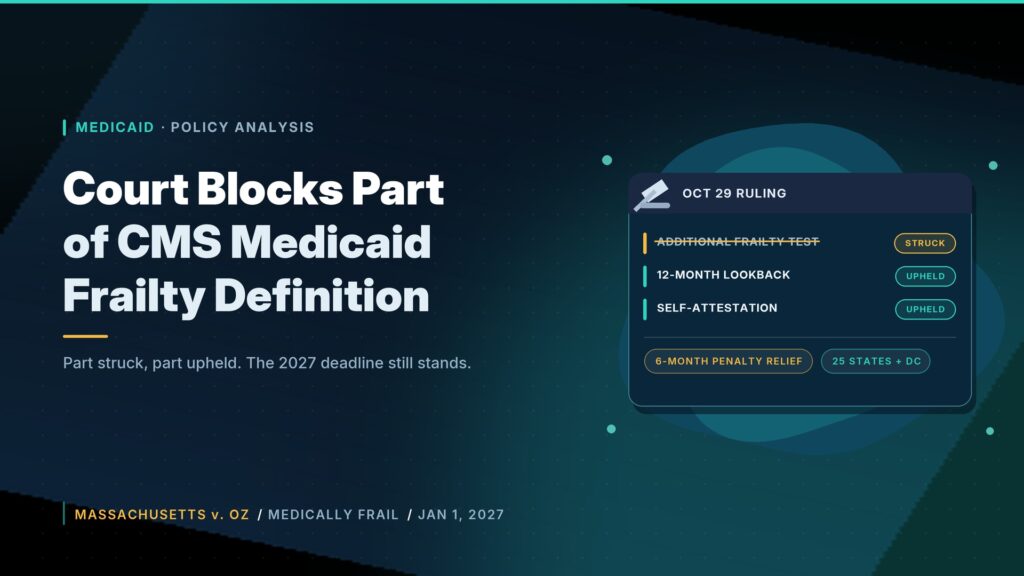
The October 29 ruling in Commonwealth of Massachusetts et al. v. Oz et al. addresses an additional test CMS imposed on people seeking a medical-frailty exemption. The court also granted the plaintiff states six months of protection against penalties for implementation errors or delays.
For state Medicaid agencies and health plans, the decision creates an immediate policy-review task: identify the affected screening language, understand the relief granted and coordinate implementation changes.
What the court rejected
Congress identified five categories of people included within the medical-frailty exemption. CMS’s June 2026 interim final rule added a further condition: a person’s physical, mental or behavioral health condition had to significantly impair their ability to comply with community-engagement requirements.
U.S. District Judge Richard Stearns concluded that CMS lacked authority to use that additional condition to exclude people within the categories Congress specified. The court invalidated the challenged language while leaving other parts of the framework intact. Court opinion
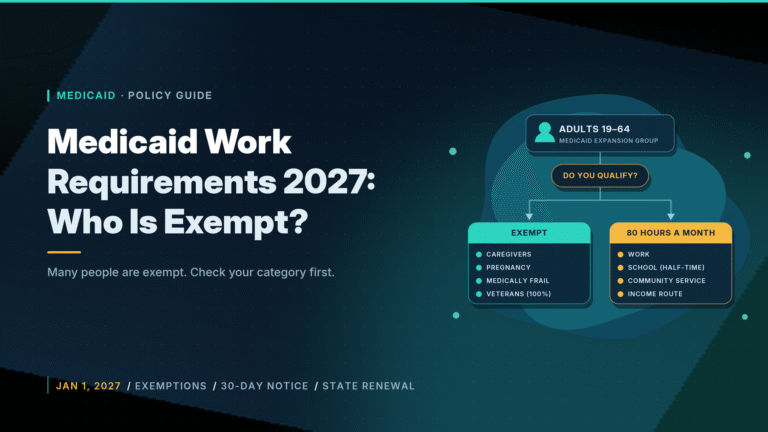
For broader eligibility background, see our guide to Medicaid work requirements in 2027 and available exemptions.
The ruling’s main effects
| Issue | What the decision establishes |
|---|---|
| Additional frailty test | The challenged language connecting a person’s condition to their ability to comply with community-engagement requirements was set aside. |
| Enforcement against plaintiff states | Federal defendants are prohibited from applying that provision to the plaintiff states. |
| Implementation penalties | The order protects plaintiff states against penalties for implementation errors or delays for six months following October 29. |
| Other challenged verification provisions | The court upheld the challenged 12-month lookback and self-attestation provisions. |
| January 1, 2027 implementation | The opinion expressly leaves the statutory implementation deadline in place. |
These distinctions follow the court’s operative order and accompanying opinion.
Which states received relief?
The case involves 25 states and the District of Columbia:
Arizona, California, Colorado, Connecticut, Delaware, Hawaii, Illinois, Kentucky, Maine, Maryland, Massachusetts, Michigan, Minnesota, Nevada, New Jersey, New Mexico, New York, North Carolina, Oregon, Pennsylvania, Rhode Island, Vermont, Virginia, Washington and Wisconsin, together with the District of Columbia.
The injunction expressly addresses application of the disputed provision to the plaintiff states. Organizations should distinguish that language from the order’s separate provision setting aside the challenged regulatory text. Case overview and filings
How the six-month protection affects implementation
The operative order bars federal defendants from penalizing plaintiff states for errors or delays in implementing the interim final rule for six months following the order.
The opinion connects the relief to the short period available for states to revise medical-frailty verification systems. It explicitly states that the enforcement protection does not change the January 1, 2027 statutory implementation deadline. Court opinion
Operational plans therefore need to track two separate matters: implementation responsibilities and the temporary protection against penalties.
What states and health plans should review
The following checklist is US Health Insights’ operational analysis. It identifies practical review areas rather than additional obligations created by the court.
| Workstream | Questions for the implementation team |
|---|---|
| Eligibility policies | Where does the challenged additional test appear in policy manuals, screening criteria or decision trees? |
| Forms and notices | Do applications, questionnaires or notices request information specifically to satisfy that test? |
| Technology | Which eligibility rules, vendor configurations and automated workflows would need revision following approved policy changes? |
| Member assistance | What instructions should call centers, navigators and provider-facing teams use when explaining exemptions? |
| Governance | Who approves revisions, communicates them to partners and confirms that changes were implemented correctly? |
Review the full decision path
A policy revision should be traced through the complete operational process.
For example, removing language from a public questionnaire may leave the same condition embedded in an internal decision tree or vendor configuration. Teams should compare written policy, system logic, staff instructions and notices to identify inconsistencies.
A useful review record would identify the affected rule, its location, the responsible owner, the approved change and the date it was tested.
Clarify responsibilities across organizations
State agencies, health plans, eligibility vendors, providers and community partners may encounter different parts of the same member’s journey.
Implementation teams should document who will issue authoritative instructions, who will update operational materials and where uncertain cases should be routed. Health plans should confirm how state guidance will reach member-service and care-management teams.
Our explanation of care management versus case management provides background on assigning coordination responsibilities and supporting individual members.
Keep verification processes aligned with the remaining rules
The decision does not remove every verification requirement.
Because the court upheld other challenged provisions, organizations should review the complete applicable framework before changing evidence requirements or self-attestation workflows. Each proposed revision should identify the legal or policy instruction supporting it.
Testing should include cases that move between automated processing and staff review, particularly where information is incomplete or requires clarification.
Use specific, consistent member communications
Member-facing explanations should identify what information is being requested, where assistance is available and how questions about an exemption will be handled.
Teams should avoid broad statements suggesting that every person with a medical condition automatically qualifies for Medicaid coverage. The ruling concerns a particular exemption provision within a wider eligibility framework.
Health plans and providers can support members by directing questions to the appropriate state eligibility channel and using the state’s current approved instructions.
What to watch next
The next developments to monitor are:
- CMS instructions responding to the decision.
- State guidance and revised exemption-screening materials.
- Vendor implementation schedules and testing results.
- Any appeal, stay or subsequent order affecting the relief.
Organizations should record these developments separately from the original ruling, preserving the date and authority behind each operational change.