Most technology decisions in healthcare come with a second bill attached. Pick the wrong data platform and you don’t just lose money, you risk a HIPAA violation. Skip an interoperability standard and a health system won’t connect to you. Guess wrong on your risk-adjustment data pipeline and your RAF scores, and the revenue tied to them, come out wrong.
Solving that usually means hiring a chief technology officer who understands both modern engineering and the regulatory reality of healthcare. That person is rare, and full-time they can cost $300,000 or more once equity and benefits are counted. Plenty of health plans, provider groups, and digital health companies need that judgment long before they can justify that salary.
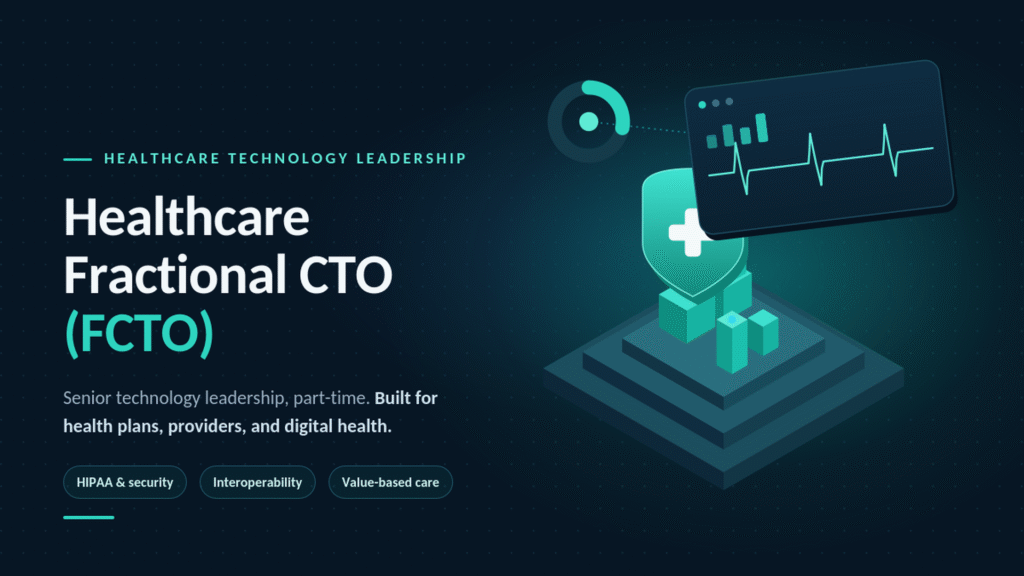
A healthcare fractional CTO closes the gap. You get a senior technology leader, one who already knows HIPAA, HL7 and FHIR, EHR integration, and value-based care data, for a set slice of their time each month instead of a full-time hire.
This guide covers what a healthcare fractional CTO actually does, why the healthcare version of the role is different from a generic one, what one costs, the signals that tell you it’s time, and the questions leaders ask most before they hire.
What is a Healthcare Fractional CTO?
A healthcare fractional CTO is an experienced technology executive who works with your organization part-time, usually a fixed number of days or hours a month, and brings deep familiarity with the healthcare environment. The “fractional” part is the commitment. Instead of 40-plus hours a week, you might book two days a week or a monthly retainer tied to specific outcomes.
What separates the healthcare version from a generic FCTO is domain fluency. A general fractional CTO can pick a cloud provider and structure an engineering team. A healthcare fractional CTO does that while also knowing:
- How protected health information (PHI) has to be handled, stored, and logged under HIPAA.
- Why interoperability standards like HL7 and FHIR determine whether you can exchange data with hospitals and payers at all.
- How claims, clinical, pharmacy, and lab data actually differ, and why reconciling them is harder than any vendor demo suggests.
- What CMS, ONC, and state regulators expect, and what an enterprise health system’s security review will demand before signing.
That fluency is the whole point. A skilled technologist with no healthcare background can burn six months learning the rules that a domain-native fractional CTO already carries in their head.
How the engagement usually works
Most healthcare fractional CTO arrangements take one of three shapes:
- Retainer: a fixed monthly fee for an agreed scope, such as two days a week ongoing. Common for organizations that want steady leadership through a modernization effort.
- Project-based: a defined deliverable, like a HITRUST or SOC 2 readiness plan, an EHR integration, or technical due diligence before a funding round or acquisition.
- Advisory: a few hours a month of high-level guidance for founders and executives who mainly need a sounding board with occasional deep dives.
What Does a Healthcare Fractional CTO Do?
The exact work depends on where your organization hurts most. A digital health startup needs different things than a health plan modernizing a legacy stack. The responsibilities usually fall into a handful of areas, each with a healthcare twist.
Technology strategy tied to clinical and financial goals. Turning business objectives into a technical roadmap the team can execute, whether the goal is closing Star Rating gaps, improving risk-adjustment accuracy, or launching a member-facing app.
Data infrastructure for value-based care. This is where a healthcare FCTO earns their keep. Value-based contracts live or die on data, and most organizations pull it from a dozen sources: EHRs, claims systems, pharmacy feeds, lab results, HIEs. Without a layer that reconciles those, the same patient can carry three different risk scores depending on which system someone opens. A good fractional CTO picks one source of truth per data type and enforces it, rather than adding another dashboard on top.
Security, privacy, and compliance. Getting HIPAA controls right, planning for HITRUST or SOC 2 certification, and preparing for the security review that a serious health-system or payer customer will run before they buy.
Interoperability and EHR integration. Choosing and implementing the FHIR APIs, HL7 interfaces, and integration approach that let your systems actually exchange data with Epic, Cerner, and the payers you contract with.
AI and automation, minus the hype. Separating the genuinely useful, say, automating chart review for HCC coding or flagging quality-measure gaps, from the expensive distractions, and making sure any model touching PHI is governed properly.
Vendor selection and build-versus-buy. Deciding what to build in-house against what to license, negotiating with health-tech vendors, and cutting the tool sprawl that quietly drains budgets.
Team building and engineering leadership. Hiring the first engineers or the next lead, setting up review and deployment practices, and coaching a team that may be strong on healthcare but light on modern engineering, or the reverse.
Board, investor, and payer communication. Preparing the technology and security sections of a pitch or an RFP response, surviving technical due diligence, and translating technology risk into terms a CEO, board, or health-plan partner can act on.
Healthcare Fractional CTO vs. Interim, Virtual, and Full-Time
These titles get used loosely, which causes real confusion during hiring. Here’s how they differ in a healthcare setting.
| Role | Time commitment | Typical duration | Best for |
|---|---|---|---|
| Fractional CTO | Part-time, ongoing | Months to years | Organizations that need steady senior leadership but not a full salary |
| Interim CTO | Often full-time, temporary | Weeks to a few months | Filling a sudden gap after a CTO departs, until a permanent hire starts |
| Virtual CTO | Part-time, often remote/advisory | Varies | Smaller providers or startups wanting lighter, mostly remote guidance |
| Full-time CTO | Full-time, permanent | Long-term | Larger health systems and scaling health-tech companies where technology is the core of the business |
An interim CTO plugs a hole, usually full-time and short-lived, while you search for a permanent replacement. A fractional CTO is a deliberate, ongoing arrangement where you never intended to fill a full-time seat. A virtual CTO tends to describe a lighter, mostly remote advisory relationship, common with smaller provider groups and managed-IT setups. If a title matters to you, ask the person exactly what level of involvement and decision-making authority they mean by it.
If technology is your core product and your engineering team is heading past roughly fifteen to twenty people, a fractional arrangement starts to strain, and a full-time CTO makes more sense. A good fractional CTO will tell you when you’ve reached that point, and some will help you hire their own replacement.
Signs Your Healthcare Organization Needs a Fractional CTO
You need one when a few of these feel familiar:
- A health-system or payer customer is asking security and compliance questions you can’t answer, and the deal is stalling because you have no HITRUST or SOC 2 story.
- Your data lives in silos, and no one can give a straight answer to what your true patient population, risk profile, or quality-gap picture actually is.
- You’re moving into value-based contracts and realize your data infrastructure was never built to support risk, only fee-for-service billing.
- You want to add AI to coding, chart review, or member engagement but can’t separate what’s useful from what’s a compliance risk waiting to happen.
- Your EHR integrations keep breaking, deadlines keep slipping, and you can’t tell whether the problem is the vendor, the team, or the plan.
- You’re raising money or facing an acquisition and need someone who can survive technical and security due diligence.
If two or three of these hit home, the cost of not having senior technical judgment usually outweighs the retainer.
Benefits of a Fractional CTO in Healthcare
Domain-specific seniority at a fraction of the price. A full-time healthcare CTO who understands both engineering and compliance commands a high salary plus equity and benefits. A fractional engagement buys comparable judgment for a portion of that.
Fewer expensive, high-risk mistakes. In healthcare, the wrong architecture or a security gap isn’t just costly, it can trigger a breach, a failed audit, or a lost enterprise contract. Prevention is the real return.
An outside perspective across many organizations. Because fractional CTOs work with several clients, they bring patterns from other health plans, provider groups, and digital health companies that a single in-house leader wouldn’t have seen. They also carry no internal politics, so they’ll tell you the uncomfortable things.
A commitment that flexes. Need more hours during an EHR migration, an audit, or a funding round, and fewer once it settles? A fractional arrangement scales in a way a full-time hire can’t.
Fast onboarding. An experienced healthcare fractional CTO already knows the terrain and can be useful within days, not months spent learning what HEDIS and RADV even mean.
What Does a Healthcare Fractional CTO Cost?
Pricing varies widely by market, seniority, and scope, so treat these as general ranges, not quotes. Healthcare domain expertise tends to sit at the higher end because the talent pool is smaller. Common models:
- Monthly retainer: often $8,000 to $25,000+ per month, depending on days committed and seniority.
- Hourly: commonly $200 to $450+ per hour, with the top end reflecting deep compliance or interoperability specialization.
- Day rate: frequently $1,800 to $3,500+ per booked day.
- Equity or hybrid: early-stage digital health startups sometimes trade reduced cash fees for equity on longer engagements.
For comparison, a full-time healthcare CTO’s total compensation in a major U.S. market can run well past $300,000 to $400,000 once salary, bonus, equity, and benefits are added up. That gap is the economic argument for the model: for many organizations, a few days a month of the right person delivers most of the value at a small share of the cost.
When comparing quotes, look past the headline number. Ask what’s included, how many hours it covers, and whether the person has actually operated inside healthcare or only advised from the sidelines. A cheap retainer buying you someone without domain depth is the most expensive option of all.
How to Hire the Right Healthcare Fractional CTO
The market has filled with people offering the service, and quality varies widely. A few things separate a strong hire from a costly one.
Insist on real healthcare experience. Ask what specific healthcare systems they’ve built or integrated, which compliance frameworks they’ve actually taken through certification, and which payer or provider data they’ve worked with. Generic tech leadership is not the same as healthcare tech leadership.
Match their background to your stage and segment. Someone who scaled engineering at a large health system may be impatient with a five-person digital health startup, and someone who has only advised startups may be out of their depth on a health plan’s compliance load. Ask about the exact stage and segment they’ve operated in.
Verify operator experience, not just advisory. There’s a difference between someone who has shipped and secured healthcare systems and someone who only ever consulted. Ask what they built and what broke.
Get references from organizations like yours. A glowing reference from a hospital IT department tells you little about how they’ll perform with a lean digital health team, and the reverse is just as true.
Define scope, authority, and success up front. Agree on hours, deliverables, decision-making authority, and how you’ll measure whether it’s working. Vague engagements drift, and drift is where budgets and timelines die.
A one-month trial or a single defined project, such as a compliance-readiness assessment or a data-architecture review, is a reasonable way to test fit before a longer retainer. Strong candidates expect this.
When a Fractional CTO Isn’t the Right Fit
The model has real limits, and an honest guide should name them.
- When you need daily, hands-on leadership, a part-time arrangement leaves gaps. A fast-scaling health-tech company making decisions every day usually needs someone in the seat full-time.
- When the work is mostly execution, not strategy, a strong engineering lead or a specialized health-tech development partner may serve you better at a lower cost.
- When you can’t grant real authority, a fractional CTO with no decision-making power becomes an expensive advisor whose recommendations get ignored.
If your bottleneck is building rather than deciding, the money is better spent on developers than on part-time leadership.
Frequently Asked Questions About Healthcare Fractional CTOs
What is a healthcare fractional CTO? A healthcare fractional CTO is a senior technology executive you hire part-time who brings healthcare-specific expertise: HIPAA and PHI security, interoperability standards like HL7 and FHIR, EHR integration, and the data infrastructure that value-based care depends on. You get executive-level guidance for a set number of hours or days a month, without a full-time C-suite salary.
How is a healthcare fractional CTO different from a regular fractional CTO? Domain knowledge. A generic fractional CTO handles engineering strategy and team building. A healthcare version does that while also working through HIPAA, CMS and ONC expectations, payer and provider data, interoperability rules, and the security reviews health systems require. That fluency saves the months a non-healthcare technologist would spend learning the rules.
How much does a healthcare fractional CTO cost? It varies by market and scope. Monthly retainers commonly range from about $8,000 to $25,000 or more, and hourly rates often run $200 to $450+, with healthcare specialists tending toward the higher end because the talent pool is smaller. Early-stage digital health startups sometimes use equity to offset cash fees.
Does my health plan or provider group actually need one? Not every organization does, and not always at the start. A healthcare fractional CTO earns their fee when you’re moving into value-based contracts, unifying siloed data, pursuing HITRUST or SOC 2, adding AI to clinical or coding workflows, or preparing for due diligence, and you lack the senior technical judgment in-house to get those right.
Can a healthcare fractional CTO help with HIPAA and HITRUST? Yes. Security and compliance are core to the role. A capable one will assess your current controls, build a realistic path to HITRUST or SOC 2, and prepare you for the security reviews enterprise healthcare buyers run. They lead the strategy, though you’ll still need auditors and, often, hands-on staff to execute.
How many hours a week does a healthcare fractional CTO work? It depends on the agreement. Arrangements range from a few hours a month of advisory work up to two or three days a week for deeper, embedded engagements. Many fractional CTOs serve two to four clients at once.
When should we move from a fractional to a full-time CTO? Usually when technology becomes central to the business and the engineering team pushes past roughly fifteen to twenty people, at which point decisions come daily and the team needs a full-time leader present. A good fractional CTO will flag this and can help you hire the permanent replacement.
The bottom line
A healthcare fractional CTO is the right hire when your organization faces executive-level technology and compliance decisions but doesn’t yet warrant an executive-level salary. The value isn’t the hours you’re buying. It’s the breach you don’t suffer, the failed audit you avoid, the enterprise contract you keep, and the value-based-care data infrastructure you don’t have to rebuild in two years.
If you can point to two or three technology or compliance decisions this quarter that you’re not confident making alone, that’s your signal. Start with a one-month trial or a defined project, agree on scope and authority up front, and judge the fit by whether your decisions get sharper. Then scale the engagement to match what the organization actually needs.