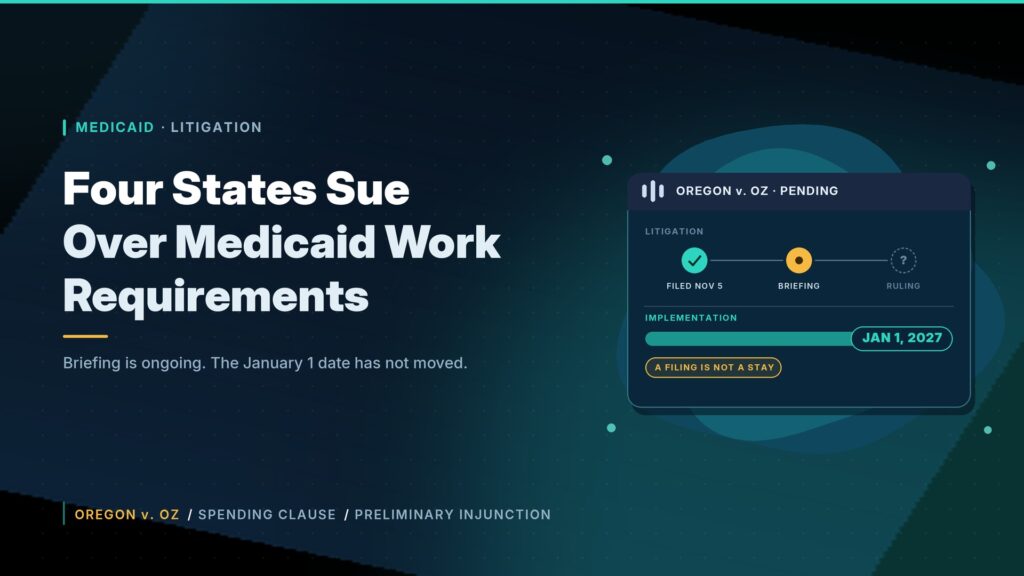
Oregon, Minnesota, New Mexico and Washington have filed a federal lawsuit challenging the use of Medicaid funding conditions to compel states to implement new work and community engagement requirements.
The case, State of Oregon et al. v. Oz et al., was filed on November 5, 2026, in the U.S. District Court for the District of Oregon. It adds another legal challenge as states prepare for requirements generally scheduled to begin January 1, 2027. Case information and filings
For state Medicaid agencies, health plans and providers, the immediate planning question is how to prepare while the litigation proceeds. Filing a lawsuit does not suspend a requirement. Organizations need to distinguish the relief the states have requested from any relief a court actually grants.
What the four states are challenging
The lawsuit focuses on the constitutional limits of federal funding conditions.
The states argue that the new eligibility requirements fundamentally change the Medicaid program they agreed to administer. They contend that threatening existing Medicaid funding to secure compliance leaves them without a meaningful choice.
Their complaint relies on the Supreme Court’s Spending Clause reasoning in National Federation of Independent Business v. Sebelius, the 2012 decision addressing the Affordable Care Act’s Medicaid expansion.
These are the states’ legal arguments. The court must decide whether they justify the requested relief. Read the complaint
What relief the states want
The complaint asks the court to declare that federal officials cannot constitutionally withdraw or suspend existing federal Medicaid funds because a plaintiff state fails to comply with the community engagement requirements.
It also seeks preliminary and permanent injunctions preventing that funding action. The requested remedy therefore focuses on protecting the plaintiff states’ existing funding if they decline to implement the requirements.
In their preliminary-injunction motion, the states request interim protection if the court cannot resolve their summary-judgment request before the end of 2026.
What is the current case status?
The public litigation tracker reviewed for this article lists briefing as ongoing. Its most recent stated update is November 6, 2026, and it links the complaint, preliminary-injunction motion and summary-judgment materials.
The materials reviewed do not include an order granting the requested relief. The case should therefore be described as a pending challenge, rather than a ruling blocking the requirements.
How this differs from the medical-frailty litigation
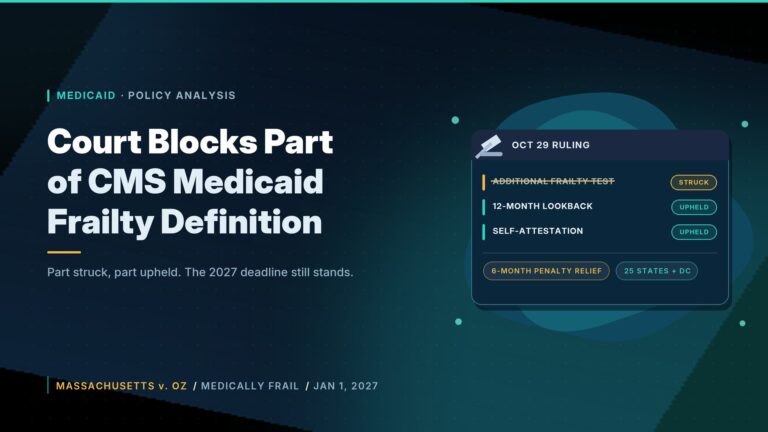
Readers following Medicaid policy may already have seen coverage of the separate challenge involving CMS’s medical-frailty definition.
The new Oregon case raises a broader constitutional question about whether existing Medicaid funding can be conditioned on state implementation of the work requirements. The frailty dispute concerns how a particular exception is defined and implemented.
These questions can affect different parts of an organization’s preparation. A decision addressing an exemption does not automatically resolve the constitutional funding challenge.
For background, see our coverage of the CMS Medicaid frailty-definition court ruling.
What remains on the 2027 implementation calendar
CMS’s community engagement materials identify January 1, 2027, as the general implementation date, subject to applicable exceptions and authorized implementation arrangements.
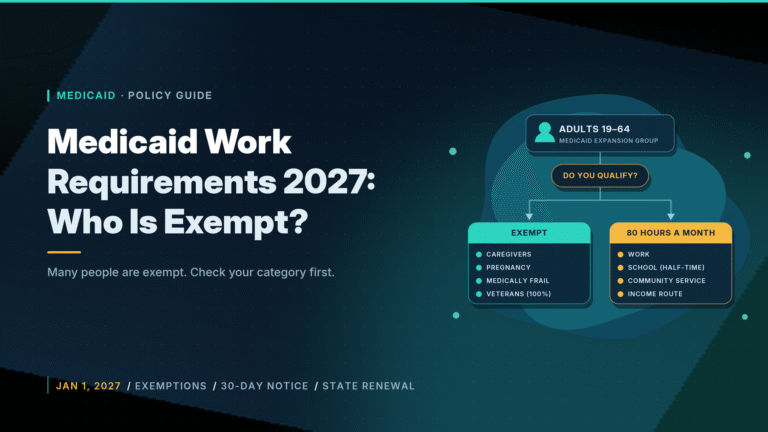
The requirements apply to specified adult eligibility groups. They do not apply uniformly to everyone enrolled in Medicaid.
CMS describes qualifying activities that include work, community service, certain work programs and education, with an 80-hour monthly standard for specified pathways. Exceptions and alternative ways of satisfying the requirement also apply.
Organizations should use current state instructions when determining the requirements relevant to a particular member. Our guide explains who is affected by Medicaid work requirements and who may be exempt.
What states, health plans and providers should prepare for
The following recommendations are US Health Insights’ operational analysis.
The most useful preparation is a change-control process that allows organizations to respond accurately when authoritative instructions change.
| Planning area | What to prepare | What could require an update |
|---|---|---|
| Legal and policy monitoring | A record of relevant rules, court orders and state instructions | New relief, an appeal or revised agency guidance |
| Eligibility systems | Documented business rules, test cases and configurable workflows | Changes to implementation dates, affected groups or exceptions |
| Member communications | Version-controlled notices, scripts and explanations | A change in the instructions members must follow |
| Health-plan operations | State-approved outreach and assistance procedures | Revised contract requirements or state operational direction |
| Provider workflows | Processes for checking coverage and connecting patients with assistance | Changes in renewal timing or coverage-verification needs |
| Governance | Named owners for approving and distributing updates | Conflicting instructions or a new implementation decision |
Keep member communications tied to authoritative instructions
Member-facing language should explain the steps a person needs to take under the rules currently applicable to them.
A pending lawsuit is not a sufficient basis to tell members that reporting obligations have disappeared. Equally, communications should not suggest that every Medicaid enrollee must meet the same requirement.
Before distributing revised material, teams should record its policy source, approval date and intended audience. They should also identify older versions that need to be withdrawn.
Clarify the health plan’s role
Managed-care organizations should confirm their responsibilities with the state Medicaid agency. Outreach, reminders and assistance need to align with the plan’s contract and the state’s eligibility processes.
A clear division of responsibilities helps prevent members from receiving inconsistent answers from their plan, provider and state agency.
For providers, a practical priority is a reliable referral pathway for patients who need help understanding a notice, documenting an exception or completing a renewal.
Plan for the scope of any future order
If the court issues relief, organizations should review the actual order before changing operations.
The review should establish:
- Which parties and jurisdictions the order covers.
- Which funding or implementation actions it restricts.
- When it takes effect.
- Whether another order or appeal changes its operation.
An accurate response depends on the court’s specific language. Headlines alone will not provide enough detail for system changes or member notices.
What to watch next
The next meaningful developments will be government responses, briefing deadlines and court decisions on the states’ requested relief.
Until then, the case adds uncertainty to 2027 planning. Organizations can address that uncertainty by maintaining clear policy ownership, documented workflows and a controlled process for updating systems and communications.
Reporting basis: Public court filings and government materials reviewed November 9, 2026. The linked litigation tracker was last updated November 6. Recheck the docket before publication and record any subsequent material update.