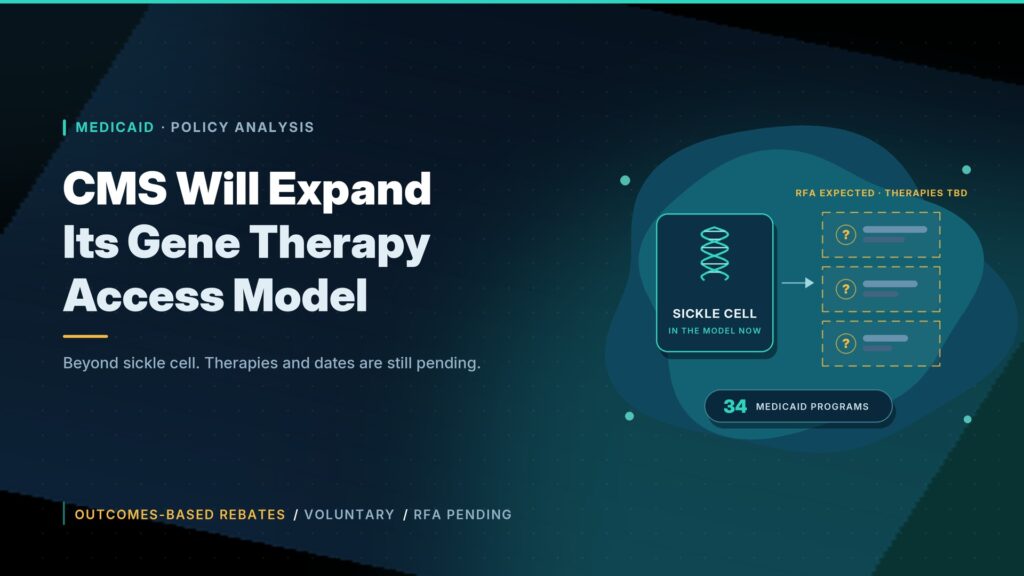
The Centers for Medicare & Medicaid Services plans to broaden its Cell and Gene Therapy Access Model beyond sickle cell disease, potentially extending its approach to negotiating outcomes-based agreements for additional treatments.
In an October 27 announcement, CMS said it will invite manufacturers of other cell and gene therapies to apply through a forthcoming Request for Applications. The announcement signals a broader direction for Medicaid drug purchasing, while leaving important details—including additional therapies and implementation dates—pending.
For Medicaid agencies, health plans and treatment centers, the immediate task is to understand the existing model and identify the operational questions that an expansion would raise.
What CMS announced
CMS expects to release the manufacturer application opportunity in the coming months. According to HHS, the next iteration is intended to support negotiations soon after a therapy receives FDA approval or licensure, while also allowing applications for therapies already approved or licensed.
The announcement does not identify a final list of additional conditions or establish an immediate coverage entitlement for people with other rare diseases. Those details will require further agency documents and participation decisions.
| Issue | What is confirmed | What remains pending |
|---|---|---|
| Model scope | CMS plans to move beyond the initial sickle cell disease focus. | Additional participating therapies and conditions. |
| Manufacturer applications | A new application opportunity is expected in the coming months. | Opening date, application deadline and selection requirements. |
| Negotiation timing | CMS intends to accommodate newly approved and already approved therapies. | Detailed procedures and timelines. |
| Patient access | The announcement sets out an expansion plan. | When patients could receive additional therapies through expanded arrangements. |
How the current CGT Access Model works
The existing model brings states together for CMS-led negotiations with manufacturers. CMS negotiates key terms, including discounts and outcomes-based rebates, which form the basis of agreements between participating states and manufacturers. States decide whether to sign those agreements.
As of October 28, CMS lists 34 participating Medicaid programs: 32 states, the District of Columbia and Puerto Rico. Participation is voluntary for states and manufacturers. The model initially focuses on gene therapies for sickle cell disease.
An outcomes-based agreement connects some of a therapy’s payment to defined patient outcomes over a specified period. If treatment is less successful than the agreement anticipates, the manufacturer reimburses the payer a portion of the payment under the contract’s terms. States remain responsible for their share of treatment costs.
For background on payment arrangements linked to performance, see our guide to fee-for-service versus value-based care.
What the first evaluation found and what it did not establish
CMS’s expansion announcement draws on the model’s first evaluation report, dated August 13, 2026. That report examined the negotiation and agreement-development process.
It found that pooling beneficiaries strengthened CMS’s negotiating position and gave states access to resources and expertise that some could not readily obtain independently. However, participants also described complex agreements, documentation demands and onboarding work that exceeded some states’ expectations.
The evaluation used documents and interviews, including interviews with officials from ten state Medicaid agencies. Its authors caution that those states’ views cannot be generalized to every Medicaid program.
These findings support an assessment of how negotiations were organized. They should not be presented as proof that the model has already improved long-term patient outcomes or reduced total healthcare spending.
What Medicaid leaders should prepare for
The forthcoming application documents will determine the expansion’s requirements. In the meantime, the existing model offers useful planning questions.
The checklist below is an operational assessment for organizations considering their readiness. It does not represent newly announced CMS obligations.
| Planning area | Questions to assess now |
|---|---|
| Coverage and authorization | Who would translate negotiated access terms into state and health-plan policies? How would conflicting criteria be identified and resolved? |
| Financial responsibility | Who would pay providers initially, receive rebates and reconcile payments? How would cash-flow exposure be assessed? |
| Treatment access | Which qualified centers could serve members? What arrangements would be needed for out-of-state care? |
| Data and outcomes | Who would collect clinical information, connect it with claims and resolve missing records? |
| Member support | Who would coordinate referrals, explain next steps and help patients maintain follow-up care? |
Align state and managed care responsibilities
Under the current model, states must coordinate with their managed care plans. CMS permits different approaches to that relationship, including changes to payment arrangements or carving model therapies out of managed care contracts.
For an expansion, organizations should identify ownership of coverage decisions, provider payment, reporting and member assistance before changing systems or contracts. Existing requirements should not be assumed to carry over unchanged to every future therapy. CMS implementation FAQs
Separate treatment financing from rebate collection
An outcomes-based rebate does not remove the need to fund treatment when it is delivered.
A useful financial assessment would examine the timing of provider payment, the period over which outcomes are measured and the information needed to collect a rebate. Leaders should also test how delayed or incomplete data could affect reconciliation.
The practical question is whether the organization can manage the full payment process, rather than simply whether a negotiated discount appears attractive.
Assess the complete care pathway
A coverage policy is only one part of access.
For each potential therapy, planners should map the steps between referral, eligibility assessment, treatment and follow-up. That assessment should identify where responsibilities pass between the state, health plan, treatment center and other providers.
Our explanation of care management versus case management provides background on assigning responsibility for broader coordination and individual patient needs.
Make outcome measurement an operational priority
Before entering a new arrangement, leaders should ask:
- Which outcomes trigger payment adjustments?
- Who supplies and verifies the underlying information?
- How are missing data and disputed results handled?
- How will follow-up continue when a patient changes coverage or providers?
These questions help determine whether an agreement can be administered reliably. They also create a clearer basis for assessing its eventual performance.
How FDA’s separate announcement fits
On the same day, FDA issued draft guidance addressing applications and postapproval management for individualized genome-editing products.
The guidance describes an approach to including multiple patient-specific variants within a single biologics license application. FDA identifies it as nonbinding draft guidance, distributed for comment rather than implementation, and requests comments by November 27, 2026.
FDA’s regulatory work and CMS’s purchasing model address different decisions. The draft guidance does not itself approve a therapy or establish Medicaid coverage.
What to watch next
The next important document is CMS’s manufacturer Request for Applications. Medicaid leaders should review it for:
- Eligible therapies and conditions.
- Manufacturer participation and negotiation requirements.
- State participation opportunities and implementation dates.
- Coverage, payment and outcome-reporting responsibilities.
Until those details are available, organizations can map their current responsibilities, identify gaps and prepare questions for CMS without treating the announcement as an immediate expansion of patient eligibility.