Beginning January 1, 2027, certain adults will need to meet Medicaid work or “community engagement” requirements to qualify for coverage or remain enrolled. States may implement the requirements earlier, and some have already begun.
The requirements apply to specific Medicaid eligibility groups. Many people qualify for exclusions, including certain caregivers, pregnant and postpartum beneficiaries, and people who meet medical-frailty criteria.
For beneficiaries, the first questions are: Does the requirement apply to my coverage category, do I qualify for an exemption, and what information does my state need?
When do the requirements begin?
CMS announced its implementing interim final rule on June 1, 2026. The rule was published June 3 and became effective July 31, 2026. Its general state implementation deadline is January 1, 2027.
| Date or stage | What it means |
|---|---|
| July 31, 2026 | The federal implementing regulations became effective |
| Before January 1, 2027 | States may implement requirements early |
| January 1, 2027 | General deadline for states to implement the requirements |
| First applicable renewal after implementation | Existing beneficiaries generally undergo their first compliance verification at the renewal initiated on or after their state’s implementation date |
January 1 does not mean every existing beneficiary loses coverage or must submit documents that day. Individual timing depends on the state’s implementation and renewal process. CMS can also approve temporary state implementation exemptions for qualifying good-faith efforts; a state’s request alone does not establish a delay.
Who is affected by Medicaid work requirements?
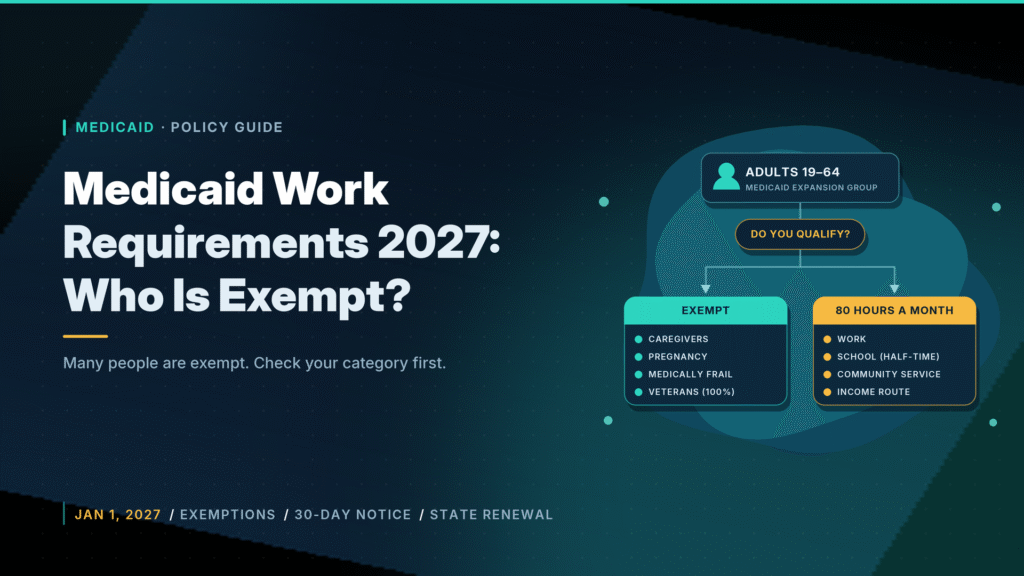
The requirements generally apply to adults ages 19 through 64 who receive coverage through:
- The Affordable Care Act Medicaid expansion adult group.
- Certain Section 1115 demonstration populations providing comprehensive coverage.
The applicable population generally excludes pregnant individuals and people entitled to or enrolled in Medicare under the specified federal criteria. Children under 19 and adults 65 or older fall outside the relevant age range.
Being enrolled in Medicaid does not, by itself, establish that someone must meet the requirement. The person’s eligibility category and any applicable exclusion must be considered.
An adult receiving coverage through expansion may need to establish an exemption even if they have a disability or significant health needs. Their eligibility category and exemption status are separate questions.
Who is exempt?
Federal regulations identify several categories of people excluded from the requirement. Each category has conditions that the state must apply.
| Exemption category | Key qualification |
|---|---|
| Pregnancy and postpartum coverage | Pregnancy or entitlement to qualifying postpartum Medicaid coverage |
| Parents and other qualifying caregivers | Care of a dependent child age 13 or younger, or a person with a qualifying disability |
| Medical frailty or special medical needs | A qualifying condition that significantly impairs the ability to meet the requirement |
| Certain veterans | A temporary or permanent VA disability rating of 100% |
| Certain former foster care youth | Must meet the federal former-foster-care eligibility definition |
| American Indians and Alaska Natives | Must meet the applicable federal definition |
| Drug or alcohol treatment participants | Participation in a qualifying treatment or rehabilitation program |
| Certain TANF and SNAP participants | Specific cross-program work-rule criteria apply |
| People incarcerated in public institutions | A separate exclusion applies; ordinary Medicaid coverage limitations during incarceration remain relevant |
These exclusions remove the community engagement condition. Beneficiaries must still meet other Medicaid eligibility requirements.
How does the caregiver exemption work?
The child-related exemption uses age 13 or younger, rather than all children under 18. Parents caring only for older teenagers should check whether another exemption applies.
Caregiver definitions also cover certain relatives and other people providing qualifying assistance to someone with a disability. Depending on the relationship and living arrangement, additional conditions apply. More than one qualifying caregiver in a residence can receive the exclusion.
What does “medically frail” mean?
Under CMS’s implementing framework, medical frailty involves a qualifying physical, mental or behavioral health condition that significantly impairs the person’s ability to satisfy community engagement requirements.
A diagnosis alone does not automatically establish that standard. Relevant categories include certain disabilities, disabling mental disorders, substance use disorders, and serious or complex medical conditions. Someone without a Social Security disability award may still qualify through another medical-frailty category.
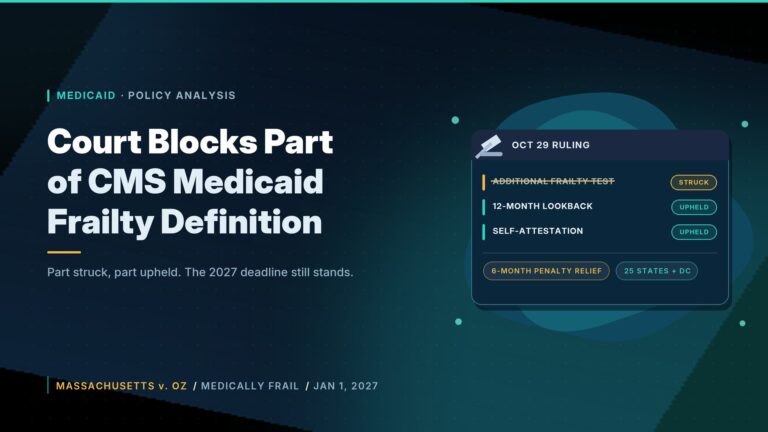
States must first attempt to verify medical frailty using reliable available information. If those data are insufficient, states may request documentation or, during 2027, accept qualifying self-declarations. Federal permission to accept self-declaration does not mean every state will use the same process. More restrictive verification rules begin in 2028.
Beneficiaries should ask their state how to request consideration and what information is needed. Clinicians can help describe functional limitations when documentation is requested.
What activities satisfy the requirement?
People subject to the requirement have several potential ways to comply.
| Qualifying route | General federal standard |
|---|---|
| Work | At least 80 hours in the month |
| Community service | At least 80 qualifying hours |
| Qualifying work programs | At least 80 hours |
| Education | Enrollment at least half-time in a qualifying program |
| Combined activities | At least 80 hours across qualifying activities |
| Income-based route | Monthly income meeting the federal minimum-wage-times-80 threshold |
| Seasonal work | A separate income-averaging calculation applies |
CMS currently illustrates the income threshold as $580 per month, based on $7.25 multiplied by 80. That figure is a community engagement compliance measure, not Medicaid’s general income eligibility limit.
Half-time educational enrollment can satisfy the requirement without an additional 80 hours of employment. Qualifying education below half-time may contribute hours toward the combined-activity route.
Already having a job does not eliminate the need to check whether the state has verified the relevant hours or income.
Are temporary hardship exceptions available?
States may offer short-term hardship exceptions for qualifying circumstances, including:
- Certain inpatient or similarly intensive medical services.
- Extended travel for necessary treatment of a serious or complex condition affecting the individual or a dependent.
- Residence in an area meeting specified unemployment criteria.
- Certain presidentially declared emergencies or disasters.
These are state options with defined conditions. Beneficiaries should check whether their state offers the relevant exception, how to request it and when it ends.
Separate mandatory protections can also apply following incarceration or during certain changes in age, Medicare status or exemption status.
Will everyone need to report every month?
The monthly activity standard and the schedule for verifying compliance are different.
For new applicants, states generally assess between one and three consecutive months immediately before the application month, according to the state’s policy.
For existing beneficiaries, states specify the months assessed between renewals and may conduct more frequent checks. An individual’s notice should identify the relevant period. Compliance assessment rules
States must use reliable available information before requesting additional information from the individual. Relevant sources can include payroll records, eligibility-system information, other program records and healthcare data.
A beneficiary may therefore have compliance verified without submitting the same documents repeatedly, while another person may receive a request because available records are incomplete.
What happens if the state cannot verify compliance?
If the state cannot verify compliance, it must issue a notice and provide 30 calendar days from receipt for the individual to show that they meet the requirement or that it does not apply.
For an enrolled beneficiary, coverage must continue until an ineligibility determination is made under the applicable process. Before denying or terminating coverage, the state must consider other Medicaid eligibility bases and provide required notices and fair-hearing rights. People disenrolled for noncompliance may reapply.
Read any notice promptly. Check:
- Which months the state is reviewing.
- What information is missing.
- Whether an exemption or exception applies.
- The response deadline and submission methods.
- How to challenge an incorrect decision.
Keep copies of submissions, confirmation numbers and correspondence.
What should beneficiaries do before 2027?
Start with your state Medicaid agency’s instructions. Medicaid.gov’s eligibility-change page provides a route to state-specific information.
Update your mailing address, phone number and electronic contact preferences. Confirm your renewal date and ask whether your coverage category is subject to community engagement.
If information is requested, relevant records may include pay statements, employer verification, educational enrollment confirmation, qualifying activity records or information supporting an exemption. Submit the documents your state requests through its approved process.
People who believe they qualify for an exemption should ask whether the state has already identified it and whether further action is needed.
What should providers and health plans prepare for?
Providers and health plans can help beneficiaries understand notices, reach the appropriate eligibility office and obtain requested clinical information. A practical preparation step is to establish a clear referral process for members who need renewal assistance or medical-frailty documentation.
For care teams, the central operational issue is continuity: a missed request or incomplete record can interrupt coverage even when the person works, participates in qualifying activities or meets an exemption.