HL7 Standards in Healthcare: A Complete Guide to Data Exchange

HL7 Standards

What Are HL7 Standards?

Health Level Seven (HL7) refers to a set of international standards designed to streamline the sharing of clinical and administrative data across healthcare systems. These standards ensure that disparate health IT applications can communicate effectively, regardless of the vendors or technologies in use.

HL7 standards function at the application layer (Level 7) of the OSI model, which is responsible for interfacing directly with end-user services. This layer governs data formatting, transmission protocols, and the overall structure of messages.

Why HL7 Matters

  • Interoperability: HL7 standards are foundational for achieving interoperability across healthcare systems, enabling seamless data exchange between hospitals, clinics, labs, payers, and public health organizations.
  • Efficiency: Standardized data formats reduce the need for manual entry, lowering administrative overhead and minimizing the risk of transcription errors.
  • Continuity of Care: Consistent access to accurate patient data leads to better clinical decisions and continuity across care settings.

HL7 is maintained by HL7 International, a not-for-profit organization comprised of healthcare stakeholders worldwide. Since its inception in 1987, HL7 has become the dominant force in health IT messaging standards.

A Brief History of HL7

Understanding the timeline of HL7 development helps contextualize its role in today’s healthcare landscape.

1987: HL7 International Founded

Formed to address the growing need for standardization in the rapidly expanding health IT sector.

1989: HL7 Version 2 Released

HL7 V2 introduced a standardized message format for transmitting patient data. Its flexibility and simplicity led to widespread adoption across hospitals and labs.

2000: CDA (Clinical Document Architecture)

A document standard derived from HL7 Version 3. CDA enabled the sharing of clinical narratives and structured data within a single document.

2005–2010: HL7 Version 3 (V3)

An ambitious attempt to create a more structured and semantically rich standard. Despite its formal modeling approach, it saw limited real-world adoption due to complexity.

2014: HL7 FHIR Introduced

FHIR (Fast Healthcare Interoperability Resources) modernized HL7 by leveraging RESTful APIs and JSON/XML, aligning with contemporary web development practices.

Today, HL7 includes multiple standards (V2, V3, CDA, FHIR), each serving different roles in healthcare data exchange.

Key HL7 Versions and Components

HL7 Version 2 (V2)

HL7 V2 is the most widely implemented healthcare messaging standard globally. It is designed for point-to-point system communication and supports messages related to admissions (ADT), orders (ORM), results (ORU), and billing (DFT).

  • Message Structure: Uses delimiters (|, ^) to separate data fields.
  • Flexibility: Highly customizable, allowing vendors to create custom Z-segments.
  • Challenges: This flexibility can lead to inconsistent implementations and interoperability issues.

HL7 Version 3 (V3)

V3 aimed to resolve V2’s inconsistencies by enforcing a more rigid data model based on a Reference Information Model (RIM).

  • Format: XML-based.
  • Strength: Semantic interoperability.
  • Limitations: Low adoption due to its steep learning curve and implementation complexity.

CDA (Clinical Document Architecture)

CDA is a standard for structured documents that blend narrative text with coded data elements.

  • Use Cases: Discharge summaries, referrals, continuity of care documents.
  • Adoption: Widely used in Meaningful Use and data exchange programs.

FHIR (Fast Healthcare Interoperability Resources)

FHIR represents the most modern HL7 standard and is designed for real-time data access via APIs.

  • Data Format: JSON and XML.
  • Transport: RESTful APIs using HTTP(S).
  • Modular Design: Composed of “resources” like Patient, Observation, and Encounter.
  • Advantages: Developer-friendly, scalable, supports mobile and cloud integration.

How HL7 Facilitates Data Exchange

HL7 standards provide a common language that enables healthcare systems to exchange data reliably and meaningfully.

HL7 V2 Example:

When a patient is admitted:

  • ADT^A01 message is sent from the registration system.
  • It includes segments such as:
    • MSH: Message header
    • PID: Patient identification
    • PV1: Patient visit
  • These messages are routed to lab systems, billing, EHRs, and more.

FHIR Example:

A patient app queries data:

  • GET /Patient/123 returns the patient’s demographics in JSON.
  • Supports CRUD operations (Create, Read, Update, Delete).
  • Real-time queries enable up-to-date insights into a patient’s record.

Interface Engines

Integration engines (e.g., Mirth, Rhapsody) serve as the backbone for HL7 implementations, translating messages, handling errors, and managing connections.

Benefits of Implementing HL7

1. Enhanced Interoperability

HL7 allows disparate systems to exchange structured data without relying on custom integrations, enabling smoother workflows across platforms.

2. Improved Patient Outcomes

By providing real-time access to clinical data, HL7 enables clinicians to make more informed decisions, reducing the likelihood of adverse events.

3. Reduced Administrative Burden

Automated data sharing eliminates repetitive data entry, streamlines documentation, and accelerates billing cycles.

4. Scalability

HL7’s modular approach (especially with FHIR) enables healthcare organizations to adopt new technologies and scale their data infrastructure as needed.

5. Regulatory Compliance

Standards like HL7 FHIR support compliance with ONC’s interoperability rules and initiatives like TEFCA and the 21st Century Cures Act.

Challenges in HL7 Implementation

1. Legacy System Constraints

Many healthcare organizations still operate outdated systems that may not fully support HL7, requiring middleware or costly upgrades.

2. Implementation Variability

Flexible standards can lead to inconsistent implementations. This requires extensive interface mapping and custom development.

3. Technical Expertise

HL7 implementation demands skilled IT professionals familiar with healthcare workflows, message formats, and security protocols.

4. Data Governance

Organizations must define clear policies for data ownership, access control, and audit logging to ensure responsible data exchange.

5. Security & Compliance

HL7 V2 lacks native encryption. Implementers must add secure transport layers (VPN, TLS) and use OAuth2 for FHIR APIs to safeguard patient data.

HL7 vs. FHIR: What’s the Difference?

FeatureHL7 V2FHIR
Year Introduced19892014
FormatDelimited TextJSON/XML
TransportTCP/IPRESTful APIs (HTTPS)
Ease of ImplementationModerate to ComplexDeveloper-Friendly
Best Use CasesInternal messaging (labs, ADT)Patient apps, analytics, cloud services

Key Differences:

  • HL7 V2 is event-driven and optimized for hospital system integration.
  • FHIR is resource-based, supporting modular data exchange ideal for modern applications.
  • FHIR leverages internet protocols, making it more accessible for web and mobile developers.

Real-World Use Cases of HL7

Hospitals

ADT messages enable real-time updates across departments, reducing communication lags and ensuring clinical staff has the latest patient information.

Laboratories

Orders (ORM) and results (ORU) flow automatically between lab equipment and EHRs, supporting rapid diagnostics.

Radiology

Imaging orders and reports are transmitted via HL7 to PACS and EHR systems, allowing immediate access to results.

Public Health

Vaccination data (VXU messages) and disease reports are sent to health departments, enabling real-time epidemiological tracking.

Patient-Facing Applications

FHIR APIs allow patients to retrieve their records securely through portals and mobile apps like Apple Health or MyChart.

Health Information Exchanges (HIEs)

HIEs aggregate data from multiple providers using HL7 and FHIR to build longitudinal patient records.

Best Practices for HL7 Implementation

  1. Define Clear Integration Goals
    • Identify systems to connect and data types to exchange.
  2. Adopt Standard Implementation Guides
    • Use HL7 profiles or national standards (e.g., US Core, IHE).
  3. Use Robust Integration Engines
    • Employ tools like Mirth Connect, Corepoint, or Rhapsody for scalable message routing.
  4. Focus on Data Quality
    • Ensure clean, accurate, and codified data to support downstream analytics and care decisions.
  5. Ensure Security and Compliance
    • Implement TLS, OAuth2, and logging mechanisms. Regularly audit interfaces.
  6. Plan for Ongoing Maintenance
    • Monitor message queues, errors, and system changes to ensure stability.
  7. Train Teams Continuously
    • Provide clinical and IT staff with ongoing education on new standards and workflows.

The Future of HL7 and Interoperability

1. Widespread FHIR Adoption

FHIR is central to U.S. interoperability mandates, including the 21st Century Cures Act, which requires patient-accessible APIs.

2. TEFCA and National Networks

The Trusted Exchange Framework and Common Agreement (TEFCA) aims to unify health data exchange across the U.S., largely powered by HL7 standards.

3. App Ecosystems and APIs

More EHRs are offering FHIR-based APIs, enabling innovation through SMART on FHIR apps and custom integrations.

4. AI and Big Data

Standardized data via HL7 enables machine learning models and population health tools to function at scale.

5. Global Expansion

Countries like the UK, Canada, Australia, and India are adopting HL7 FHIR in national health IT strategies.

6. Integration with IoT

FHIR extensions support wearables, remote monitoring tools, and connected medical devices for holistic patient views.

Final Thoughts

HL7 standards remain the cornerstone of healthcare interoperability. From HL7 V2’s foundational messaging to FHIR’s modern APIs, each version has played a critical role in transforming healthcare delivery.

For healthcare IT leaders, implementing HL7 isn’t just about connecting systems—it’s about unlocking better care, empowering patients, and future-proofing health IT infrastructure.

Whether you’re integrating internal hospital systems, launching a telehealth platform, or building patient-centered applications, HL7 provides the foundation for efficient, secure, and meaningful data exchange.

FAQs

What does HL7 stand for?
Health Level Seven – referencing the 7th layer of the OSI model (application layer).

Is FHIR part of HL7?
Yes. FHIR is a standard developed by HL7 International.

Is HL7 mandated by law?
In many regions, including the U.S., FHIR-based APIs are mandated for certified EHRs under ONC rules.

Can HL7 be used in mobile apps?
Yes. FHIR is specifically designed for web and mobile integration.

Medicare Risk Adjustment: A Complete Guide for Providers

Medicare Risk Adjustment

What Is Medicare Risk Adjustment?

Medicare Risk Adjustment is a payment methodology designed by the Centers for Medicare & Medicaid Services (CMS) to ensure fair compensation for healthcare plans and providers who care for patients with varying levels of health risk.
In simple terms, it means: the sicker or more complex a patient’s condition is, the higher the reimbursement CMS provides to the plan or provider managing their care.

The Purpose and Foundation of Risk Adjustment

Traditional Medicare payments once used a “one-size-fits-all” approach, where every beneficiary was funded equally, regardless of their health status. This often led to underfunding care for high-risk patients and overpayment for healthy populations.
Risk adjustment was created to solve this imbalance – by predicting future healthcare costs based on a patient’s diagnoses, age, gender, and other factors.

How CMS Uses Risk Adjustment in Medicare Advantage

Medicare Advantage (MA) plans receive a per-member-per-month (PMPM) payment from CMS. The amount is “adjusted” based on the health risk score of each beneficiary. This ensures that plans caring for high-risk patients (e.g., those with chronic illnesses) receive adequate funding to provide comprehensive care.

Key Goals: Fairness, Accuracy, and Predictive Care Costs

Risk adjustment aims to:

  • Promote fair compensation for plans managing sicker patients.
  • Encourage accurate documentation and coding.
  • Improve predictive modeling for population health management.
  • Support value-based care, where payment aligns with patient outcomes rather than volume of services.

Why Risk Adjustment Matters for Providers

Financial Implications and Value-Based Reimbursement

Accurate risk adjustment coding directly affects reimbursement. For providers in Medicare Advantage or ACO models, each documented diagnosis contributes to the patient’s risk score. If a chronic condition is missed or not recaptured annually, reimbursement for that patient’s care may be significantly lower.
Inaccurate documentation = lost revenue.

Impact on Patient Care and Quality Outcomes

When risk scores reflect true patient complexity, providers can allocate resources more effectively – for example, assigning care managers to high-risk diabetics or scheduling follow-ups for COPD patients.
Better data drives better care coordination, preventive interventions, and improved outcomes.

How Accurate Coding Drives Fair Compensation

Every diagnosis must be supported by clear, specific documentation. A missed or incorrectly coded diagnosis doesn’t just affect payment; it skews population health data and risk profiles.
This is why risk adjustment coding is now seen as a clinical responsibility, not just a billing task.

How the CMS Risk Adjustment Model Works

1. Understanding Hierarchical Condition Categories (HCC)

The CMS risk adjustment system relies on Hierarchical Condition Categories (HCCs) – a model that groups related diagnoses into categories that reflect similar clinical severity and cost impact.
For example, diabetes without complications maps to a lower-weight HCC than diabetes with chronic complications.

Each patient’s HCCs are identified annually from their documented diagnoses.

2. The Risk Adjustment Factor (RAF) Scoring Explained

Each beneficiary receives a Risk Adjustment Factor (RAF) score that represents their predicted cost relative to an average Medicare beneficiary.

  • A RAF score of 1.0 indicates average risk.
  • Scores above 1.0 indicate higher expected costs due to comorbidities or age.
  • CMS combines these scores with demographic data to calculate payments.

3. Data Sources: Demographic, Clinical, and Encounter Data

CMS uses:

  • Demographic data (age, gender, Medicaid eligibility)
  • Clinical data (diagnoses from claims and encounter reports)
  • Prescription Drug Event (PDE) data for Medicare Part D

Example: How Risk Scores Affect Reimbursement

If a patient with diabetes and heart failure has both conditions documented, their plan might receive 1.35× the standard payment.
If one diagnosis is missing, payment could drop to 1.05×, potentially reducing funding by hundreds of dollars per month.

Medicare Advantage and Risk Adjustment

1. How Medicare Advantage Plans Use Risk Scores

Medicare Advantage plans depend heavily on risk scores to forecast patient costs and manage population health. The higher the aggregate RAF score, the greater the expected medical expenses — and the higher the CMS reimbursement to support that care.

2. Key Differences from Traditional Medicare Payments

Unlike Fee-for-Service (FFS) Medicare, which pays per service rendered, Medicare Advantage (MA) operates on a capitated model – a fixed payment per beneficiary.
Risk adjustment ensures these capitated payments remain actuarially sound and reflect the real-world health status of members.

3. How CMS-HCC Models Evolve Annually

CMS continually updates the HCC model (e.g., Version 28 for 2025) to account for medical advances, coding trends, and policy priorities.
Each version adjusts how certain conditions are grouped and weighted – impacting reimbursement logic and clinical documentation requirements.

The Role of Providers in Risk Adjustment Accuracy

1. Accurate and Complete Documentation

Providers are the front line of risk adjustment. Every diagnosis entered into the EHR must:

  1. Be evaluated during a face-to-face visit.
  2. Be supported by clinical evidence.
  3. Clearly describe the patient’s condition and its impact on care.

2. Importance of Annual Wellness Visits and Condition Recapture

CMS requires that chronic conditions be recaptured annually to remain active in risk adjustment calculations.
Annual wellness visits and routine follow-ups are essential for maintaining accurate HCC mappings.

3. Common Documentation and Coding Errors to Avoid

  • Listing historical or resolved conditions as active
  • Failing to specify disease severity or type
  • Using unspecified ICD-10 codes when specificity is available
  • Missing linkage between conditions (e.g., “diabetes with neuropathy”)

2025 CMS Risk Adjustment Model Updates

1. Transition from V24 to V28 – What Changed?

CMS finalized the transition from Model V24 to V28, introducing:

  • More clinically precise groupings
  • Fewer HCCs (from 86 to 115 consolidated categories)
  • Updated condition hierarchies that better reflect disease burden

2. New Condition Mappings and RAF Score Recalibrations

Certain chronic conditions, like obesity and substance use disorder, now carry more weight, while others (like simple hypertension) have less financial impact.

3. Key Takeaways for Clinicians and Coding Teams

  • Reassess all chronic condition lists for proper specificity.
  • Focus on hierarchical relationships — higher severity trumps lower ones.
  • Regularly train staff on CMS V28 coding changes.

Data Capture, EHR, and Technology in Risk Adjustment

1. How EHR Integration Improves Coding Precision

Integrated EHR systems can flag missing or uncaptured chronic conditions, reducing human error and optimizing documentation workflows.
Automation ensures real-time HCC validation and fewer missed codes.

2. Role of AI and NLP in Identifying Unrecorded Diagnoses

Modern risk adjustment technology uses Natural Language Processing (NLP) and AI models to scan clinical notes and identify undocumented or under-coded diagnoses.
This can increase RAF accuracy and support compliance.

3. Leveraging Analytics to Close Documentation Gaps

Providers can use dashboards to:

  • Track documentation completeness
  • Benchmark RAF performance
  • Identify outliers or missed opportunities in coding

Compliance and Audit Readiness

1. CMS Audits and Data Validation Processes

CMS conducts Risk Adjustment Data Validation (RADV) audits to verify the accuracy of submitted HCCs.
Each documented condition must be supported by a medical record from a face-to-face encounter.

2. Documentation Best Practices for Audit Defense

  • Maintain clear progress notes linking diagnosis to treatment.
  • Ensure provider signatures and dates are complete.
  • Store supporting test results or specialist notes for high-risk diagnoses.

3. Ethical Coding and Compliance Considerations

Upcoding (intentionally inflating diagnosis severity) can result in fines or clawbacks.
Providers should always prioritize accuracy and integrity over financial gain.

Best Practices to Improve Risk Adjustment Performance

1. Provider Education and Training

Ongoing education helps physicians understand how documentation affects reimbursement.
Quarterly workshops or CDI (Clinical Documentation Improvement) sessions ensure teams stay current with CMS model updates.

2. Implementing Clinical Documentation Improvement (CDI) Programs

CDI programs align clinical workflows with coding requirements, ensuring the right diagnoses are captured every time.

3. Collaboration Between Payers and Providers

When payers and providers share insights, risk adjustment outcomes improve.
Joint audits, shared dashboards, and feedback loops promote mutual accountability and better patient representation.

Future of Medicare Risk Adjustment

1. AI-Driven Models and Predictive Analytics

The next generation of risk adjustment will use machine learning to forecast risk dynamically, leveraging social determinants of health (SDOH) and real-time data.

2. Shift Toward Outcome-Based Risk Modeling

Future models may tie reimbursement not only to risk but also to actual patient outcomes and preventive performance metrics.

3. What Providers Should Prepare for Beyond 2025

  • Greater interoperability between EHRs and CMS systems.
  • Advanced AI-assisted clinical documentation tools.
  • Heightened focus on ethical and transparent coding practices.

Key Takeaways for Providers

  • Document every active chronic condition annually.
  • Verify HCC and RAF accuracy before submission.
  • Use AI and EHR analytics to uncover missed diagnoses.
  • Keep staff trained and compliant with CMS model updates.
  • Maintain complete audit-ready documentation.

Conclusion

Medicare Risk Adjustment is not just a billing mechanism – it’s a core pillar of equitable healthcare financing. By mastering documentation accuracy, embracing technology, and focusing on patient outcomes, providers can ensure they are fairly compensated while delivering high-quality, coordinated care.

In 2025 and beyond, the providers who invest in data accuracy and continuous education will lead the charge toward a more predictive, value-based healthcare future.

FAQ’s

1. What is Medicare Risk Adjustment?

Medicare Risk Adjustment is a payment system used by the Centers for Medicare & Medicaid Services (CMS) to make sure health plans and providers are fairly reimbursed for the care they deliver.
It adjusts payments based on each patient’s health status, age, and demographics, ensuring that providers who care for sicker or more complex patients receive appropriate compensation.

2. How does the CMS Risk Adjustment model work?

CMS uses the Hierarchical Condition Categories (HCC) model to assign a Risk Adjustment Factor (RAF) score to each beneficiary.
This score is calculated using documented diagnoses, age, gender, and dual-eligibility status. Higher scores represent higher expected healthcare costs and lead to higher reimbursements for the provider or health plan.

3. Why is Medicare Risk Adjustment important for providers?

For providers, accurate risk adjustment ensures fair payment and supports value-based care initiatives.
It also helps healthcare organizations manage population health, identify high-risk patients, and allocate care resources efficiently.
Inaccurate or incomplete documentation can lead to revenue loss and compliance risks

4. What is an HCC code in Medicare Risk Adjustment?

An HCC (Hierarchical Condition Category) is a grouping of medical diagnoses that reflect similar clinical severity and cost impact.
Each diagnosis is mapped to one HCC, which contributes to a patient’s overall risk score. For example, diabetes with complications maps to a higher-weight HCC than diabetes without complications.

5. What is a RAF score in Medicare?

The Risk Adjustment Factor (RAF) score quantifies a patient’s predicted healthcare costs compared to the average Medicare beneficiary.
RAF = 1.0 → Average expected cost
RAF > 1.0 → Higher expected cost (more complex patient)
RAF < 1.0 → Lower expected cost (healthier patient)

6. How often do risk scores need to be updated?

Risk scores are recalculated annually by CMS.
Providers must recapture all active chronic conditions each calendar year during face-to-face encounters for them to count toward the next year’s risk score.

7. What are common documentation errors in risk adjustment?

Some of the most frequent errors include:
Missing chronic condition documentation
Using unspecified ICD-10 codes
Failing to link related conditions (e.g., “CKD due to diabetes”)
Listing historical conditions as active
Avoiding these errors helps maintain compliance and accurate reimbursement.

8. What changed in the 2025 CMS Risk Adjustment Model (V28)?

The 2025 model (Version 28) includes:
Updated condition hierarchies and weights
Greater focus on clinical precision and chronic disease burden
Reduced redundancy in condition categories (from 86 to 115 refined HCCs)
Providers must ensure coding and documentation align with V28 updates to avoid payment discrepancies.

9. How can technology help improve risk adjustment accuracy?

Modern EHRs, AI-powered tools, and Natural Language Processing (NLP) can automatically identify uncoded or under-documented conditions.
Analytics dashboards also help monitor RAF trends, detect coding gaps, and support audit readiness — making risk adjustment more accurate and efficient.

Revenue Cycle Management in Healthcare

Revenue Cycle Management in Healthcare

What is Revenue Cycle Management (RCM) in Healthcare?

“Revenue Cycle Management (RCM)” in healthcare refers to the end-to-end administrative and clinical functions that capture, manage, and collect patient service revenue. It encompasses the entire lifecycle of a patient encounter – from appointment scheduling and registration to final payment or write-off.

It’s critical because even minor inefficiencies at any stage can result in delayed reimbursements, write-offs, compliance risk, or revenue leakage. In a sector where margins are often thin and regulatory scrutiny is high, optimizing RCM is not optional – it’s a financial necessity.

Hospitals and health systems routinely report that 2% to 5% of net patient revenue is lost due to inefficiencies in their RCM operations.

A well-designed RCM system supports cash flow stability, operational transparency, and accountability across clinical, billing, and financial teams.

Why healthcare organizations can’t ignore RCM efficiency

  • Revenue leakage is cumulative. Losing 3% here, 2% there – across thousands of claims – becomes millions of dollars lost annually.
  • Denials and rework sap labor resources. Each denied or rejected claim must be reworked, appealed, resubmitted – all of which cost time and money.
  • Delays hurt cash flow and forecasting. Inconsistent collections make budgeting and capital investment risky.
  • Compliance and audit risk. Errors in billing, coding, or documentation invite audits, penalty exposure, or revenue recoupments.
  • Patient experience and satisfaction. When billing is opaque or confusing, patients may resist paying. Transparent, timely billing fosters trust and higher collections.

Key Stages of the Revenue Cycle Management Process

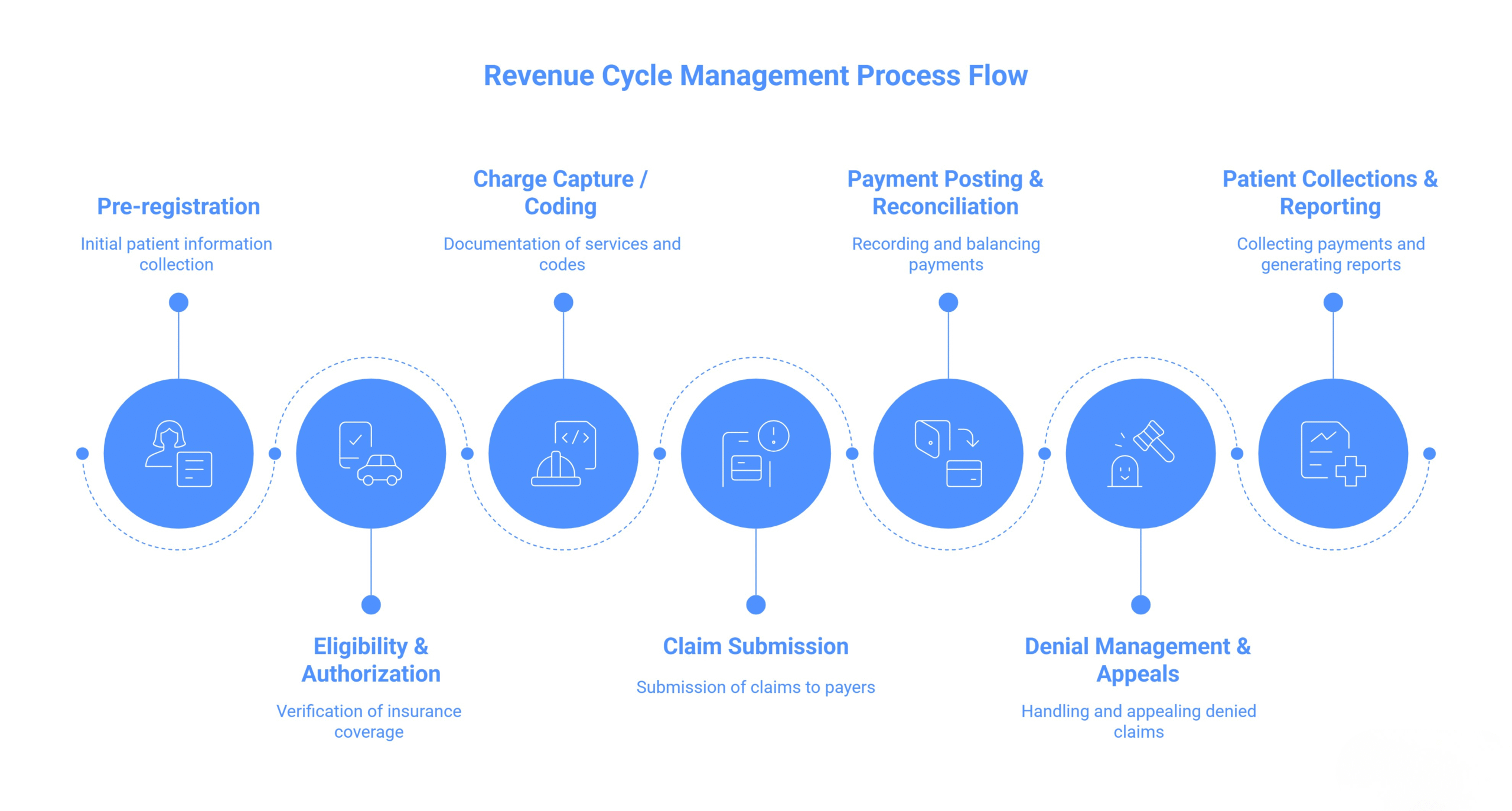
The key stages of the revenue cycle management process in healthcare form a structured framework that drives financial accuracy and operational efficiency. Each phase – from patient registration to final collections – plays a vital role in ensuring providers receive proper reimbursement while maintaining compliance and patient satisfaction. Understanding and optimizing every stage of the RCM process helps healthcare organizations reduce denials, accelerate payments, and achieve sustainable revenue growth.

Revenue Cycle Management Process

1. Patient Pre-Registration and Eligibility Verification

  • At intake or scheduling, capture accurate patient demographics, insurance details, and eligibility.
  • Verify coverage, benefit levels, co-pays/deductibles, and any prior authorizations needed.
  • Ensure data hygiene (correct names, DOB, insurance IDs) to prevent downstream denials.
  • Use real-time eligibility verification systems to flag gaps or lapses before service.

2. Charge Capture and Medical Coding

  • Document every service, supply, and procedure delivered in structured form.
  • Map clinical documentation (EHR notes) to standardized billing codes (ICD, CPT, HCPCS).
  • Use audits and coding validation tools to minimize undercoding, miscoding, or missed charges.
  • If charge capture is weak (e.g., manual logs, missing entries), revenue leakage multiplies. (Especially in high-volume or rural settings)

3. Claims Submission

  • Assemble clean, scrubbed claims (checking for mandatory fields, formatting, modifiers).
  • Route claims electronically per payer guidelines, meeting timely filing windows.
  • Apply payer-specific business rules or edits before submission.
  • Leverage clearinghouse tools and claim scrubbing to reduce reject/denial risk.

4. Payment Posting and Reconciliation

  • Receive remittance advice (ERA/EOB) from payers; post payments and adjustments against claims.
  • Identify underpayments, discrepancies, and variances.
  • Segregate correct payments vs. partial payments needing follow-up.
  • Reconcile to general ledger and flag anomalies for review.

5. Denial Management and Appeals

  • Classify denials into soft (fixable) vs hard (final) and triage accordingly.
  • Track denial root causes (eligibility, coding, documentation, authorization).
  • Perform timely appeals or resubmissions where possible.
  • Use denial analytics to identify recurring patterns and feedback for upstream prevention.
  • According to industry research, 86 % of denials are potentially avoidable.
  • Many organizations see 10–15 % claim denial rates.

6. Patient Collections and Reporting

  • Generate patient statements, billing notices, and reminders promptly.
  • Offer flexible payment plans, online pay portals, and clear financial counseling.
  • Monitor aging accounts receivable (AR), follow up on slow payers, and write off bad debt when necessary.
  • Produce dashboards and reports showing trends (e.g., clean claim rate, denial rate, AR days).

The Role of Technology in RCM

1. How automation and AI improve RCM workflows

  • Claim scrubbing & edits: Automated checks before submission reduce reject/denial rates.
  • Predictive denial analytics: AI models can flag claims with high denial likelihood and prompt preemptive fixes.
  • Intelligent routing & bidding: Automate assignment of claims to optimal payer paths.
  • Automated appeals workflows: Track and escalate denials based on severity and deadlines.
  • Robotic process automation (RPA): Automate repetitive tasks like data extraction, remittance matching, and status inquiries.

2. The impact of EHR integration on financial performance

  • Seamless integration between EHR/clinical systems and billing modules prevents transcription errors and delays.
  • Real-time capture of charges at point of care ensures accuracy and timeliness.
  • Shared data across clinical and financial systems increases visibility and reduces silos.
  • Integrated systems support closed-loop feedback (e.g. denial reasons pushing improvements upstream in documentation).

3. Real-time analytics for revenue insights

  • Dashboards alert to trends: rising denial clusters, payer lag, underpayment variances.
  • Predictive models project cash flow, AR aging, and likely risk exposures.
  • Drill-down analytics allow root-cause diagnosis (by payer, department, service).
  • Real-time insights empower quicker corrective action and continuous process improvement.

Common Challenges in Revenue Cycle Management

1. Inefficient claims and denial management

  • High denial rates (10–15 %) are common and rising.
  • Reworking denied claims is expensive (often $25+ per claim) and labor intensive.
  • Many denied claims are never appealed—research suggests 65 % of denials go unworked, causing ~3 % net revenue loss.
  • Payer complexity: each insurer has distinct business rules, documentation requirements, and denial codes, making consistent compliance difficult.

2. Lack of interoperability between systems

  • Disconnected EHRs, billing, and payer systems create data silos and manual handoffs.
  • Legacy or homegrown systems often can’t scale or integrate with modern RCM modules.
  • Poor data mapping leads to mismatches and errors when transferring between modules.

3. Regulatory changes and compliance burdens

  • Frequent updates to coding systems (ICD, CPT, HCPCS) require ongoing training and software updates.
  • Payer audits, regulatory reporting, and shifting reimbursement models raise risk.
  • Compliance with privacy laws (e.g., HIPAA in the U.S.) adds complexity to data sharing and handling.

4. Staff shortages and training gaps

  • Skilled coders, billing experts, and denial analysts are in high demand and low supply.
  • Turnover strains continuity, and training new staff is time-consuming.
  • Manual processes consume staff bandwidth, leaving little time for higher-value tasks.

5. Inaccurate patient data and eligibility issues

  • Incorrect demographic or insurance data at registration causes claim rejections or denials.
  • Benefit changes, lapsed coverage, or policy exclusions may go unrecognized.
  • Patients may have multiple coverages; coordination-of-benefits errors are frequent.

Proven Solutions to RCM Challenges

1. Centralizing data and improving interoperability

  • Migrate to a unified platform where clinical, financial, and payer data reside in shared modules.
  • Use APIs and middleware to connect formerly disparate systems.
  • Standardize data formats and master patient indexing to eliminate duplication.
  • A unified system avoids data handoffs and reduces transcription errors.

2. Leveraging AI-powered automation

  • Use AI to predict claim denial risk and trigger alerts for pre-submission remediation.
  • Automate denial appeals or routing based on severity thresholds.
  • Use natural language processing (NLP) to scan documentation and flag missing elements.
  • Automate remittance reconciliation, variance detection, and payment adjustment workflows.

3. Regular staff training and process audits

  • Host frequent coding, documentation, and compliance refreshers.
  • Perform root-cause audits on denied claims and feed insights upstream.
  • Create feedback loops so denials drive changes in registration, documentation, or service workflows.
  • Incentivize accuracy and performance (e.g. bonuses, recognition for clean claims).

4. Enhancing patient financial transparency

  • Provide cost estimates, pricing tools, and financial counseling before or at service.
  • Offer digital statements, online billing portals, and payment plans.
  • Communicate clearly about co-pays, deductibles, and balances.
  • Transparently assigning patient responsibility reduces disputes and collection friction.

5. Outsourcing or partnering with RCM specialists

  • Use third-party RCM vendors or managed services for specialty functions (e.g. denial appeals, AR aging).
  • Hybrid models: internal core team + specialist partners for high-skill tasks.
  • Many hospitals see ROI from outsourcing non-core, labor-intensive tasks while retaining control of strategy.
  • Case study angle: e.g., “A mid-size hospital increased collections by 20 % within 6 months after deploying an AI-augmented RCM partner.”

Metrics to Track for a Healthy Revenue Cycle

To monitor your RCM health, focus on these key performance indicators (KPIs):

MetricWhy It MattersTarget / Benchmark
Days in Accounts Receivable (A/R)Measures how quickly claims are paid30–45 days (varies by payer mix)
Clean Claim RatePercentage of claims accepted on first pass≥ 95 %
Denial RatePercentage of claims denied initially< 10 %, ideally < 5 %
Net Collection Ratio (NCR)Actual collections / total expected≥ 95 %
Patient Payment Turnaround TimeTime from statement to payment15–30 days
Underpayment / Adjustment Variance$ or % of claims paid less than billed< 2–4 %
Appeal & Recovery Rate% of denied claims successfully overturned≥ 50–70 % depending on payer

These metrics should be tracked by payer, service line, department, and denial reason so you can spot trends, diagnose issues, and direct improvement efforts.

Future of Revenue Cycle Management in Healthcare

1. Predictive analytics for proactive revenue management

  • Machine learning models will forecast payer behavior, claim risk, and cash flow scenarios.
  • Predictive systems may proactively flag high-risk encounters for additional review or documentation predication.
  • Models like “Deep Claim” have shown promise in predicting payer responses with improved recall.

2. The rise of value-based care and its financial impact

  • As more providers transition to bundled payments, capitation, or risk-sharing models, RCM must evolve beyond fee-for-service.
  • Revenue cycle systems will need to accommodate quality metrics, risk corridors, shared savings, and population health incentives.
  • Financial models will shift from volume to value — requiring tighter integration of clinical and financial data.

3. AI-driven coding and claims automation

  • AI-assisted coding may push accuracy > 99%, reducing manual effort and audit risk.
  • Autonomous claim generation and submission with built-in payer rule logic may emerge.
  • Self-learning systems adapt to payer policy changes automatically over time.

4. Patient-centered RCM systems

  • RCM systems will cater to the patient journey (financial counseling, price transparency, digital payments).
  • Consumerization of healthcare demands billing systems that feel more like e-commerce: intuitive, transparent, flexible.
  • Real-time financial estimate tools, chatbot support, and mobile pay are becoming table stakes.

How Curitics Health Simplifies RCM Operations

1. Unified workflows for billing, claims, and reporting

Curitics Health offers a fully unified RCM platform that brings registration, coding, billing, and reporting into a single, seamless interface. No more fragmented modules – all data flows in context, with fewer handoffs and reduced transcription errors.

2. Integrations with EHR and payer systems

Curitics is built with robust API connectors to leading EHRs, payer portals, and clearinghouses. This integration ensures that clinical documentation, insurance verification, and payer responses stay synchronized – reducing delays and manual reconciliation.

3. End-to-end visibility across the revenue lifecycle

With Curitics, revenue cycle managers gain real-time dashboards and analytics at every stage: pre-registration, claims in flight, denials, AR aging, and patient collections. Predictive engines anticipate problem claims and recommend preventive actions.

4. AI-native enhancements and continual learning

Curitics embeds AI modules at key touchpoints:

  • Pre-submission scrubbers flag anomalies before claim submission
  • Denial risk predictors flag high-risk claims for review
  • Auto-appeal engines route and escalate appeals based on severity and payer logic
  • Feedback loops update system rules based on actual outcomes

Together, these capabilities help healthcare organizations reduce denials, accelerate collections, and optimize cash flow — all within a unified, intelligent platform.

Conclusion

Revenue Cycle Management in healthcare is more than a back-office function – it’s central to financial viability, operational efficiency, and patient experience. While the RCM journey is complex and fraught with challenges (rising denials, system fragmentation, skilled staffing gaps), the path to improvement is clear:

  1. Optimize each stage of the revenue cycle with best practices.
  2. Leverage intelligent automation and AI to reduce manual errors and speed workflows.
  3. Track the right metrics continuously to identify leaks and drive accountability.
  4. Adopt unified platforms and interoperability as foundational enablers.
  5. Prioritize patient transparency — easier billing, clearer payments, better compliance.

Curitics Health is positioned to help healthcare organizations modernize their RCM operations – unifying workflows, applying AI-driven enhancements, and providing end-to-end visibility across the revenue cycle.