A patient has heart failure. She had it last year, she has it now, and she will have it for the rest of her life. Your cardiologist documented it beautifully in October, the coder captured it, the encounter went to CMS, and it contributed to her risk score exactly as it should have.
On January 1, none of that counts anymore.
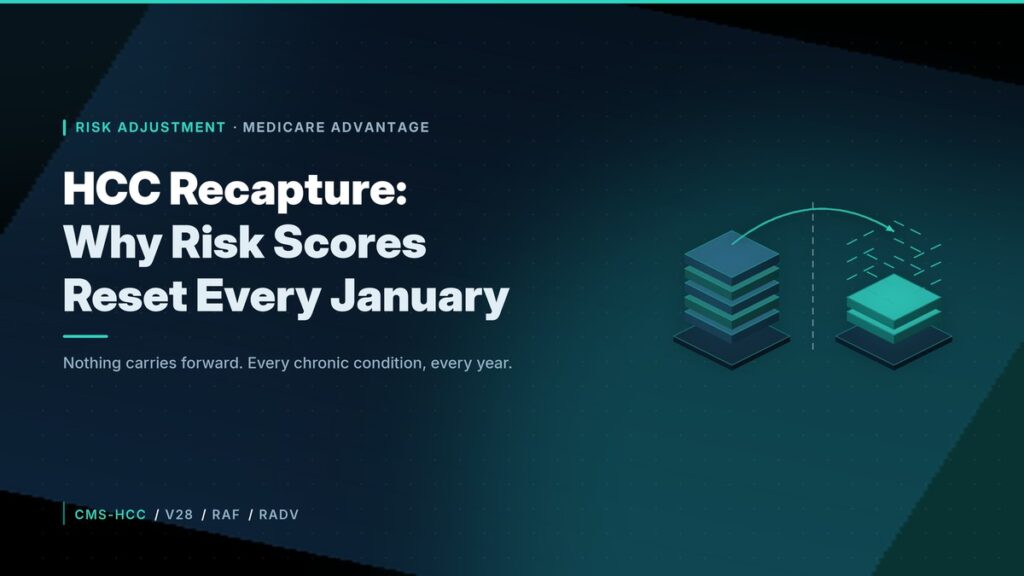
Risk adjustment has amnesia by design. Every payment year is calculated from diagnoses documented in a single calendar year of dates of service. Nothing carries forward. A condition that will never resolve has to be documented, coded, and submitted again, every twelve months, forever.
That annual re-documentation is what the industry calls HCC recapture, and it’s the single largest recurring source of unearned risk-adjusted revenue in Medicare Advantage. Not because organizations don’t know about it. Because knowing about it and operationalizing it are different problems.
This guide covers what HCC recapture is, how the annual cycle actually works, which conditions need recapture and which don’t, how to calculate your recapture rate, what the V28 model changed, how to build a program that holds up, and where recapture crosses into compliance risk.
What is HCC Recapture?
HCC recapture is the process of re-documenting and re-coding a patient’s chronic conditions in the current calendar year so they continue to count toward the risk adjustment factor used for the following payment year.
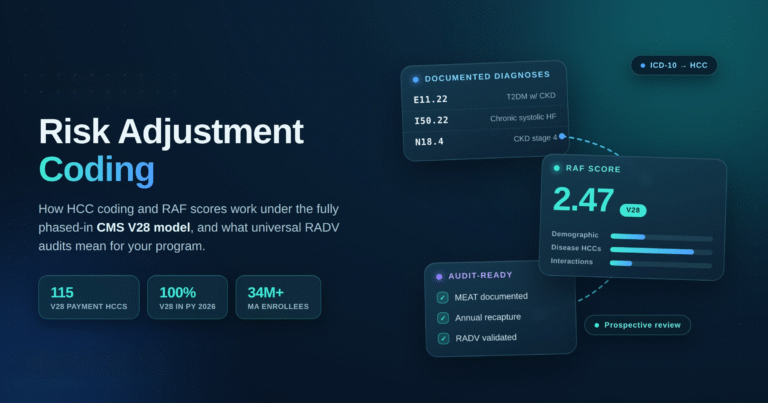
Hierarchical Condition Categories, or HCCs, are the groupings CMS uses to translate diagnosis codes into a risk score. Each HCC carries a coefficient. Add up a patient’s demographic factors and condition coefficients, apply the model, and you get a risk adjustment factor (RAF) that determines what a plan is paid to care for that person.
Why the Slate Wipes Clean
The CMS-HCC model is prospective. Diagnoses collected during one calendar year predict cost for the next. The mechanism is simple and unforgiving:
- Dates of service in calendar year 2026 determine risk scores for payment year 2027
- Only diagnoses with a date of service inside that window count
- A diagnosis submitted in 2025 has no effect on 2027 payment, no matter how permanent the condition
So amputation status, HIV, cirrhosis, multiple sclerosis, and a below-the-knee amputation from 2011 all have to be documented again this year to be paid for next year.
This is the part clinicians find genuinely irritating, and they’re not wrong. Nothing about the patient changed. The requirement exists because CMS has no way to verify a condition still exists, and still affects care, other than a clinician saying so during a face-to-face encounter.
Recapture, Gap Closure, and Suspects
These three terms get used loosely and mean different things:
- Recapture applies to an HCC documented in a prior year that has not yet been documented this year. You know the condition exists. The work is re-documentation.
- Gap closure is the umbrella term for closing any open HCC opportunity, including recapture.
- Suspect conditions have never been coded but the evidence suggests they exist: a patient on metformin with no diabetes diagnosis, a nephrology referral with no CKD code, an eGFR pattern implying stage 4.
Recapture is the easier and safer work. The condition is established, the documentation history exists, and the compliance risk is lower. Suspecting is higher-yield and higher-risk, and it should never be the first thing a program tackles.
How the HCC Recapture Cycle Actually Works?
The Data Collection Year
The recapture calendar has two distinct deadlines, and confusing them causes real losses.
- The date of service deadline is December 31. The encounter must physically occur inside the calendar year. No amount of retrospective effort creates an encounter that didn’t happen.
- The submission deadline comes later. CMS accepts risk adjustment data after the collection year closes, through a series of sweeps culminating in a final reconciliation deadline in the following year.
That gap is why retrospective chart review exists. It’s also why a program that thinks December 31 is the end of all recapture work leaves money on the table, and why one that relies on the submission window to save it will run out of runway.
Verify current-year submission deadlines against CMS guidance before building an operating calendar, since the sweep schedule is defined annually.
What Counts as an Acceptable Source
Not every diagnosis on a claim counts for risk adjustment. This trips up more programs than any other technical detail.
Diagnoses generally count when they come from:
- A face-to-face encounter with a physician or an acceptable non-physician practitioner
- Hospital inpatient encounters
- Hospital outpatient encounters
- Telehealth visits meeting CMS requirements, which have been treated as face-to-face for risk adjustment purposes
Diagnoses generally do not count from:
- Laboratory or radiology reports on their own, with no clinician documentation
- Durable medical equipment claims
- Skilled nursing facility and home health claims
- Ambulance and other non-qualifying provider types
The consequence: an abnormal lab that proves a condition exists does not create a codable diagnosis. A clinician has to see the patient and document it. This is why “the data already shows she has CKD” is not an argument that ends in payment.
Chart Review as a Supplemental Source
Retrospective chart review is permitted, and CMS allows plans to submit diagnoses found through review, provided they link to a valid face-to-face encounter within the collection year.
Two obligations that get quietly skipped: reviews must be linked to a qualifying encounter, and plans are expected to submit deletions as well as additions when review finds unsupported codes. A chart review program that only adds is a compliance finding waiting to happen.
Which Conditions Need Recapture, and Which Don’t?
This distinction is where clinical judgment matters more than coding rules, and where bad programs cause the most damage.
Persistent Conditions: Recapture Every Year
Conditions that do not resolve and continue to affect care should be documented annually as long as they remain clinically true:
- Diabetes, with the level of complication currently present
- Heart failure, atrial fibrillation, ischemic heart disease
- COPD and other chronic respiratory conditions
- Chronic kidney disease, staged accurately
- Amputation status, transplant status, ostomy status
- HIV, multiple sclerosis, cirrhosis, cystic fibrosis
- Major depressive disorder and other chronic psychiatric conditions, when active
- Morbid obesity, when the current BMI supports it
- Dementia and cognitive disorders
Conditions That Should Not Be Recaptured
Equally important, and routinely handled badly:
- Acute myocardial infarction becomes a history of MI after the acute period. Recoding an acute MI annually is not recapture, it’s an error.
- Acute stroke becomes sequelae or history of. The residual deficits are codable. The acute event is not.
- Pressure ulcers that healed, pneumonia, sepsis, and other resolved acute conditions
- Cancer in remission with no active treatment, which has specific coding rules and is not automatically an active malignancy
- Any condition that genuinely resolved, including morbid obesity after substantial weight loss
A recapture program that pushes providers to re-code everything from last year, without clinical filtering, is producing exactly the pattern auditors look for. The correct target is not 100 percent recapture. It’s 100 percent recapture of conditions that are still true, and zero recapture of conditions that aren’t.
How to Calculate Your HCC Recapture Rate?
The formula is straightforward:
HCC Recapture Rate  =  HCCs documented in both prior year and current year
                       ─────────────────────────────────────────────────────
                       HCCs documented in prior year
Worth computing in more than one cut, because the aggregate number hides everything useful:
- By condition. Diabetes recapture and dementia recapture behave very differently. So do conditions that require a specialist.
- By provider or practice. Variation between clinicians on the same panel is usually the largest single opportunity.
- By persistent conditions only. This is the honest denominator. Including resolved acute conditions makes your rate look worse than it is and obscures real gaps.
- By month of capture. More on why this matters below.
- Excluding patients with no encounter. A patient who never came in is an access problem, not a documentation problem, and mixing the two hides both.
One caution on benchmarks. Published recapture rate targets circulate widely and mean little without knowing the denominator definition. A program reporting 92 percent may simply be measuring a narrower set of conditions than one reporting 74 percent. Define your denominator, write it down, and compare yourself to yourself over time.
What V28 Changed
The CMS-HCC model version 28 was phased in over three payment years, replacing version 24. The phase-in blended the two models, with V28 reaching full weight by payment year 2026.
Changes that matter most for recapture strategy:
- The HCC count expanded substantially, with renumbered categories. Crosswalks built for V24 category numbers do not transfer.
- Roughly two thousand diagnosis codes were removed from risk adjustment. Conditions that previously carried weight now carry none.
- Diabetes coefficients were constrained. Under V24, escalating specificity of diabetes complications produced escalating payment. V28 largely flattens that, which changes the return on chasing diabetes specificity.
- Vascular disease was significantly trimmed. Several peripheral vascular and atherosclerosis codes without ulceration or gangrene lost payment weight, as did angina.
- Some unspecified depression codes were removed, raising the value of accurate specificity in psychiatric documentation.
- Renal categories were restructured with more attention to CKD staging accuracy.
The strategic implication is uncomfortable but clear: some of the recapture work organizations optimized for years is now worth nothing. A program still running a V24-era priority list is spending clinical attention on codes that no longer pay, while under-attending categories that do.
Two housekeeping realities on top of the model change. ICD-10-CM updates every October 1, so mappings shift mid-collection-year. And CMS applies normalization factors and a statutory coding pattern adjustment, which means raw HCC coefficients are not what lands in a payment.
Confirm current model version, coefficients, and phase-in status against the latest CMS Rate Announcement before making resource allocation decisions on this.
Building an HCC Recapture Program That Works
Move the Work Upstream to the Point of Care
The highest-performing programs surface open HCCs before or during the visit, inside the workflow the clinician is already in. Not in a portal, not in a monthly spreadsheet, not in a coder query three weeks later.
What “good” looks like:
- Open recapture opportunities visible in the EHR at the moment of charting
- Prior-year documentation and supporting evidence one click away, so the clinician can verify rather than guess
- The ability to document and dismiss in the same interface, because a gap the clinician judges resolved should be closable as resolved
Retrospective review will always have a role. But a program whose primary mechanism is retrospective is structurally more expensive, less accurate, and more exposed to audit than one that captures at the visit.
Fix the Panel Before Fixing the Documentation
A large share of apparent recapture failure is actually an access failure.
- Identify patients with no encounter year to date. These are not documentation gaps. They need outreach, scheduling, transportation, or a home visit.
- Handle attribution churn. Patients who switched plans or practices mid-year distort every rate.
- Segment by condition ownership. Some HCCs realistically require a specialist. Expecting primary care to recapture advanced heart failure staging is a workflow design error, not a provider performance problem.
- Use care management contact as a scheduling channel. Programs running chronic care management already have monthly patient contact by a clinical team member. That contact is a natural vehicle for getting an unseen patient scheduled, without turning the care manager into a coding function.
Engage Providers on HCC Coding Accuracy, Not Score
The framing choice here determines whether a program succeeds.
Clinicians respond badly to revenue arguments and reasonably so. They respond well to two things: their documentation being an accurate picture of their patient, and not being asked to do clerical work twice.
Practical moves:
- Show individual providers their own recapture pattern against peers, with the conditions named
- Explain what the risk score does, specifically that it sets the resources available to care for that panel
- Reduce clicks before adding education. A provider who ignores your gap list is often telling you the list is badly designed.
- Never set individual coding volume targets. That is the fastest route to both bad data and legal exposure.
Documentation That Actually Supports the Code
The working standard is MEAT: the note should show the condition being Monitored, Evaluated, Assessed or Addressed, or Treated. A diagnosis carried forward in a problem list with no clinical engagement in the note does not support the code, even if the condition is real.
What auditors flag:
- Conditions listed in the problem list but absent from the assessment
- Copy-forward documentation identical across visits and across patients
- Status conditions with no acknowledgment of current relevance
- Diagnoses appearing only in an addendum after a coder query
The Annual Wellness Visit Question
The AWV is widely used as a recapture vehicle and it’s a reasonable one, with a caveat. An annual wellness visit is a preventive service, not a problem-focused evaluation. Documenting and addressing chronic conditions inside an AWV requires care to ensure the note supports actual clinical assessment.
Many organizations pair the AWV with a problem-oriented visit component. That’s cleaner, both clinically and for audit.
Technology, and What to Be Skeptical Of
Useful capabilities: prospective gap identification from claims and clinical data, NLP surfacing evidence from notes, EHR-integrated presentation at the point of care, coder query workflow, and reporting that ties recapture to submitted encounter data rather than to claims alone.
The analytics underneath this is a genuine data problem, not a reporting exercise. You need point-in-time correctness to know what was documented when, source-of-truth rules across claims and clinical feeds, and history that survives corrections. Those are healthcare data model decisions, and programs that skipped them end up unable to explain their own numbers.
Be skeptical of any vendor whose value proposition is expressed primarily as RAF lift. Ask what their deletion rate is. A review program that never finds an unsupported code isn’t reviewing.
The Q4 Problem
Pull your recapture curve by month. Almost every organization finds the same shape: a slow first half, a modest third quarter, and a violent spike in November and December.
That pattern causes real damage:
- Providers get a compressed burden during the busiest clinical months, which degrades documentation quality precisely when volume peaks
- Patients who don’t come in during Q4 are simply lost, with no remaining runway
- Coder capacity saturates, so queries go unanswered
- Audit exposure concentrates, because late-year bulk documentation is a visible pattern in claims data
The fix is unglamorous: set a Q1 and Q2 target and manage to it. Front-loading recapture is almost entirely a scheduling and outreach problem, and it’s solvable a year in advance. Organizations that shift meaningful volume into the first half report better documentation quality and less December heroics, which is a better outcome than the same rate achieved in a panic.
Where HCC Recapture Becomes Compliance Risk
This deserves plain treatment, because the enforcement environment has tightened considerably.
RADV audits changed materially. CMS finalized a rule permitting extrapolation of Risk Adjustment Data Validation audit findings, meaning error rates found in a sample can be applied across a contract, and declined to apply a fee-for-service adjuster. CMS has since signaled a substantial expansion of audit activity, including moving toward auditing all eligible Medicare Advantage contracts annually and significantly growing its medical coder capacity.
Health risk assessments and chart reviews are under specific scrutiny. HHS OIG has published findings that billions of dollars in risk-adjusted payments traced to diagnoses reported only on health risk assessments or HRA-linked chart reviews, with no other clinical encounter supporting them. Diagnoses that appear nowhere except an in-home assessment are a documented enforcement focus.
False Claims Act activity is ongoing against plans and provider groups over unsupported HCC coding, including cases centered on retrospective review and provider incentive design.
The practices that reduce exposure:
- Audit yourself first, with reviewers who are not incentivized by yield. Sample charts and ask whether the documentation would survive an outside reviewer who has never met your team.
- Submit deletions. Genuinely. Track your delete rate as a program metric.
- Never pay for codes. Provider compensation tied to HCC coding volume or RAF lift is the highest-risk design choice in this domain.
- Document the clinical decision, not the code. If the note shows real assessment, the code follows. If it shows a code hunting for justification, that’s visible.
- Keep the resolved-condition path open. A program where providers can only add and never resolve will accumulate false conditions, and the pattern is detectable.
The compliance test worth internalizing: would this diagnosis have been documented if it carried no payment weight? If the honest answer is no, don’t submit it.
HCC Recapture Beyond Medicare Advantage
Most content on this topic assumes Medicare Advantage. Several other programs use risk adjustment with meaningfully different mechanics, and applying MA habits to them produces wrong answers.
- ACA individual and small group markets use the HHS-HCC model, which is concurrent rather than prospective. Diagnoses in the current year adjust payment for the current year. The annual reset still applies, but the timing logic and the model itself differ, including different condition categories and the presence of an RXC prescription drug component.
- Medicare Shared Savings Program uses CMS-HCC with constraints on risk score growth between benchmark and performance years, which caps the return on aggressive coding intensity.
- ACO REACH and related models apply their own risk score methodology and coding intensity adjustments.
- Medicaid managed care varies by state, with several states using CDPS, CRG, or state-specific models rather than HCCs at all.
If you operate across lines of business, your recapture priority list is not portable. A condition worth pursuing in MA may carry no weight in your ACA population.
Metrics That Matter
A short dashboard beats a long one:
- Recapture rate for persistent conditions, overall and by provider
- Patients with no encounter year to date, trended weekly from Q2 forward
- Share of recapture completed by June 30, the single best predictor of a calm Q4
- Deletion rate from internal review
- Documentation audit pass rate on random chart samples
- Suspect condition confirmation rate, meaning how often a suspected condition turns out to be real, which tells you whether your suspecting logic is sound or noisy
- Encounter data acceptance rate, because a documented, coded condition that failed submission is worth nothing
That last one gets forgotten with expensive regularity. Recapture is not complete when the note is signed. It’s complete when the encounter is accepted.
Frequently Asked Questions
What is HCC recapture?
The annual re-documentation and re-coding of a patient’s chronic conditions so they continue to count toward the risk adjustment factor used for the next payment year. Because the CMS-HCC model is prospective and resets each calendar year, conditions do not carry forward.
Why do HCCs have to be recaptured every year?
Because risk scores are calculated from diagnoses with dates of service inside a single calendar year. CMS has no mechanism to confirm a condition is still present and still affecting care other than clinician documentation from a face-to-face encounter during that year.
How do you calculate HCC recapture rate?
Divide the number of HCCs documented in both the prior year and the current year by the number documented in the prior year. Compute it for persistent conditions separately, since including resolved acute conditions distorts the result.
What is a good HCC recapture rate?
Benchmarks are not comparable across organizations without knowing the denominator definition. Measure persistent conditions only, define your denominator explicitly, and track your own trend rather than chasing a published figure.
Which conditions should be recaptured annually?
Chronic conditions that do not resolve and continue to affect care: diabetes, heart failure, COPD, chronic kidney disease, HIV, cirrhosis, multiple sclerosis, amputation and transplant status, active major depression, and dementia among others.
Where to Start
If you’re inheriting or fixing a recapture program, three moves in this order.
First, split your gap list into three piles. Patients with no encounter this year, patients seen but with undocumented persistent conditions, and conditions that probably resolved. These are three different problems with three different owners: outreach, documentation, and clinical review. Most programs treat them as one list, which is why they stall.
Second, pull your monthly capture curve. If more than 40 percent of your recapture lands in the fourth quarter, that’s your highest-return fix, and it’s an outreach and scheduling problem you can solve with a year of lead time.
Third, run an honest internal audit before someone else does. Twenty charts, a reviewer with no stake in the yield, and one question: would this documentation support this code to a stranger? What you find will set your priorities better than any vendor assessment.
The organizations that do this well stopped treating recapture as a revenue exercise and started treating it as a documentation accuracy exercise that happens to be paid. The ones that struggled did the reverse, and the enforcement environment is no longer forgiving about the difference.