Here’s a number that should stop any health system leader cold: $10.9 million.
That’s the average cost of a single healthcare data breach in 2024 — the highest of any industry, for the thirteenth consecutive year, according to IBM’s Cost of a Data Breach Report. And the damage extends far beyond the ransom payment or regulatory fine. Fragmented, ungoverned patient data quietly costs health organizations far more every single day — in duplicated lab orders, misidentified patients, failed quality audits, and care gap programs that never reach the members who need them most.
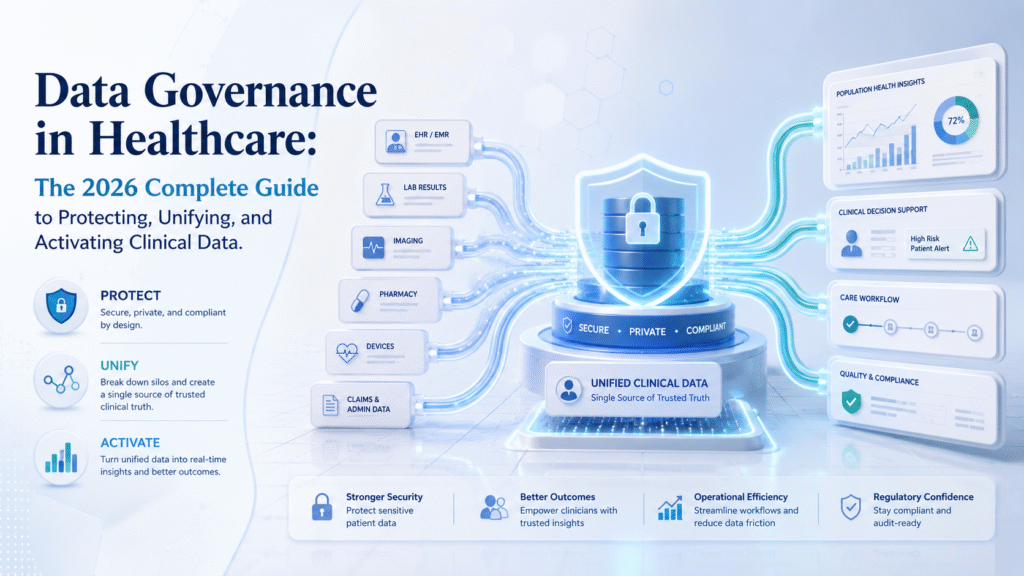
Data governance in healthcare is the discipline that puts a stop to all of it. It’s the operational backbone that determines who can access clinical data, what that data means, how it’s protected, and — critically — how it’s actually used to improve care.
This guide is built for health plan executives, health IT leaders, ACO operators, and clinical workflow architects who are done tolerating data chaos. You’ll get a comprehensive framework, current regulatory context, implementation steps, and actionable strategies to build or mature a governance program that serves both compliance and clinical outcomes.
What Is Data Governance in Healthcare?
Data governance in healthcare is the system of policies, processes, standards, and accountabilities that control how an organization collects, stores, protects, and uses health data across its entire lifecycle — from the moment a patient first interacts with the system to the moment that data informs a population health report five years later.
It is not merely a compliance checkbox. It’s an organizational discipline that touches every data consumer in a health system: clinicians, care managers, coders, analysts, finance teams, and payer operations staff.
At its core, a mature healthcare data governance program answers six foundational questions:
- Who is accountable for each data domain (clinical, financial, operational)?
- What data exists, where does it live, and is it complete?
- When should data be collected, updated, or retired?
- How should data be formatted, coded, and standardized across systems?
- Why is each data element collected — and does its use align with patient consent?
- How well is data actually performing? (quality thresholds, error rates, audit trails)
Think of it this way: Electronic Health Records (EHRs) store data. Interoperability moves data. But data governance determines whether that data is trustworthy enough to act on.
Data Governance vs. Data Management: Know the Difference
This is a distinction that trips up even experienced health IT professionals.
| Data Governance | Data Management | |
|---|---|---|
| Focus | Strategy, policy, accountability, ownership | Execution, operations, infrastructure |
| Who does it | Leadership, data stewards, cross-functional councils | IT, data engineers, analysts |
| Output | Policies, standards, role definitions, audit frameworks | Pipelines, databases, ETL processes, dashboards |
| Cadence | Ongoing, evolving | Project-by-project and operational |
Data governance sets the rules. Data management executes them. Both are essential — but governance must come first.
Why Healthcare Data Governance Is More Urgent Than Ever in 2026
The convergence of four major forces has made data governance a strategic imperative — not a nice-to-have — for every healthcare organization in 2026.
1. The Interoperability Mandate Has Raised the Stakes
CMS’s interoperability and patient access rules have dramatically expanded the flow of health data across payer, provider, and patient boundaries. FHIR-based APIs are now required infrastructure. More data flowing freely means more data that can be misused, misidentified, or corrupted — without strong governance in place.
2. AI Adoption Without Governance Is a Liability
Healthcare AI is proliferating fast. Clinical decision support tools, risk stratification models, prior authorization automation, ambient documentation — all of these consume patient data at scale. Any AI model trained on ungoverned, biased, or incomplete data will produce unsafe outputs. The FDA’s increasing oversight of AI/ML-based Software as a Medical Device (SaMD) means AI governance is now inseparable from clinical governance.
3. CMS V28 HCC Model Changes Demand Cleaner Risk Data
The full transition to the CMS-HCC V28 model for Medicare Advantage (MA) risk adjustment — which began phasing in during 2024 and is now fully implemented — restructured hundreds of Hierarchical Condition Category (HCC) codes. Health plans that lack clean, complete, and auditable diagnosis data are leaving RAF scores on the table and exposing themselves to RADV audit risk. Data governance is the infrastructure that makes V28 compliance sustainable.
4. The $3.7 Trillion Data Quality Problem
A 2023 study published in the Journal of the American Medical Informatics Association estimated that poor data quality costs the U.S. healthcare system approximately $3.7 trillion annually — through unnecessary testing, adverse events, administrative waste, and missed diagnoses. Every dollar of that waste has a data governance failure somewhere in its origin story.
Core Components of a Healthcare Data Governance Framework
A functional healthcare data governance framework isn’t a single tool or policy document. It’s an integrated system made up of six interlocking components.
1. Data Governance Council (Organizational Structure)
This is the decision-making body that owns the governance program. A well-structured council typically includes:
- Chief Data Officer (CDO) or Chief Medical Informatics Officer (CMIO) — executive sponsor
- Data Stewards — department-level owners for clinical, financial, and operational data domains
- Data Custodians — IT personnel responsible for technical implementation
- Privacy and Compliance Officers — HIPAA, state law, and payer contract alignment
- Clinical Representatives — frontline input on workflow impact
Without an empowered, cross-functional council, governance initiatives stall at the policy stage and never reach implementation.
2. Data Dictionary and Metadata Management
A healthcare data dictionary is the authoritative record of every data element your organization collects — its definition, source system, format, allowable values, owner, and usage rules.
Without a shared data dictionary, “diabetes” means something different in your EHR than in your claims system. Your care management platform uses ICD-10-CM Z87.39 while your analytics team pulls on E11.9. Your quality team can’t reconcile the gap — and neither can your auditors.
Metadata management extends this to include data lineage (where did this data come from, and how was it transformed?), which is now a compliance requirement under the 21st Century Cures Act’s information blocking provisions.
3. Data Quality Management
Data quality in healthcare is measured across six dimensions:
| Dimension | Definition | Clinical Example |
|---|---|---|
| Completeness | Are all required fields populated? | Missing smoking status on 34% of patient records |
| Accuracy | Does the data reflect reality? | DOB recorded as 1920 instead of 1992 |
| Consistency | Is the same data consistent across systems? | BMI = 32 in EHR, BMI = 19 in care management platform |
| Timeliness | Is data available when needed? | Discharge diagnoses not coded for 12+ days |
| Validity | Does data conform to defined formats? | Invalid NPI numbers in provider claims data |
| Uniqueness | Are records deduplicated? | Same patient with 7 MPI records across facilities |
High-performing governance programs establish thresholds for each dimension and monitor them continuously — not just during audits.
4. Data Access and Security Controls
Healthcare data governance must define — and enforce — who can see what data, under what circumstances, and with what audit trail. This includes:
- Role-based access controls (RBAC) aligned to job function
- Attribute-based access controls (ABAC) for sensitive data classes (behavioral health, HIV status, substance use disorder records under 42 CFR Part 2)
- Data masking and de-identification protocols for analytics and research use cases
- Audit logging that captures every access, modification, and transmission event
HIPAA’s minimum necessary standard isn’t just a compliance requirement — it’s a data access governance principle.
5. Data Stewardship Program
Data stewardship is the human layer of governance. Data stewards are domain experts — typically senior analysts or clinical informatics staff — who are accountable for the quality, documentation, and appropriate use of data within their domain (e.g., claims data, lab data, ADT feeds, social determinants of health data).
Strong stewardship programs:
- Establish clear ownership for every data domain
- Create escalation paths for data quality issues
- Participate actively in interoperability and integration projects
- Document data lineage as new sources are onboarded
6. Policies, Standards, and Compliance Alignment
A governance framework requires documented, enforced policies covering:
- Data classification (public, internal, confidential, restricted/PHI)
- Data retention and destruction schedules
- Consent management and patient rights under HIPAA and state privacy laws
- Breach response procedures
- Third-party data sharing agreements (BAAs, DUAs)
- Standard code sets — ICD-10, SNOMED CT, LOINC, RxNorm, HL7 FHIR profiles
Key Benefits of Data Governance for Healthcare Organizations
Organizations that invest in mature data governance see returns across every dimension of performance.
Enhance Strategic Decision-Making
When leadership trusts the data, decisions accelerate. A health plan with a governed, unified data environment can identify care gaps in near-real-time, model the impact of benefit design changes on utilization, and respond to CMS audit requests within days — not months. High-quality data doesn’t just reduce risk. It creates competitive advantage.
Drive Operational Efficiency
Poor data quality forces workarounds. Coders manually reconcile claims. Care managers call members whose addresses are three years out of date. IT teams build redundant pipelines because no one trusts the data warehouse. A 2022 Gartner survey found that poor data quality costs organizations an average of $12.9 million per year in operational inefficiency alone. Governance eliminates the root causes of those workarounds.
Boost Financial Performance for Health Plans and ACOs
For Medicare Advantage plans, ACOs, and risk-bearing medical groups, data governance directly impacts the bottom line:
- Accurate risk adjustment requires complete, coded, and auditable diagnosis data — governance makes that possible
- RADV audit readiness depends on documentation integrity governance
- Accurate attribution in value-based contracts requires clean member/patient identity resolution
- Stars quality measures depend on consistent, complete data capture across care settings
Improve Clinical Outcomes and Patient Safety
This is the benefit that matters most. When clinicians can trust that a patient’s medication list is complete, their allergies are current, and their care plan reflects input from every provider involved — they make better decisions. Medication reconciliation errors alone contribute to over 400,000 preventable patient harm events per year in the U.S. Many of those trace directly to ungoverned data.
Maintain Regulatory Compliance
HIPAA, the 21st Century Cures Act, CMS interoperability rules, state-level privacy laws (CCPA, Washington My Health MY Data Act), and Stark Law all create data obligations. A governance framework provides the documented controls and audit trails that demonstrate compliance — and the infrastructure to respond quickly when regulations change.
Manage Risk Effectively
Beyond regulatory risk, healthcare data governance reduces:
- Cybersecurity exposure through access controls and data classification
- Reputational risk from data breaches or information blocking violations
- Operational risk from decisions made on bad data
- Contract risk in value-based arrangements where performance measurement relies on data integrity
Regulatory Compliance and Data Governance
No healthcare data governance discussion is complete without a clear-eyed look at the regulatory landscape in 2026.
HIPAA and the HITECH Act
The foundational U.S. framework for healthcare data privacy and security. Key governance implications:
- The Privacy Rule governs use and disclosure of PHI — governance policies must operationalize minimum necessary and consent requirements
- The Security Rule requires administrative, physical, and technical safeguards — governance provides the administrative and policy layer
- The Breach Notification Rule requires rapid detection and reporting — governance enables the audit logging that makes this possible
- HITECH increased penalties to up to $1.9 million per violation category per year (post-2023 inflation adjustments)
21st Century Cures Act and Information Blocking
Effective since 2021 and with enforcement fully underway, the Cures Act prohibits healthcare actors from engaging in “information blocking” — practices that interfere with the access, exchange, or use of electronic health information (EHI).
Governance is the compliance mechanism. Organizations must be able to demonstrate they have policies and processes — not just technology — that enable appropriate data sharing.
CMS Interoperability and Patient Access Rules
CMS requires Medicare Advantage, Medicaid, CHIP, and Exchange plans to implement Patient Access APIs, Provider Directory APIs, and Payer-to-Payer Data Exchange. Each of these requires governed, standardized FHIR-based data. Organizations without a governance foundation are building APIs on a sand foundation.
42 CFR Part 2 (Substance Use Disorder Records)
Updated in 2024 to align with HIPAA, 42 CFR Part 2 governs the confidentiality of SUD patient records. The key governance challenge: these records require special consent protections that must be tracked and enforced at the data element level — a governance function, not just an IT one.
State Privacy Laws: A Patchwork Growing More Complex
Washington’s My Health MY Data Act, Nevada’s health data provisions, and similar state laws are extending privacy rights to health data outside of HIPAA’s scope (including wellness apps, fitness trackers, and consumer health platforms). Organizations operating across state lines need governance programs flexible enough to accommodate this growing patchwork.
Data Governance Across Key Healthcare Sectors
Healthcare is not a monolith. Data governance challenges — and solutions — look different depending on your organizational model.
Health Plans and Medicare Advantage Organizations
Health plan data governance priorities:
- Member identity resolution across claims, pharmacy, and clinical data sources
- Risk adjustment data governance for HCC coding accuracy and RADV defensibility
- Stars quality measure data — ensuring HEDIS-relevant data is complete and consistent
- Prior authorization data — audit trails and clinical documentation integrity
- Delegated vendor oversight — ensuring downstream data governance obligations are met by IPAs, MSOs, and care management vendors
Accountable Care Organizations (ACOs) and ACO REACH
For ACOs — particularly those participating in ACO REACH — data governance is the foundation of financial performance:
- Attribution accuracy depends on clean provider and patient identity data
- Shared savings calculations require consistent encounter and claims data
- Benchmark and performance year comparisons require historically governed data
- HCC coding for ACO REACH’s benchmark model requires diagnosis data governance equivalent to MA
Medical Groups and IPAs
Often the most under-resourced for formal governance, medical groups face:
- EHR fragmentation — multiple EHR instances across acquired practices with inconsistent coding conventions
- Referral data gaps — specialist encounter data rarely flows back to the primary care record
- Value-based reporting — quality and utilization data for delegated contracts often require data integration that governance makes reliable
Health Systems and IDNs
Large integrated delivery networks govern at scale:
- Enterprise Master Patient Index (EMPI) integrity across dozens of facilities
- Clinical data repositories and enterprise data warehouses
- Research and de-identification governance
- Supply chain and operational data alongside clinical data
Building a Healthcare Data Governance Strategy: 7 Steps
Governance programs fail when they start with technology. They succeed when they start with people, purpose, and priorities.
Step 1: Identify Your Data Governance Priorities
Not all data is equally important to govern first. Prioritize based on:
- Business and clinical risk — what ungoverned data creates the greatest patient safety, financial, or compliance exposure?
- Value-based contract obligations — what data must be reliable for your most important payer relationships?
- Regulatory timelines — what governance gaps create the most imminent compliance risk?
- Quick wins — what governance improvements would create immediate, visible value for data users?
A governance priority matrix that scores data domains by risk × business value will help your council align on where to start.
Step 2: Build a Multidisciplinary Governance Team
Your governance team must include representation from clinical operations, health IT, compliance, finance, and analytics. The single most common governance failure mode is a program that lives entirely in IT — without clinical and operational ownership, policies don’t get adopted, and data stewards don’t have the domain authority to enforce standards.
Designate a Data Governance Lead with dedicated time (this cannot be a 10% of someone’s job initiative at enterprise scale).
Step 3: Appoint and Empower Data Stewards
Identify subject matter experts for each priority data domain:
- Claims data steward — understands EDI 837/835 transactions, diagnosis coding, NCCI edits
- Clinical data steward — EHR data model, clinical terminology standards, documentation workflows
- Member/patient identity steward — EMPI, MPI, address verification, consent management
- Quality data steward — HEDIS technical specifications, measure denominator/numerator logic
- SDOH data steward (increasingly critical) — standardized screening tools, Z-codes, community resource linkage
Stewards must have authority — not just responsibility. They need to be able to flag data quality failures, block problematic data integrations, and escalate to leadership.
Step 4: Standardize Definitions and Metadata
Conduct a data inventory. Document every significant data source: its system of origin, the data model, the refresh cadence, the business owner, the known quality issues, and the downstream consumers.
Then build your data dictionary. Start with the data elements that matter most for your priority use cases. Establish official definitions and defend them — the governance council is the arbiter when there’s disagreement.
This step is where most organizations underinvest. Without a shared vocabulary, every downstream data project becomes a negotiation over definitions.
Step 5: Implement Automated Data Lineage and Observability
Manual data quality monitoring doesn’t scale. Modern governance programs implement data observability tools that automatically monitor:
- Record volume anomalies (a feed that typically delivers 50,000 daily claims suddenly delivers 800 — catch that before anyone builds a report on it)
- Schema drift (an upstream system changes a field format without notification)
- Null rate changes (a previously 2% null field suddenly hits 45% null)
- Duplicate record rates across key identifiers
Data lineage tools provide visual maps of exactly how data flows from source to consumption — essential for root cause analysis when quality issues arise, and increasingly required for regulatory documentation.
Step 6: Invest in Data Management Tools Aligned to Governance Needs
Governance policies need technology infrastructure to enforce them at scale. Key platforms include:
- Healthcare data platforms with native workflow and clinical data unification capabilities
- Master data management (MDM) for patient, provider, and member identity
- Data catalogs for metadata management and data discovery
- Data quality platforms for automated profiling and rule enforcement
- Privacy and access management tools for role-based controls and consent tracking
Look for platforms built specifically for healthcare data complexity — generic enterprise data tools often lack native support for FHIR, HL7, ICD coding hierarchies, and healthcare-specific identity matching.
Step 7: Foster a Culture of Data-Driven Decision Making
Technology and policy alone don’t create data governance maturity. Culture does. Governance leaders who succeed consistently do these things:
- Make data quality visible — publish dashboards that show data quality scores by domain, system, and trend
- Celebrate data stewardship wins — recognize teams that surface and fix data quality issues proactively
- Connect governance to outcomes — show how improved data quality led to better care gap closure rates, higher Stars scores, or cleaner RADV audits
- Train continuously — onboard new employees with data governance basics; provide role-specific training for data producers
- Remove blame from quality conversations — governance programs stall when people fear consequences for surfacing data problems
Common Challenges and How High-Performing Organizations Overcome Them
Challenge 1: Siloed EHR and Claims Data
The average health plan or ACO touches data from 15 to 40+ source systems. Getting those systems to share a common data model is a years-long initiative.
How leading organizations address it: Rather than attempting a full data warehouse rebuild, they implement a clinical data unification layer — a platform that normalizes data from disparate sources into a governed, queryable data model without requiring every source system to change. Incremental integration, governed from day one, beats a “big bang” approach that never launches.
Challenge 2: Physician and Clinical Staff Resistance
Governance initiatives that impose new documentation requirements on already-overloaded clinicians will fail. Period.
How leading organizations address it: They lead with the clinical value proposition — governance that improves the quality of the data clinicians receive, not just the data they produce. Reducing alert fatigue, surfacing complete medication histories, and presenting accurate care gaps at point of care are outcomes that earn clinical buy-in.
Challenge 3: Unclear Ownership and Accountability
“Everyone is responsible” means no one is responsible.
How leading organizations address it: The governance council creates a RACI matrix (Responsible, Accountable, Consulted, Informed) for every governance function and data domain — and reviews it annually. Accountability is built into job descriptions and performance objectives for data stewards.
Challenge 4: Governance That Lives in Documents, Not Processes
Many organizations have governance policies. Far fewer have governance processes — the operational workflows that make policies real.
How leading organizations address it: They embed governance into existing workflows. Data quality reviews happen in existing operational meetings. Steward escalation paths are integrated into existing IT ticketing systems. Governance isn’t a parallel universe — it’s woven into how the organization already operates.
Challenge 5: Vendor Data Complexity
Third-party data vendors, delegated risk entities, and health information exchanges often deliver data in formats, quality levels, and governance standards that differ from internal expectations.
How leading organizations address it: They build governance requirements into vendor contracts, conduct data onboarding assessments before integration, and treat vendor data sources as governed assets from day one — with the same quality monitoring, lineage documentation, and stewardship oversight as internal sources.
Technology’s Role: Platforms, AI, and Automation
Healthcare data governance in 2026 cannot be executed at scale with spreadsheets and email threads. The right technology stack is an enabler — but only when it’s deployed in service of a governance strategy, not as a substitute for one.
Healthcare Data Platforms and Low-Code Clinical Workflow Tools
Purpose-built healthcare data platforms — particularly those with AI-powered data unification and low-code workflow capabilities — are changing what’s possible for mid-market health plans, ACOs, and medical groups that can’t afford 18-month enterprise data warehouse projects.
The most effective platforms:
- Ingest and normalize data from EHRs, claims systems, HIEs, lab feeds, pharmacy data, and SDOH sources
- Apply healthcare-specific terminology standards (FHIR, HL7, SNOMED, LOINC, ICD) natively
- Provide built-in data quality monitoring and alerting
- Offer workflow automation tools that activate governed data — converting insights into care management tasks, gap closure workflows, and risk stratification outputs
- Maintain complete audit trails for compliance
AI and Machine Learning in Governed Data Environments
AI is only as good as the data it learns from. This principle has major governance implications:
- Training data governance — what data was used to train a clinical AI model, was it representative, and was it consented for research use?
- Model performance monitoring — governance programs must track AI model drift and bias over time
- Explainability — for clinical decision support tools, governance requires that the basis for AI recommendations can be documented and audited
Conversely, AI is increasingly being used for governance: automated data quality classification, anomaly detection, duplicate patient record identification, and coding compliance monitoring are all areas where ML is delivering meaningful efficiency gains.
Interoperability Infrastructure: FHIR as a Governance Enabler
FHIR (Fast Healthcare Interoperability Resources) isn’t just a technical standard — it’s a governance infrastructure. When organizations expose and consume FHIR-based APIs, they’re creating standardized data contracts between systems. Governance programs that define FHIR profiles for their key data elements are building governance directly into the interoperability layer.
Data Governance Metrics That Actually Matter
You can’t govern what you don’t measure. These are the KPIs that mature healthcare data governance programs track:
| Metric | What It Measures | Target (Mature Programs) |
|---|---|---|
| Data Completeness Rate | % of required fields populated per domain | >95% for clinical, >98% for claims |
| Duplicate Patient Record Rate | % of records with confirmed duplicates | <0.5% post-EMPI implementation |
| Data Latency | Time from care event to data availability | <24 hours for ADT, <72 hours for claims |
| Issue Resolution Time | Avg. days to resolve flagged data quality issues | <5 business days for P1/P2 issues |
| Stewardship Coverage | % of data domains with designated stewards | 100% of priority domains |
| Policy Acknowledgment Rate | % of relevant staff trained on governance policies | >95% annually |
| Audit Finding Rate | # of governance-related audit findings per quarter | Year-over-year reduction |
| Data Dictionary Coverage | % of critical data elements documented | >90% for tier-1 data elements |
| Access Control Compliance | % of user access rights reviewed on schedule | 100% on annual review cycle |
Report these metrics to your governance council quarterly. Publish a subset to organizational leadership. Nothing accelerates governance maturity faster than visibility.
People Also Ask: Your Top Data Governance Questions Answered
What is data governance in healthcare?
Data governance in healthcare is the framework of policies, processes, standards, roles, and technologies that determines how health data is collected, stored, accessed, protected, and used across an organization. It ensures data is accurate, consistent, secure, and usable — for clinical care, regulatory compliance, financial operations, and population health management.
What are the key components of a healthcare data governance framework?
The core components are: (1) a governance council with defined roles and accountability; (2) a data dictionary and metadata management system; (3) data quality standards and monitoring; (4) access controls and security policies; (5) a data stewardship program with domain-level owners; and (6) documented policies aligned to HIPAA, CMS rules, and applicable state privacy laws.
Why is data governance important in healthcare?
Healthcare data governance is important because ungoverned health data creates direct patient safety risks, compliance exposure, financial losses, and operational inefficiency. With the explosion of data from EHRs, claims, HIEs, wearables, and SDOH sources, organizations that can’t trust their data can’t effectively manage risk, close care gaps, pass audits, or make sound clinical or financial decisions.
What is the difference between data governance and data management in healthcare?
Data governance sets the strategy, policies, standards, and accountability structures for how data should be handled. Data management is the operational and technical execution of those standards — building pipelines, managing databases, running ETL processes. Governance is the “what and why.” Management is the “how.” Both are required, but governance must come first.
How does data governance relate to HIPAA compliance?
HIPAA compliance requires documented policies, administrative safeguards, access controls, audit logging, and breach response capabilities — all of which are core elements of a data governance framework. A mature governance program doesn’t just meet HIPAA requirements; it provides the organizational infrastructure that makes HIPAA compliance sustainable and defensible over time.
What are the biggest challenges in healthcare data governance?
The most common challenges are: siloed source systems with inconsistent data models; lack of clear data ownership and accountability; clinical staff resistance to new documentation requirements; governance policies that exist on paper but aren’t operationalized; and the complexity of governing third-party and vendor data sources. Successful programs address all of these by connecting governance to clinical and business value — not just compliance.
How does data governance support value-based care?
Value-based care performance depends entirely on data quality. Accurate risk stratification, care gap identification, attribution, quality measure calculation, and shared savings calculations all require governed, complete, and consistent data. Organizations participating in Medicare Advantage, ACO REACH, or delegated risk arrangements that invest in governance outperform their peers in financial and clinical outcomes because they can trust their data enough to act on it.
What role does AI play in healthcare data governance?
AI serves two roles in governance. First, AI needs governance — machine learning models trained on ungoverned data produce unreliable, potentially unsafe outputs. Governance programs must address AI training data quality, model performance monitoring, and explainability. Second, AI enables governance — automated data quality monitoring, duplicate detection, coding compliance review, and anomaly detection all benefit from ML-powered tools that scale governance capabilities without scaling headcount.
How do you measure the success of a healthcare data governance program?
Measure success through metrics like data completeness rates by domain, duplicate patient record rates, data latency from care event to availability, issue resolution time, data dictionary coverage, audit finding rates, and stewardship coverage. Track trends quarterly. The most compelling success metric is connecting improved data quality to tangible outcomes — better RADV audit performance, higher Stars scores, reduced care gap rates, or faster response to compliance requests.
How long does it take to implement healthcare data governance?
A foundational governance program — council in place, priority domains covered, stewards designated, and basic quality monitoring running — can be stood up in 90 to 180 days with strong executive sponsorship. A mature enterprise program covering all data domains, automated quality monitoring, full metadata documentation, and a governed AI layer typically takes 18 to 36 months to build. Most organizations achieve meaningful ROI within the first year by focusing governance on their highest-value use cases first.
Final Thoughts: Data Governance Is Your Most Strategic Investment in 2026
Every healthcare organization is sitting on a data problem that’s costing them more than they realize — in compliance risk, clinical outcomes, financial performance, and operational efficiency. The solution isn’t more data. It’s governed data.
The organizations winning in value-based care, navigating CMS model changes with confidence, and scaling AI without fear are the ones that built a data governance foundation before they needed it. Not after a breach. Not after a failed audit. Not after a costly wrong decision.
Healthcare data governance isn’t a destination. It’s an operating model. And the organizations that treat it that way — with dedicated leadership, cross-functional accountability, the right technology, and a relentless focus on data quality — are the ones that will define what excellent care and excellent performance look like in the decade ahead.
Turn Data Governance Into a Competitive Advantage With Curitics Health
Curitics Health is an AI-powered, low-code clinical workflow and data unification platform purpose-built for health plans, ACOs, MSOs, and medical groups. We help healthcare organizations govern, unify, and activate their clinical and claims data — without the 18-month enterprise data project.
What Curitics delivers:
- Unified patient and member data across disparate EHR, claims, and SDOH sources
- Built-in data quality monitoring and governance-ready audit trails
- Low-code workflow automation that turns governed data into care management action
- FHIR-native interoperability with HL7, SNOMED CT, LOINC, ICD-10 support
- Risk adjustment and Stars quality data readiness for CMS V28 and HEDIS reporting
Whether you’re standing up your first governance program or maturing a complex enterprise data environment, Curitics is built to accelerate your journey.
Schedule a Curitics Health Platform Demo – https://curiticshealth.com/demo