AI medical scribes can help turn clinical conversations into draft documentation. For healthcare organizations, the purchasing decision depends on how reliably a tool supports the entire documentation workflow from capturing the encounter to producing a reviewed, accurate note in the electronic health record.
A useful comparison measures clinical accuracy, clinician effort, integration, privacy, patient experience and total cost together.
The U.S. Government Accountability Office identifies potential benefits from AI documentation tools while highlighting uncertainty around accuracy, billing effects and healthcare spending. Those questions make a structured local evaluation essential.
Start by defining the work the tool must perform
“AI medical scribe” can describe several capabilities. Before comparing vendors, document exactly what your organization needs:
- Ambient capture of patient-clinician conversations.
- Dictation and transcription.
- Drafting specialty-specific notes or letters.
- Incorporating relevant information from the existing chart.
- Producing patient instructions.
- Suggesting diagnoses, billing codes or orders.
Evaluate each enabled function separately. A product’s ability to draft a useful progress note does not establish the accuracy of its coding suggestions or order-entry features.
Define the initial setting as well. An outpatient consultation, inpatient progress note and emergency department encounter involve different workflows.
The American Medical Association’s evaluation framework emphasizes the clinical use case, relevant validation data, risks, effectiveness, workflow integration and ongoing monitoring.
Use a consistent comparison framework
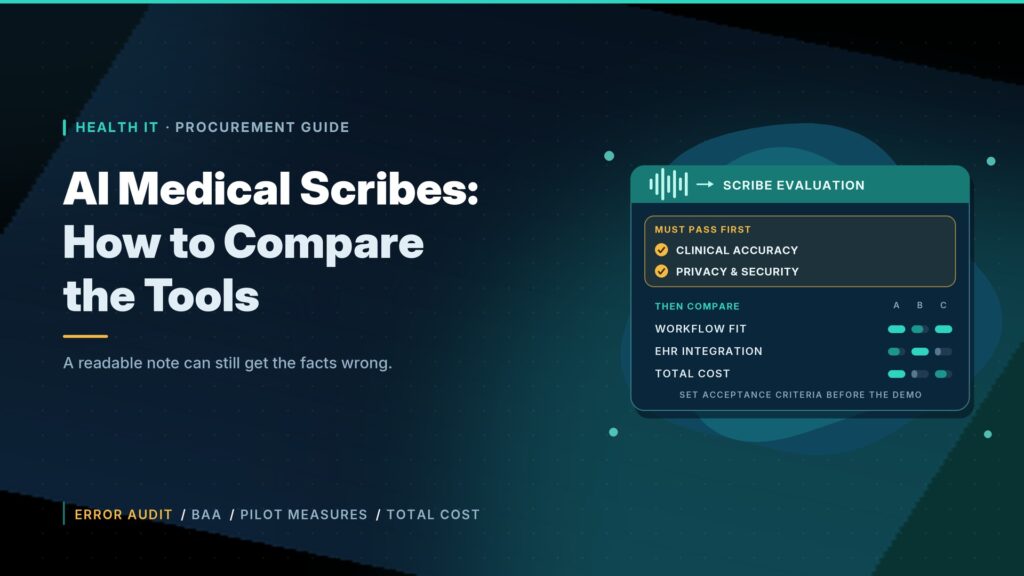
The following table provides a practical starting point for procurement discussions. Set acceptance criteria before reviewing demonstrations or pilot results.
| Comparison area | Questions to ask | Evidence to request |
|---|---|---|
| Clinical accuracy | Does the note preserve facts, uncertainty, medication details and the intended plan? | Specialty-relevant testing and an error audit |
| Workflow fit | How much work remains before the clinician can sign? | Observed review, editing and transfer time |
| EHR integration | Where does information appear, and what remains manual? | A demonstration using your actual configuration |
| Patient experience | How are recording, disclosure and patient preferences handled? | Patient-facing explanations and a fallback workflow |
| Privacy and security | Who processes the information, for what purposes and for how long? | Data-flow documentation, contractual terms and security evidence |
| Reliability and support | What happens during failed recordings, downtime or delayed notes? | Incident procedures and service commitments |
| Total cost | What will implementation and sustained use cost? | An itemized commercial proposal |
| Monitoring and updates | How will performance changes be detected? | Version information, monitoring processes and change notifications |
Treat essential privacy, security and clinical-safety requirements as conditions for selection before comparing convenience or price.
Evaluate note accuracy against the encounter
A note can be readable and well organized while still containing clinically important errors.
A September 2026 exploratory study compared three ambient scribe systems using two simulated encounters. Clinician preferences did not align with the lowest independently audited error counts. Its small sample limits generalization, but it illustrates the value of evaluating readability and factual correctness separately.
Build test cases that reflect your clinical environment. Include medication changes, multiple problems, uncertain diagnoses, caregiver participation, interpreters and interruptions where relevant.
Review for:
- Omissions: Important findings or follow-up instructions are missing.
- Unsupported additions: The note contains an examination finding, diagnosis or action absent from the encounter.
- Incorrect attribution: A caregiver’s history becomes the patient’s history.
- Changed meaning: A possibility becomes a confirmed diagnosis, or a conditional plan becomes a completed action.
For example, “We may consider imaging if symptoms persist” should retain that conditional meaning. It should not become documentation that imaging was ordered.
Record error severity as well as frequency. Formatting corrections and an incorrect medication instruction have different implications. Keep clinician review and approval central to the workflow.
Measure the complete documentation process
A tool may generate a draft quickly while leaving substantial work for the clinician.
During testing, measure the time needed to:
- Start and manage capture.
- Review the generated note.
- Correct inaccuracies and omissions.
- Transfer information into the appropriate EHR locations.
- Complete and sign the documentation.
Assess clinician experience alongside objective workflow measures.
A 2026 randomized crossover trial involving 160 outpatient clinicians found improvements in satisfaction and personal and work-related burnout relative to baseline. However, it did not find statistically meaningful improvements in several after-hours EHR measures. The study involved volunteers at one academic health system, which limits how broadly its findings apply.
These results support measuring satisfaction, documentation time and after-hours work separately.
Check what EHR integration actually includes
Ask the vendor to demonstrate the complete workflow in your organization’s environment.
Confirm how the tool identifies the correct patient and encounter, accesses chart context, places draft content, preserves edits and records who approved the final note.
Also establish whether information reaches:
- A narrative note.
- Structured medication or problem-list fields.
- Draft orders.
- Patient instructions.
- Coding workflows.
These are separate capabilities. Confirm which functions are available under the proposed contract and which require additional implementation work.
Test what happens when the chart changes during the encounter or when a clinician edits the draft outside the scribe application. Include downtime and recovery procedures in the evaluation.
Our guide to EMR vs EHR and clinical information exchange provides background on the systems involved.
Examine the entire patient-data pathway
For cloud-based services that create, receive, maintain or transmit electronic protected health information on a covered entity’s behalf, HHS explains that the provider is generally a business associate. The relationship requires an appropriate business associate agreement, alongside the organization’s other HIPAA obligations.
A BAA should be part of the evaluation together with the actual technical configuration and risk analysis.
Request clear answers about:
- Retention of audio, transcripts, drafts and final notes.
- Access by vendor employees and human reviewers.
- Third-party models and other subprocessors.
- Processing locations.
- Use of information for training, evaluation or product improvement.
- Deletion, export and contract termination.
- Incident reporting and investigation support.
Document the permitted uses rather than relying on general assurances about data ownership. The Health Sector Coordinating Council’s third-party AI guide provides a useful framework for examining these relationships.
HHS also states that it does not endorse private organizations’ HIPAA Security Rule certifications. Such certification does not remove a covered entity’s obligations. HHS clarification on certification.
Build patient communication into the workflow
Establish a disclosure and consent process that meets applicable requirements. Have privacy and legal teams confirm the approach for relevant care settings and recording practices.
Patients should receive an understandable explanation of what the tool does, what information it captures and how their preferences will be handled. Provide a workable documentation alternative when patients decline its use.
The American Psychological Association’s scribe guidance emphasizes informed-consent processes, data handling and review of generated documentation before signing. Its recommendations are tailored to psychological practice and offer useful questions for other organizations to investigate within their own settings. APA guidance for evaluating AI scribes.
Run a pilot with defined measures
Begin with approved synthetic encounters for controlled comparisons. Use the same scenarios across shortlisted products and, where practical, have reviewers assess notes without knowing which system produced them.
Then evaluate real workflows under approved data-handling and patient-communication arrangements. Include clinicians with different specialties, documentation habits and levels of technical confidence.
| Pilot measure | What to record |
|---|---|
| Clinical quality | Errors, omissions and unsupported statements, classified by severity |
| Documentation effort | Time spent reviewing, correcting, transferring and signing |
| After-hours work | EHR activity outside scheduled hours, using a consistent definition |
| Adoption | Use among eligible encounters and reasons for nonuse |
| Patient experience | Questions, concerns, preferences and complaints |
| Operational performance | Failed captures, delayed drafts, integration problems and support requests |
Establish the baseline, denominators and decision thresholds in advance. Record the product version and configuration being tested.
Compare total cost and usable time savings
Request pricing that includes implementation, EHR interfaces, devices, training, support, internal administration and ongoing quality review.
Two useful calculations are:
Cost per completed AI-assisted note = total program cost ÷ completed AI-assisted notes
Net documentation time saved = baseline documentation time − total time required with the AI workflow
Use actual pilot utilization when estimating costs.
As an illustration, saving two minutes across 20 encounters on 18 clinic days would recover 12 hours per clinician per month. That is a calculation, not an expected performance benchmark.
Whether recovered time produces financial savings depends on how it is used. Reduced overtime, improved working conditions and additional appointment capacity are distinct outcomes.
Evaluate billing effects separately. A longer note or more suggested diagnoses does not establish that a higher-level claim is supported.
Plan for performance after deployment
Assign responsibility for clinical quality, privacy, technical support and vendor management.
Continue reviewing a sample of notes, investigating reported errors and checking performance after significant product updates. Define when a problem requires corrective action, restricted use or temporary suspension.
Maintain a fallback documentation process and preserve access to necessary records when changing suppliers. The Health Sector Coordinating Council guide addresses monitoring, incident response and transition planning across the AI vendor lifecycle.
For broader implementation planning, see our guide to digital transformation in healthcare.