Imagine running a health plan where you consistently underestimate how sick your members actually are. Your capitation payments come in lean. Your care management teams are overwhelmed — reactive instead of proactive. And your quality metrics quietly erode, quarter after quarter.
This isn’t a hypothetical. It’s the lived reality for hundreds of health plans, Accountable Care Organizations (ACOs), and risk-bearing provider groups that haven’t yet optimized their risk adjustment strategy.
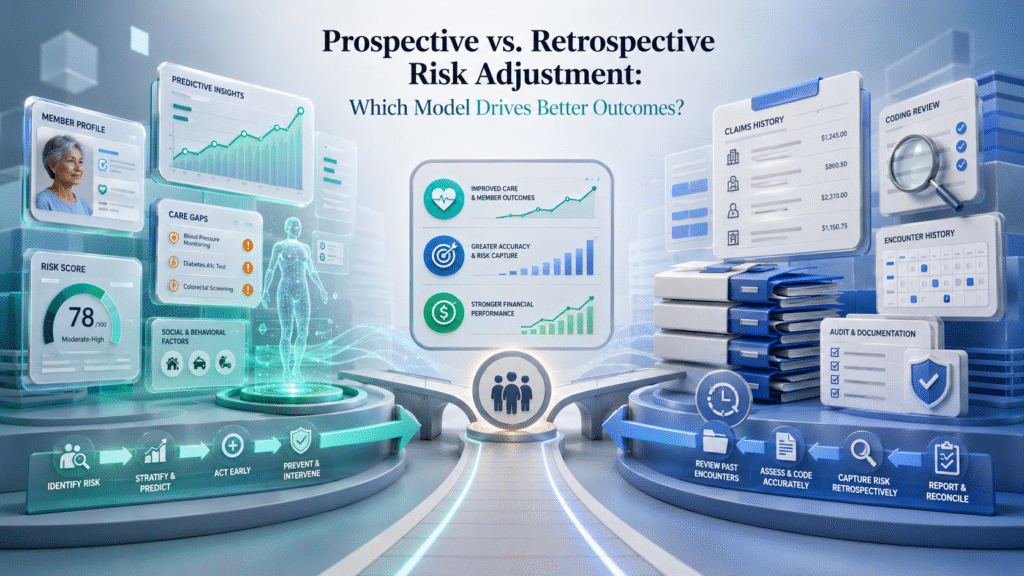
At the heart of this challenge sits one of the most consequential decisions in value-based care: Should you use a prospective risk adjustment model, a retrospective one, or a thoughtful combination of both?
The answer isn’t always obvious. Both approaches have a place in modern healthcare — but confusing one for the other, or leaning too heavily on just one, creates blind spots that cost organizations millions of dollars annually and, more importantly, leave high-risk patients without the care they need.
This guide breaks it all down. You’ll walk away understanding exactly how each model works, where each falls short, what the data says about ROI, and how leading healthcare organizations in 2025 are using intelligent clinical workflow platforms to get the best of both worlds.
What Is Risk Adjustment in Healthcare?
Before we compare the two models head-to-head, let’s anchor on what risk adjustment actually does.
Risk adjustment is a statistical process used in healthcare to account for the differences in health status across patient populations. It ensures that payers and providers are compensated fairly based on the actual clinical complexity of the people they serve – not just headcount.
Under value-based care models like Medicare Advantage, ACO REACH, and Medicaid managed care, risk scores directly influence:
- Capitation payments paid to health plans and provider organizations
- Quality benchmarks and performance expectations
- Care management resource allocation
- Financial risk corridors in shared savings programs
The most commonly used risk adjustment framework in the U.S. is CMS’s Hierarchical Condition Category (HCC) model, which assigns numeric risk scores to patients based on their diagnosed chronic conditions. The average Medicare Advantage enrollee has a risk score around 1.0, with higher scores representing greater predicted healthcare costs.
The problem? That score is only as accurate as the data feeding it and that’s where the choice between prospective and retrospective approaches becomes critical.
What Is Prospective Risk Adjustment?
Prospective risk adjustment is a forward-looking model. It uses a patient’s historical health data – diagnoses, claims, clinical records, labs, pharmacy data to predict their likely healthcare needs and costs in a future period (typically the next plan year).
In simple terms: you’re building a risk profile before the care is delivered.
How Prospective Risk Adjustment Works
- Data aggregation — Clinical and claims data from the prior 12–24 months is compiled for each member.
- HCC mapping and risk scoring — Diagnoses are mapped to HCC codes, and a composite risk score is calculated.
- Gap identification — Conditions that are likely to be present based on clinical signals but haven’t been recently documented are flagged as “suspected” or “presumed” diagnoses.
- Outreach and care planning — Patients with high or rising risk scores are proactively enrolled in care management programs before they deteriorate.
- Coding capture at the point of care — Providers are prompted to document relevant diagnoses during visits, ensuring the risk score is accurate for the upcoming payment period.
Key Characteristics of Prospective Risk Adjustment
- Timing: Applied before the service period
- Primary goal: Predict cost and utilization; drive proactive care delivery
- Data source: Historical claims, EHR data, prior-year HCC hierarchies
- Use case: Medicare Advantage plan bidding, ACO care gap closure, population health management
- Primary stakeholders: Health plans, risk-bearing provider groups, population health teams
The Real Advantage: Prevention Over Reaction
The clearest clinical win of prospective risk adjustment is what it enables before a patient has a crisis. A member with poorly controlled Type 2 diabetes and early-stage chronic kidney disease (CKD) may not have generated high costs yet but their risk trajectory is unmistakable. A prospective model catches that patient now, enabling medication reconciliation, nutritional counseling, and nephrology referrals that may prevent a hospitalization that would have cost $40,000 or more.
According to a 2024 JAMA Health Forum analysis, prospective care management programs targeting high-risk patients identified through predictive risk stratification reduced 30-day readmission rates by up to 18% in Medicare Advantage populations.
What is Retrospective Risk Adjustment?
Retrospective risk adjustment is a backward-looking model. It reconciles a patient’s actual diagnoses and resource utilization after services have been delivered, typically at the end of a plan year or contract period.
In simple terms: you’re correcting the risk score after the care has already happened.
How Retrospective Risk Adjustment Works
- Claim submission and diagnosis collection — All medical claims and encounter data from the service period are compiled.
- Risk score reconciliation — Final HCC risk scores are calculated based on documented diagnoses from that year.
- Risk adjustment data validation (RADV) and submission — Final diagnosis codes are submitted to CMS or the relevant payer for reconciliation.
- Retrospective chart reviews — Medical records are audited to identify diagnoses that were treated but not coded, allowing organizations to submit addendum or corrected claims.
- Financial settlement — Payments are adjusted up or down based on the difference between the preliminary prospective payment and the final risk score.
Key Characteristics of Retrospective Risk Adjustment
- Timing: Applied after the service period
- Primary goal: Accurate payment reconciliation; capture all documented diagnoses
- Data source: Final claims data, medical record reviews, encounter data
- Use case: RADV audits, MA plan reconciliation, provider contract settlements
- Primary stakeholders: Health plan finance teams, revenue cycle management, compliance officers
The Real Advantage: Accuracy and Completeness
Prospective models are predictive — they’re educated guesses. Retrospective models are definitive – they reflect what actually happened. For a health plan managing $500 million in premium revenue, a 0.05 improvement in average HCC risk score across 100,000 members can mean tens of millions of dollars in additional premium revenue but only if diagnoses were properly documented and submitted.
A 2023 Government Accountability Office (GAO) report found that Medicare Advantage plans received approximately $75 billion in risk-adjusted payments that year, with CMS estimating that at least 10% of those payments were associated with diagnoses that couldn’t be validated through medical records – underscoring the critical importance of getting retrospective accuracy right.
Prospective vs. Retrospective Risk Adjustment: Side-by-Side Comparison
| Feature | Prospective Risk Adjustment | Retrospective Risk Adjustment |
|---|---|---|
| Timing | Before the service period | After the service period |
| Primary Purpose | Predict risk; drive proactive care | Reconcile payments; capture all diagnoses |
| Data Used | Historical claims, prior HCCs, EHR signals | Final claims, encounter data, chart reviews |
| Clinical Impact | High — drives care management outreach | Lower — care has already occurred |
| Financial Impact | Enables accurate capitation bidding | Corrects underpayment/overpayment |
| Risk of Error | Overestimating future risk | Missing documented diagnoses |
| Regulatory Focus | CMS risk score trending | RADV audit exposure |
| Best For | Population health, ACO REACH, MA bidding | Revenue cycle, compliance, financial close |
| Technology Need | Predictive analytics, NLP, gap workflows | Chart review platforms, coding tools |
Why Prospective Risk Adjustment Is Gaining Traction in 2025
The industry shift toward value-based care has dramatically elevated the strategic importance of prospective risk adjustment. Here’s why organizations are leaning in:
1. CMS Is Tightening Retrospective Audit Exposure
CMS’s expanded Risk Adjustment Data Validation (RADV) audit program – finalized with broader extrapolation rules in 2023 means health plans can no longer rely on aggressive retrospective coding to make up for poor prospective accuracy. The financial risk of an adverse RADV audit finding has increased significantly, pushing plans to get their risk scores right before the year begins.
2. Value-Based Care Contracts Reward Proactive Outreach
Under ACO REACH and similar programs, prospective care gap closure directly impacts quality scores and shared savings calculations. Organizations that can identify a patient with undiagnosed depression, uncontrolled hypertension, or a lapsed annual wellness visit before a costly event and actually close that gap – outperform peers on both quality and financial metrics.
3. AI and NLP Are Making Prospective Models Far More Accurate
The single biggest historical limitation of prospective risk adjustment was data quality. If a patient’s chronic kidney disease was documented in a specialist’s notes but never made it into the claims system, the prospective model couldn’t see it.
Today, AI-powered clinical data unification platforms can ingest unstructured notes, lab results, pharmacy records, and social determinants of health (SDOH) data and surface suspected diagnoses with high accuracy. This closes the gap between what the prospective model predicts and what the patient actually has.
According to a 2024 Health Affairs study, AI-assisted HCC gap closure programs identified an average of 1.8 additional actionable diagnoses per member compared to claims-only prospective models – a meaningful lift in both clinical accuracy and risk score completeness.
4. Provider Engagement Starts with Prospective Signals
When a care coordinator walks into a patient encounter armed with a prospective risk flag – “this patient likely has CKD Stage 3 based on their creatinine trend” – it transforms the clinical conversation. Prospective data enables point-of-care decision support that retrospective models simply can’t replicate.
The Limitations of Prospective Risk Adjustment (And Why Retrospective Still Matters)
Prospective models aren’t infallible. Here’s where they fall short and why retrospective processes remain essential:
Prediction ≠ Reality
A prospective model predicts that a member will have high costs. Sometimes they don’t – the patient moves, gets better, or simply doesn’t utilize services as expected. Without retrospective reconciliation, payers may overpay for years on members whose health status has materially improved.
Prospective Coding Can Miss New Diagnoses
A patient may develop a new condition during the plan year that wasn’t predictable from prior data – a cancer diagnosis, a traumatic injury, new-onset heart failure. Retrospective processes catch these and ensure they’re reflected in final risk scores.
Compliance Risk Without Retrospective Validation
Prospective coding programs that aren’t validated against clinical documentation create RADV audit exposure. Every prospective diagnosis flag should eventually be confirmed by a documented clinical encounter — and retrospective chart review is how you verify that.
Risk Adjustment ROI: What the Data Actually Shows
Let’s talk dollars. Because at the end of the day, finance leaders and C-suite executives need to understand the financial case for investing in risk adjustment infrastructure.
Prospective Risk Adjustment ROI
- Medicare Advantage organizations with mature prospective HCC programs report average risk score improvements of 0.08–0.15 HCC RAF points per member per year through systematic gap closure.
- On a typical MA plan with a $12,000 annual premium per member, a 0.10 RAF improvement translates to approximately $1,200 per member in additional premium revenue.
- For a plan with 50,000 members, that’s $60 million in incremental revenue – from better documentation and care management alone.
Retrospective Risk Adjustment ROI
- Retrospective chart review programs typically recover $200–$600 per member in previously undocumented diagnoses.
- Organizations with robust retrospective coding programs report 3–8x ROI on chart review investments, depending on population complexity and prior coding accuracy.
- Conversely, organizations that over-code retrospectively face CMS repayments. The average RADV audit extrapolation has resulted in repayment demands ranging from $1 million to $200 million for larger plans.
The Blended Approach Wins
Organizations that integrate both models — using prospective analytics to drive care management AND retrospective processes to validate and reconcile — consistently outperform single-model approaches. A 2024 Advisory Board analysis of 47 Medicare Advantage plans found that plans using integrated prospective + retrospective risk adjustment strategies achieved 22% higher risk-adjusted revenue accuracy than those relying primarily on retrospective reconciliation.
Best Practices for Blending Prospective and Retrospective Risk Adjustment
Leading healthcare organizations in 2025 don’t think of these as competing models. They think of them as two engines in the same airplane. Here’s how to run both effectively:
Build a Unified Clinical Data Foundation
You can’t run effective risk adjustment – prospective or retrospective – without clean, unified clinical data. That means:
- Breaking down silos between EHR systems (Epic, Cerner, athenahealth), claims data, pharmacy records, and lab data
- Implementing FHIR-compliant APIs for real-time data exchange
- Using NLP to extract diagnoses from unstructured clinical notes
- Applying SDOH data to identify patients at risk of care gaps due to social barriers
Stratify Your Population — Don’t Chase Everyone
Not every patient needs intensive risk adjustment outreach. A tiered approach works best:
- Tier 1 (High-risk, high-gap): Patients with high prospective risk scores AND documented HCC gaps — prioritize for care management outreach and face-to-face encounters
- Tier 2 (Rising-risk): Patients with clinical signals suggesting emerging conditions — prioritize for annual wellness visits and preventive screenings
- Tier 3 (Stable): Patients with complete, accurate documentation — focus on maintenance and HEDIS quality measures
Embed Risk Adjustment into Clinical Workflows
Risk adjustment fails when it’s treated as a back-office finance function. The most successful programs embed gap alerts, HCC flags, and coding prompts directly into the clinical workflow — surfacing the right information to the right provider at the point of care, not months later during a chart review.
Continuous feedback loops matter: Providers who see how their documentation quality affects patient care plans — not just revenue — engage more consistently.
Automate Retrospective Chart Review – Strategically
Not all charts need manual review. AI-powered coding platforms can pre-prioritize records with the highest likelihood of containing undocumented HCCs, dramatically improving efficiency. Organizations using AI-assisted chart review report 40–60% reductions in cost per chart reviewed compared to traditional manual programs.
Validate, Validate, Validate
Every prospective diagnosis flag must be anchored to a documented clinical encounter before submission. Build audit-ready documentation into your workflows from the start — don’t wait for a RADV notice to find out your prospective coding program wasn’t clinically supported.
How Low-Code Clinical Workflow Automation Transforms Risk Adjustment
One of the most significant operational challenges in risk adjustment isn’t the analytics – it’s the execution. Identifying a patient with a suspected HCC gap is step one. Getting that flag to the right provider, ensuring it’s addressed in the right encounter, confirming the documentation meets CMS requirements, and closing the loop in real time — that’s where most organizations break down.
This is where low-code clinical workflow automation platforms are changing the game.
Modern platforms enable healthcare organizations to:
- Configure custom risk adjustment workflows without engineering teams — a care coordination team can build a prospective HCC gap outreach workflow in days, not months
- Unify data from disparate sources — pulling EHR, claims, labs, and pharmacy data into a single actionable view without expensive point-to-point integrations
- Trigger automated outreach based on risk score thresholds — scheduling calls, sending patient reminders, or alerting care managers when a high-risk patient misses an appointment
- Track gap closure in real time — providing management dashboards that show which HCC gaps are open, which providers are addressing them, and what’s still outstanding before the coding submission deadline
- Support retrospective validation — automatically flagging submitted HCCs that lack supporting documentation, reducing RADV audit exposure proactively
The result is a risk adjustment program that’s not just analytically sophisticated – it’s operationally executable at scale.
Turning Insight Into Action: A Risk Adjustment Workflow Example
Here’s how a mature prospective + retrospective workflow looks in practice:
Step 1 — September (Q3): AI model runs across the full Medicare Advantage population, generating prospective risk scores and flagging HCC gaps for the upcoming contract year. A patient with hypertensive heart disease and Type 2 diabetes is flagged for a suspected CKD Stage 3 gap based on lab trends.
Step 2 — October: An automated outreach workflow schedules an AWV (Annual Wellness Visit) for the flagged patient. The primary care provider receives a pre-visit summary highlighting the suspected CKD gap and prompting a creatinine review.
Step 3 — November (visit): The provider reviews labs, confirms CKD Stage 3, documents the diagnosis in the EHR, and submits an ICD-10 code (N18.3). The workflow automatically marks the gap as closed and logs the encounter for compliance review.
Step 4 — January (new contract year): The confirmed CKD diagnosis flows into the prospective risk score, improving the patient’s RAF from 1.42 to 1.68 — reflecting their true clinical complexity and triggering enhanced care management resources.
Step 5 — Q3 of the following year: Retrospective reconciliation confirms all HCCs submitted match documented clinical encounters. The risk score holds up in RADV review. No repayment required.
This isn’t a theoretical ideal. It’s the operational reality for organizations that have invested in unified clinical data infrastructure and intelligent workflow automation.
Common Risk Adjustment Mistakes to Avoid
Even sophisticated organizations make these errors:
1. Treating prospective and retrospective as separate programs. They should be integrated. Retrospective validation should inform prospective model calibration every year.
2. Coding without clinical support. Submitting HCC codes that aren’t backed by a documented face-to-face diagnosis encounter is the #1 RADV audit trigger. Every code needs a clinical anchor.
3. Ignoring SDOH in risk stratification. A patient with poorly controlled diabetes who lacks transportation to clinic visits has a very different risk profile than a clinically similar patient with good access to care. SDOH-adjusted prospective models predict utilization more accurately.
4. Running chart reviews too late. Many organizations run retrospective reviews in Q4, after the coding submission window has narrowed significantly. Best-in-class programs run continuous retrospective monitoring throughout the year.
5. Under-investing in provider education. HCC coding accuracy is ultimately a clinical documentation problem. Providers who understand why accurate diagnosis coding matters for their patients’ care plans, not just for revenue – document more completely and consistently.
Frequently Asked Questions
What is the main difference between prospective and retrospective risk adjustment?
Prospective risk adjustment uses historical data to predict a patient’s future health needs and risk score before a service period begins. Retrospective risk adjustment reconciles actual diagnoses and costs after services have been delivered. Both are used in value-based care, but they serve different purposes – prospective drives proactive care, while retrospective ensures payment accuracy.
Which type of risk adjustment is better for Medicare Advantage plans?
Most high-performing Medicare Advantage plans use both. Prospective models drive care management strategy and capitation bidding accuracy. Retrospective processes validate documentation and reconcile final risk scores. Plans that rely exclusively on retrospective reconciliation miss significant opportunities for proactive care — and face greater RADV audit exposure.
How does HCC coding relate to risk adjustment?
HCC (Hierarchical Condition Category) coding is the primary mechanism through which risk adjustment scores are calculated in Medicare Advantage and similar programs. Each HCC represents a cluster of clinically similar, cost-predictive diagnoses. Accurate HCC coding – both prospective (predicted) and retrospective (documented) — directly determines a health plan’s risk-adjusted premium revenue.
What is RADV, and why does it matter?
RADV (Risk Adjustment Data Validation) is CMS’s audit program to verify that Medicare Advantage plans’ risk-adjusted payments are supported by medical record documentation. Under expanded RADV rules effective in 2023, audit findings can be extrapolated across an entire plan, creating significant financial exposure. Robust retrospective validation processes are essential for RADV compliance.
Can AI improve risk adjustment accuracy?
Yes, significantly. AI and NLP tools can identify suspected HCC diagnoses from unstructured clinical notes, lab trends, and pharmacy data that traditional claims-based models miss. AI-powered chart review tools also prioritize records with the highest likelihood of containing undocumented diagnoses, reducing cost per chart reviewed while improving capture rates. In 2024, health plans using AI-assisted prospective HCC programs reported up to 1.8 additional actionable diagnoses per member compared to claims-only approaches.
How does risk adjustment affect provider reimbursement in ACOs?
In ACO models like ACO REACH, risk adjustment directly influences the benchmark against which shared savings are calculated. A more accurate prospective risk score means a more appropriate benchmark – one that reflects your population’s true complexity. ACOs with systematically higher risk scores (due to better documentation, not sicker patients) are often unfairly benchmarked against lower risk scores, eroding their shared savings potential. Getting prospective risk adjustment right is essential for ACO financial sustainability.
What’s the difference between prospective and concurrent risk adjustment?
Concurrent risk adjustment uses diagnoses from the current year to set risk scores for the current year rather than using prior-year data (prospective) or post-year data (retrospective). It’s less common in commercial applications but used in some Medicaid managed care markets. It’s generally considered more accurate than purely prospective models but requires real-time data infrastructure.
How often should risk adjustment models be recalibrated?
Best practice is annual model recalibration, with quarterly monitoring of risk score trends. Organizations should also recalibrate whenever there are significant changes in their population (new market entry, major benefit changes), CMS model updates (CMS updates its HCC model periodically), or significant shifts in care utilization patterns (as seen during and after COVID-19).
The Bottom Line: An Integrated Approach Is the New Standard
The debate between prospective and retrospective risk adjustment is a false choice. The answer is both but with strategic clarity about what each model does, when to apply it, and how to operationalize it at scale.
Prospective risk adjustment is your clinical strategy engine: it drives care management, informs population health priorities, and ensures your highest-risk members get attention before they crash. Retrospective risk adjustment is your financial accuracy engine: it ensures your documentation supports your claims, protects you from RADV exposure, and corrects for what prospective models can’t predict.
The organizations pulling ahead in value-based care aren’t better at analytics. They’re better at turning analytics into action and that requires clinical workflow infrastructure that connects risk scores directly to care delivery, provider engagement, and documentation capture in real time.
Ready to Transform Your Risk Adjustment Strategy?
Whether you’re a Medicare Advantage plan looking to improve HCC capture rates, a risk-bearing provider group navigating ACO REACH, or a health system building value-based care competencies, the foundation is the same: unified clinical data, intelligent workflows, and a platform that makes risk adjustment something your care teams can actually execute on.
See how Curitics Health’s AI-powered low-code clinical workflow platform connects risk scores to real-time care delivery: https://curiticshealth.com/demo