Imagine a surgeon finishing a complex procedure and, instead of spending the next 45 minutes entering notes into an EHR system, simply speaks: “Post-op findings: no complications, patient stable, proceed with standard recovery protocol.” Within seconds, a complete, structured clinical note is generated, coded, and filed.
That’s not a vision of the future anymore. That’s Tuesday.
Voice recognition in healthcare has quietly become one of the most impactful technologies reshaping clinical workflows, patient documentation, and care delivery across the United States. What started as rudimentary dictation software has evolved into an AI-powered, clinically intelligent layer that sits between providers and the mountains of administrative work threatening to drown modern medicine.
In this guide, we’ll break down where the technology stands today, where it’s headed, and most importantly why it matters for your organization.
What Is Voice Recognition Technology in Healthcare?
Healthcare voice recognition technology (also called clinical speech recognition or medical voice-to-text) uses artificial intelligence and natural language processing (NLP) to convert spoken language into structured clinical data. Unlike consumer voice assistants (think Siri or Alexa), healthcare-grade speech recognition is trained on medical terminology, ICD codes, SNOMED CT, and specialty-specific clinical language.
Modern systems go well beyond simple transcription. Today’s platforms can:
- Interpret clinical intent — distinguishing “the patient denies chest pain” from “the patient reports chest pain”
- Auto-populate EHR fields — mapping spoken phrases directly into structured data fields
- Trigger workflow actions — ordering labs, scheduling follow-ups, or flagging risk alerts based on spoken commands
- Learn provider-specific speech patterns — adapting to accents, pacing, and specialty vocabulary over time
The core technologies powering this include deep learning-based automatic speech recognition (ASR), large language models (LLMs), and real-time NLP pipelines. The best platforms combine all three.
Why Voice Recognition in Healthcare Is Exploding Right Now
The numbers paint a stark picture of why this technology is urgently needed.
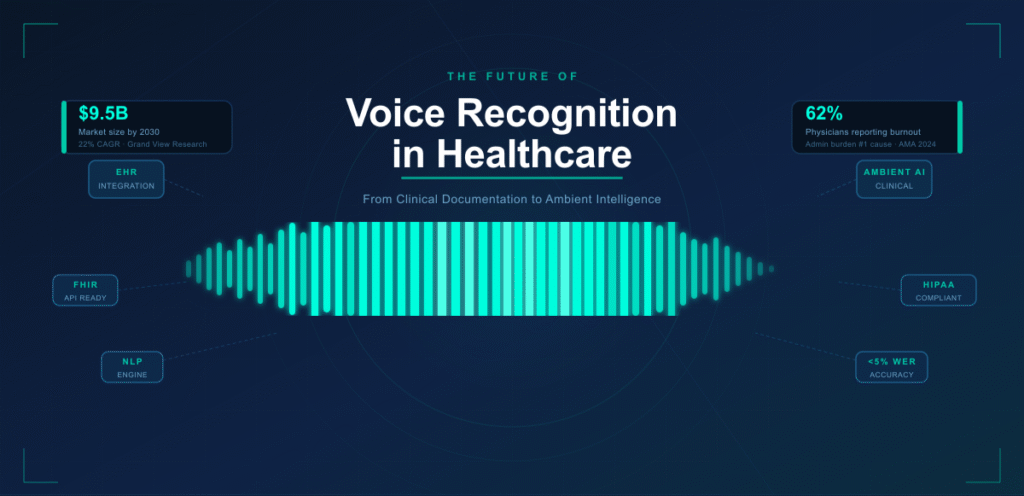
Physician burnout is a national crisis. A 2024 survey by the American Medical Association found that 62% of physicians reported burnout symptoms and administrative burden was cited as the #1 driver. Physicians spend an average of 15.6 hours per week on documentation and administrative tasks alone, according to research published in Health Affairs.
That’s nearly two full working days every week spent on paperwork rather than patients.
Meanwhile, the U.S. healthcare system faces a projected shortfall of 86,000 physicians by 2036 (AAMC, 2024 report). When there aren’t enough clinicians to go around, the answer can’t simply be “hire more.” Efficiency has to be part of the solution and voice-enabled AI is emerging as one of the most viable paths.
The global healthcare speech recognition market reflects this urgency. Valued at approximately $2.8 billion in 2024, the market is projected to reach $9.5 billion by 2030, growing at a compound annual growth rate (CAGR) of over 22% (Grand View Research, 2025). The United States accounts for the largest share, driven by widespread EHR adoption and mounting pressure to reduce documentation burden.
Key Applications of Voice Recognition in Healthcare Today
1. Clinical Documentation and Medical Transcription
This is the flagship use case and the one generating the most ROI for health systems.
Physicians using ambient AI clinical documentation (tools like Nuance DAX, Suki, DeepScribe, and others) report saving an average of 2–3 hours per day on note-writing. A landmark study from the Mayo Clinic found that ambient AI documentation reduced after-hours EHR time (a major burnout driver) by 36% over a six-month period.
The workflow looks like this: a physician has a natural conversation with a patient, the AI listens passively (with patient consent), generates a draft SOAP note in real time, and the physician reviews and approves typically in under 90 seconds. No dictation device required. No transcriptionist waiting on the other end.
2. EHR Navigation and Hands-Free Workflow Control
Navigating an EHR during a patient encounter is one of the most cited frustrations in modern medicine. Physicians often spend more time clicking through screens than talking to patients.
Voice-enabled EHR navigation lets clinicians move through charts, pull up lab results, and document findings without touching a keyboard or mouse. This is especially valuable in:
- Surgical suites — where sterile fields prohibit touching devices
- Radiology — where voice-activated image navigation speeds reads
- Emergency departments — where speed and hands-free operation are critical
- Inpatient rounding — where physicians move room to room and can’t carry a laptop
Epic, Oracle Cerner, and Meditech have all introduced or expanded native voice capabilities in recent years, and third-party integrations have proliferated across the EHR market.
3. Telehealth and Remote Patient Interactions
The telehealth boom that accelerated during COVID-19 created a new documentation challenge: visits conducted over video don’t lend themselves to traditional note-taking, and the clinician can’t break eye contact to type without it feeling disruptive to the patient.
AI-powered ambient documentation for telehealth solves this elegantly. During a virtual visit, the system transcribes and structures the conversation in real-time, producing a draft note without any additional clinician effort. Platforms like Nabla Copilot and Suki have built specific workflows for telehealth environments.
4. Radiology and Pathology Reporting
Radiology was among the earliest adopters of speech recognition in healthcare – radiologists have been dictating reports for decades. Today’s AI-enhanced reporting systems go further, offering:
- Real-time structured reporting that populates standardized reporting templates (like RadLex-compliant formats)
- Automated critical finding detection that flags urgent findings and initiates notification workflows
- Preliminary read assistance that suggests diagnoses based on image analysis combined with spoken clinical context
Nuance PowerScribe 360 and Fluency for Imaging are two of the leading platforms in this space, used in thousands of radiology practices across the country.
5. Patient-Facing Voice Interfaces and Virtual Health Assistants
Voice recognition isn’t just for clinicians. Patient-facing applications include:
- Automated intake and symptom collection — patients describe symptoms verbally before a visit, and structured data flows into the EHR
- Medication reminders and adherence support — smart speakers and mobile apps prompt patients and track responses
- Post-discharge follow-up — voice-based conversational AI checks in with patients after discharge, collecting symptom data and escalating concerns
- Remote monitoring support — voice interfaces for elderly or mobility-impaired patients who struggle with traditional device interfaces
Healthcare organizations using AI-powered post-discharge voice follow-up have reported 30-day readmission rate reductions of up to 18% in pilot programs (NEJM Catalyst, 2024).
6. Behavioral Health and Mental Health Support
One emerging application that’s gaining traction is the use of voice analytics in behavioral health. Natural language processing can detect changes in speech patterns – pace, pauses, vocabulary associated with depression, anxiety, mania, or cognitive decline. While not a diagnostic tool on its own, voice analytics is being explored as a passive screening mechanism for mental health deterioration in high-risk populations.
How AI and NLP Are Elevating Clinical Speech Recognition
Early speech recognition systems were frustrating. Error rates were high, medical terminology tanked accuracy, and the software required hours of “training” to a specific user’s voice. Productivity gains were modest at best.
That’s changed dramatically.
Large language models (LLMs) have transformed what’s possible. Today’s best systems achieve word error rates (WER) below 5% on medical terminology comparable to trained human transcriptionists and some clinical LLMs are now trained on hundreds of millions of clinical notes, enabling them to understand context, not just words.
The difference matters. A purely transcription-based system might produce: “Patient has a PE.” A context-aware LLM-powered system knows this means pulmonary embolism, populates the appropriate ICD-10 code (I26.99), flags a risk alert, and suggests anti-coagulation documentation – all from the same three words.
Key AI capabilities driving this leap forward include:
- Contextual disambiguation — interpreting clinical terminology based on the surrounding conversation
- Named entity recognition (NER) — identifying and tagging medications, conditions, procedures, and anatomical structures
- Structured data extraction — converting free-form speech into discrete, queryable EHR data points
- Speaker diarization — identifying who is speaking (physician, patient, family member) in multi-party conversations
- Ambient listening — passively capturing relevant clinical content from natural conversation without active dictation triggers
The integration of multimodal AI combining voice with images, wearable data, and EHR context represents the next frontier. Systems that can cross-reference what a physician says with what an imaging study shows, a patient’s vitals trend, and their medication history will produce documentation and decision support that no single-channel system can match.
Real-World ROI: What Health Systems Are Seeing
It’s worth being concrete about the financial and operational impact voice recognition is delivering.
Documentation time savings:
Institutions deploying ambient AI documentation consistently report note-completion time reductions of 50–70%. At a large multi-specialty group practice, even a 1-hour-per-day savings per physician — well below what the studies suggest is achievable – translates to meaningful capacity gains. If a practice of 20 physicians each recover 1 hour of clinical time daily, that’s 4,600 additional patient-hours per year.
Patient throughput:
Cleveland Clinic reported a 12% increase in patient visit capacity after deploying AI-assisted documentation for primary care physicians, attributable to reduced time spent on documentation per visit.
Physician satisfaction and retention:
With physician recruitment and onboarding costs averaging $500,000 to $1 million per physician (including recruitment fees, credentialing, and productivity ramp-up), even modest improvements in retention driven by reduced administrative burden generate substantial savings. Post-deployment satisfaction surveys across multiple health systems have shown NPS score improvements of 15–30 points among physicians using ambient AI tools.
Coding and revenue cycle accuracy:
Voice recognition systems integrated with AI-driven coding assistance have shown measurable improvements in Hierarchical Condition Category (HCC) capture rates and CPT code accuracy. In value-based care environments, improved risk score accuracy directly translates to appropriate risk adjustment payments – a significant financial lever.
Voice Recognition and EHR Integration: The Technology Stack
For voice recognition to deliver its full clinical value, deep integration with EHR systems is essential. Data captured via voice needs to flow seamlessly into structured fields, trigger workflows, and be retrievable in downstream analytics.
The integration landscape in 2025–2026 has matured considerably:
- FHIR (Fast Healthcare Interoperability Resources) APIs have become the standard integration backbone, enabling voice platforms to read and write clinical data across EHR systems
- HL7 standards continue to underpin legacy integrations, particularly in inpatient environments
- Pre-built EHR connectors from major voice vendors have reduced implementation complexity – what once required months of custom development can now be deployed in weeks
Leading EHR platforms and their voice integration ecosystems:
| EHR Platform | Native Voice Capability | Key Third-Party Partners |
|---|---|---|
| Epic | Suki, Nuance DAX via App Orchard | Ambient.ai, DeepScribe |
| Oracle Cerner | Nuance Dragon Medical | Suki, Saykara |
| MEDITECH | MEDITECH Expanse Voice | Nuance, MModal |
| athenahealth | Alexa integration, Suki | Nabla |
| Allscripts/Veradigm | Nvoq, Nuance | Various |
Challenges and Considerations in Deploying Voice Recognition Technology
No technology solves every problem cleanly, and voice recognition in healthcare comes with its own set of implementation realities.
Data Privacy and HIPAA Compliance
Voice data captured in clinical environments is Protected Health Information (PHI) under HIPAA. This creates significant compliance requirements around:
- Data storage and encryption — where audio and transcriptions are stored, and how they’re secured
- Retention and deletion policies — how long raw audio is kept and under whose control
- Business Associate Agreements (BAAs) — ensuring vendors meet HIPAA standards contractually
- Patient consent — informing patients when ambient AI is active during visits
Most enterprise-grade vendors have addressed these concerns with on-premise or private-cloud deployment options, robust encryption (AES-256 at rest and in transit), and comprehensive BAA frameworks. However, health systems should conduct thorough vendor due diligence, particularly around subprocessors and data residency.
Accuracy in High-Noise Environments
Emergency departments, ICUs, and procedure rooms are loud. Background noise – alarms, conversations, equipment can degrade voice recognition accuracy. Modern systems use adaptive noise cancellation and directional microphone arrays to address this, but performance in high-noise settings still varies by vendor and use case.
Algorithmic Bias and Health Equity
Research has documented that ASR systems can exhibit higher word error rates for speakers with certain accents or dialects. A 2022 study published in Nature found error rate disparities of 35–68% between standard American English and African American Vernacular English (AAVE) speakers across major voice recognition systems.
For healthcare applications, this isn’t just an inconvenience – it’s a patient safety concern. A misunderstood medication dosage or a misrecognized symptom description could contribute to a documentation error. Health organizations should evaluate vendor commitments to bias testing, diverse training datasets, and continuous accuracy monitoring across demographic groups.
Provider Adoption and Change Management
The best voice recognition platform in the world delivers zero value if physicians don’t use it. Change management is often underestimated in voice technology deployments. Key success factors include:
- Physician champions — peer advocates who model the technology and provide social proof
- Gradual rollout — piloting in receptive specialties before enterprise-wide deployment
- Feedback loops — mechanisms for physicians to flag errors and track improvements
- IT and workflow support — reducing the friction of learning a new tool during an already demanding workday
Organizations that invest in change management alongside technology deployment consistently report higher adoption rates and faster time-to-value.
Integration Complexity
Despite maturation in FHIR standards and vendor connectors, integration with legacy EHR systems and complex multi-vendor environments can still be technically demanding. Organizations with older or heavily customized EHR implementations should build realistic integration timelines and budget for technical services.
The Future of Voice Recognition in Healthcare: What’s Coming
We’re at an inflection point. The current generation of voice technology has proven its value in reducing documentation burden. The next generation will do something far more significant: it will make clinical intelligence ambient.
Ambient Clinical Intelligence
The concept of ambient clinical intelligence (ACI) describes an AI layer that continuously perceives, contextualizes, and acts on everything happening in a clinical environment without requiring any direct input from the clinician. Voice is the primary input channel, but ACI systems will also integrate data from cameras, wearables, monitoring devices, and EHRs.
In an ACI-enabled hospital room, the system monitors a patient conversation, detects that a clinician mentioned a new symptom, checks it against the patient’s medication list and recent lab results, and surfaces a relevant drug-drug interaction alert – all before the physician has finished the visit. Microsoft-Nuance’s Dragon Ambient eXperience (DAX) Copilot and similar platforms are early implementations of this vision.
Predictive and Prescriptive Documentation
Future voice systems won’t just transcribe what’s said, they’ll suggest what should be said. Drawing on population health data, clinical guidelines, and a patient’s longitudinal history, AI will prompt clinicians with documentation suggestions, missing care gap flags, and risk stratification alerts in real time.
For example, a physician discussing a diabetic patient’s visit might receive a real-time prompt: “HbA1c hasn’t been ordered in 11 months consider adding to today’s order set.” The physician speaks the order, and it’s documented and submitted simultaneously.
Voice in the Revenue Cycle
Voice recognition is beginning to extend beyond clinical documentation into revenue cycle management. Natural language interfaces for coding review, prior authorization requests, and denial appeal drafting represent the next wave of administrative AI in healthcare.
Interoperability With Wearables and Remote Monitoring
As wearable health sensors proliferate (continuous glucose monitors, cardiac monitors, blood pressure cuffs, pulse oximeters), voice interfaces will become the human layer through which patients interact with and contextualize their own health data. Patients will speak to their healthcare AI about what they’re experiencing; the AI will correlate it with objective sensor data and surface insights to the care team.
Voice as an Accessibility Tool
Perhaps the most underappreciated future application is accessibility. For elderly patients, those with limited literacy, non-English speakers, and individuals with physical disabilities that limit technology interaction, voice-driven health interfaces have the potential to meaningfully reduce health disparities. Multilingual clinical voice recognition trained on diverse medical terminology across Spanish, Mandarin, Vietnamese, and other widely spoken languages is an area seeing active investment.
How to Evaluate Voice Recognition Platforms for Your Health Organization
If your organization is considering a voice recognition investment, here’s a practical evaluation framework:
Clinical accuracy:
- What is the vendor’s documented WER across specialties relevant to your service lines?
- How does accuracy perform for providers with non-standard accents or speech patterns?
- What is the process for error reporting and model retraining?
EHR integration:
- Does the platform offer a pre-built connector for your EHR?
- What data structures does the integration support (structured fields, NLP-extracted data, free text)?
- What FHIR resources are supported for read/write?
Security and compliance:
- Is the platform HIPAA-compliant with a comprehensive BAA?
- What are the data residency options (cloud vs. on-premise)?
- What encryption standards apply to audio data at rest and in transit?
Workflow fit:
- Does the platform support your target use cases (ambient, dictation, navigation, patient-facing)?
- How does the workflow change for end users?
- What is the vendor’s change management support offering?
Total cost of ownership:
- What is the per-provider or per-facility pricing model?
- What professional services are required for implementation?
- What are the expected productivity ROI and time-to-value?
Frequently Asked Questions About Voice Recognition in Healthcare
What is the accuracy rate of voice recognition in healthcare settings?
Modern AI-powered clinical speech recognition systems achieve word error rates (WER) of 3–7% on medical terminology — comparable to human transcriptionists. Accuracy varies by vendor, specialty, microphone quality, and environmental conditions. Radiology-specific platforms often achieve even lower error rates due to structured reporting templates and domain-specific training. Real-world accuracy is improving rapidly with each generation of underlying large language models.
Is voice recognition in healthcare HIPAA compliant?
It can be, but compliance depends entirely on the vendor and implementation. Enterprise-grade voice recognition platforms designed for healthcare are built with HIPAA compliance as a foundation, including Business Associate Agreements (BAAs), AES-256 encryption, access controls, and audit logging. Health organizations must conduct thorough vendor due diligence and ensure BAAs are executed before any patient data is processed.
How does ambient AI documentation differ from traditional medical dictation?
Traditional dictation requires a physician to actively describe findings in a structured narrative — essentially narrating a note. Ambient AI documentation passively captures the natural conversation between a provider and patient, then uses AI to extract clinically relevant information and generate a structured note automatically. The physician reviews and approves rather than dictates. This shift from active to passive documentation is the core reason ambient AI drives much larger time savings than traditional dictation.
Can voice recognition technology reduce physician burnout?
Yes — and the evidence is growing. Multiple peer-reviewed studies and health system reports have documented significant reductions in documentation time, after-hours EHR work, and self-reported burnout symptoms among physicians using ambient AI documentation tools. The AMA has endorsed ambient AI as one of the most promising tools for addressing the administrative burden driving physician burnout.
What EHR systems support voice recognition integration?
All major EHR platforms — including Epic, Oracle Cerner, MEDITECH, athenahealth, and Allscripts — support voice recognition integration, either through native voice features or third-party partnerships. Epic’s App Orchard and Cerner’s App Market provide curated vendor integrations. FHIR API compatibility has significantly expanded the integration ecosystem across the industry.
How long does it take to implement voice recognition in a healthcare organization?
Implementation timelines vary widely depending on scope, EHR complexity, and deployment model. A focused deployment for a single specialty or department can be operational in 4–8 weeks. An enterprise-wide rollout across multiple facilities and specialties typically takes 6–18 months. Cloud-based SaaS platforms generally deploy faster than on-premise solutions.
Does voice recognition work well for non-native English speakers or physicians with accents?
This has historically been a weakness of voice recognition systems, but it has improved significantly. Modern AI-powered platforms train on diverse speaker datasets and offer user-specific adaptation that improves accuracy over time. However, performance disparities still exist across some platforms and accent profiles. Organizations serving diverse provider populations should request accent-specific accuracy data from vendors during the evaluation process and prioritize platforms with demonstrated commitment to bias mitigation.
What is the ROI of voice recognition technology in healthcare?
ROI is driven by multiple factors: documentation time savings, increased patient throughput, improved coding accuracy, reduced transcription costs, and physician retention improvements. Health systems typically report full ROI within 12–24 months of enterprise deployment. Practices with high documentation burden (primary care, hospitalists, psychiatry) tend to see the fastest payback periods.
The Bottom Line: Voice Is the Interface of Healthcare’s Future
For decades, the primary interface between clinicians and the healthcare system has been the keyboard – a tool that was never designed for clinical work and has exacted an enormous human cost. Voice recognition technology is finally mature enough, accurate enough, and intelligent enough to replace it.
The trajectory is clear: AI-powered voice will move from documentation assistant to ambient clinical intelligence. From reducing administrative burden to actively supporting clinical decision-making. From a single-use productivity tool to the conversational layer through which clinicians, patients, and AI systems interact in real time.
The organizations that invest in voice-enabled workflows today are building a strategic advantage that will compound over time – in operational efficiency, physician satisfaction, data quality, and ultimately, patient outcomes.
The question isn’t whether voice recognition will reshape healthcare. It’s whether your organization will lead that transformation or catch up to it.