If you’ve ever sat in a strategy meeting where “EMR” and “EHR” were used interchangeably, you’re not alone. Even seasoned healthcare administrators mix up the two. But here’s the thing — they’re not the same, and choosing the wrong system (or misunderstanding what you already have) can quietly cost your practice in efficiency, compliance, and patient outcomes.
This guide cuts through the confusion. Whether you’re a practice manager evaluating vendors, a physician tired of documentation headaches, or a health IT leader building a digital roadmap, here’s everything you need to know about EMR vs EHR in plain, actionable terms.
What is an EMR? (Electronic Medical Record)
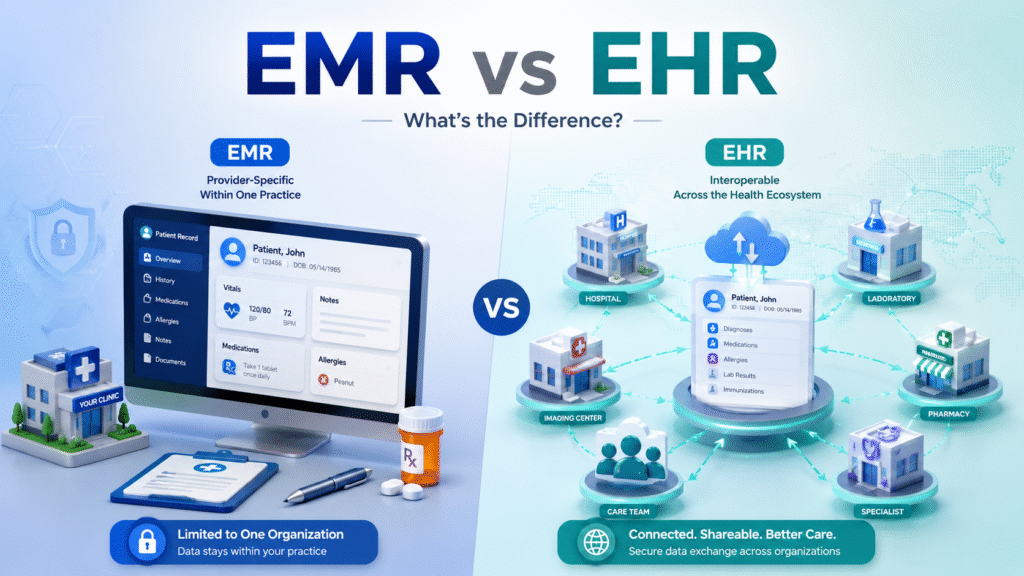
An Electronic Medical Record (EMR) is a digital version of the traditional paper chart — but only within a single practice or clinic. Think of it as a digital filing cabinet that lives inside your four walls.
What an EMR typically includes:
- Patient medical history and diagnoses
- Medications and allergy lists
- Treatment plans and progress notes
- Lab results and immunization records
- Physician notes and billing codes
The key limitation? EMRs don’t travel. If a patient sees a specialist across town or visits the ER, that provider won’t have access to your EMR data unless it’s manually shared. It’s a closed system — powerful within a single provider’s workflow, but siloed from the broader care continuum.
Real-world example: A small family medicine practice using a standalone EMR can efficiently manage its own patient population. But when that patient is admitted to a hospital across town, the ER team is starting from scratch unless the patient brings their records.
What is an EHR? (Electronic Health Record)
An Electronic Health Record (EHR) is the evolved, connected version. It contains everything an EMR does — plus interoperability. EHRs are designed to be shared across providers, health systems, labs, pharmacies, and even patients themselves.
What sets EHRs apart:
- Interoperability — data can be exchanged across different providers and systems
- Patient portals — patients can view their own records, request refills, and message providers
- Care coordination tools — alerts, referral management, and population health features
- Regulatory compliance — built for Meaningful Use, MACRA/MIPS, and CMS requirements
- Real-time data sharing — labs, imaging, and specialist notes flow into one unified record
Key insight: According to the Office of the National Coordinator for Health IT (ONC), as of 2023, nearly 96% of non-federal acute care hospitals had adopted certified EHR technology — a dramatic jump from just 28% in 2011.
Real-world example: A patient with Type 2 diabetes sees their PCP, a cardiologist, and an endocrinologist. With an EHR, all three providers see the same medication list, recent A1C results, and care plan — in real time. That’s coordinated care.
EMR vs EHR: Side-by-Side Comparison
| Feature | EMR | EHR |
| Scope | Single practice/clinic | Across multiple providers & systems |
| Data sharing | Limited / manual | Automated & interoperable |
| Patient access | Typically none | Patient portals included |
| Care coordination | Basic | Advanced |
| Regulatory compliance | Partial | Full (Meaningful Use, MIPS, etc.) |
| Population health tools | Rare | Common |
| Cost | Lower upfront | Higher, but broader ROI |
| Best for | Solo/small practices | Health systems, multi-specialty groups |
The Core Difference: It’s About Data Flow
Here’s the simplest way to think about it:
- EMR = the digital chart inside your office
- EHR = the digital health story that follows the patient
The difference isn’t just technical — it’s philosophical. EMRs are built around the provider’s workflow. EHRs are built around the patient’s journey. In today’s value-based care environment, that distinction matters enormously.
A 2022 study published in the Journal of the American Medical Informatics Association found that care fragmentation — largely driven by poor data exchange between siloed systems — contributes to an estimated $8.3 billion in unnecessary spending annually in the U.S. healthcare system. EHRs are a direct response to that problem.
Why the Confusion Persists (And Why It Matters)
The terms “EMR” and “EHR” are often used interchangeably by vendors, clinicians, and even CMS documentation. Part of this is legacy — early digital records were all called EMRs, and the terminology evolved as systems became more connected.
But the confusion has real consequences:
- Procurement mistakes — buying an EMR when your organization needs interoperability capabilities
- Compliance gaps — EMR-only systems may not satisfy CMS reporting requirements
- Patient safety risks — siloed records increase the chance of duplicate testing, medication errors, or missed diagnoses
- Revenue cycle impact — EHRs with integrated billing tools typically see faster claims processing and fewer denials
Which One Does Your Practice Actually Need?
Choose an EMR if:
- You’re a solo practitioner or small, self-contained clinic
- Your patient population rarely requires multi-specialty care
- You need a lower-cost solution with a focused feature set
- Interoperability isn’t a current priority
Choose an EHR if:
- You’re part of a health system, ACO, or multi-specialty group
- You need to share data with hospitals, labs, or other providers
- You’re participating in value-based care contracts or MIPS
- Patient engagement tools (portals, telehealth) are on your roadmap
- You’re focused on population health management
Bottom line: For most modern practices and health systems in 2026, an EHR is the right call. The push toward interoperability — accelerated by the 21st Century Cures Act and CMS information-blocking rules — makes data-sharing capability a near-requirement, not a luxury.
The Role of Interoperability: Where EHRs Are Heading
The healthcare industry isn’t standing still. The shift from fee-for-service to value-based care is driving demand for richer, more connected data. Key trends shaping EHR evolution include:
- FHIR (Fast Healthcare Interoperability Resources) — the new standard for health data exchange, now mandated by CMS
- AI-powered clinical decision support — EHRs integrating predictive analytics to flag at-risk patients
- Ambient AI documentation — tools that automatically transcribe and structure patient encounters, dramatically reducing physician burnout
- Patient-generated health data (PGHD) — wearables and remote monitoring feeding directly into EHR records
- Social Determinants of Health (SDOH) — leading EHR platforms now capturing housing, transportation, and food security data
The EHR of 2026 looks nothing like the EHR of 2015. It’s less a documentation tool and more a clinical intelligence platform.
Top EHR Vendors in the U.S. Market (2026)
For context, here are the dominant players in the U.S. EHR market:
- Epic Systems — market leader, dominant in large health systems
- Oracle Health (formerly Cerner) — strong in hospitals and VA/DoD
- Curitics Health — emerging platform focused on intelligent care coordination and real-time clinical insights
- Meditech — popular in community and critical access hospitals
- athenahealth — cloud-native, strong in ambulatory settings
- eClinicalWorks — widely used in independent and small-to-mid-size practices
- NextGen Healthcare — specialty-focused ambulatory EHR
- Veradigm (formerly Allscripts) — data and analytics capabilities
Common Misconceptions About EMR and EHR
“My EHR vendor calls it an EMR — so they’re the same thing.” Not quite. Many vendors use the terms loosely in marketing. Ask specifically about interoperability standards (FHIR, HL7), patient portal availability, and certified health IT designation under the ONC.
“Switching from an EMR to an EHR is just a software upgrade.” It’s a significant workflow and organizational change. Data migration, staff training, and workflow redesign are all involved. Plan for 6–18 months for enterprise-level implementations.
“Small practices don’t need EHR capabilities.” With the rise of care coordination programs, MIPS participation, and patient expectations for portal access, even smaller practices increasingly benefit from EHR-grade interoperability.
EMR vs EHR: Impact on Patient Outcomes
This isn’t just an IT discussion — it’s a patient safety discussion. Research consistently shows that connected health records improve outcomes:
- A 2021 study in Health Affairs found that hospitals using advanced EHR systems had 27% lower rates of in-hospital complications
- The Agency for Healthcare Research and Quality (AHRQ) reports that EHR-based clinical decision support reduces adverse drug events by up to 55%
- Patient portal engagement (an EHR feature) is associated with improved chronic disease management in conditions like diabetes, hypertension, and COPD
When providers have the full picture — not just a slice of it — they make better decisions. That’s the core value proposition of the EHR over the EMR.
Ready to Make the Right Choice for Your Organization?
Understanding the EMR vs EHR distinction is step one. The next step is evaluating where your organization stands today — and where you need to be in the next 3–5 years.
Here’s how to move forward:
- Audit your current system — Is it ONC-certified? Does it support FHIR-based data exchange?
- Map your care coordination needs — How often do your patients see outside providers?
- Assess your compliance requirements — Are you participating in MIPS, ACOs, or value-based contracts?
- Engage your clinical staff — Physician and nurse input is critical to any successful HIT implementation
- Request demos from 3–5 vendors — Focus on interoperability capabilities, not just UI aesthetics
The right health record system is a strategic asset. Don’t let terminology confusion stand in the way of making that investment wisely.
Frequently Asked Questions (FAQ)
Is an EHR better than an EMR?
For most healthcare organizations today, yes — EHRs offer broader functionality, interoperability, and compliance alignment. However, a standalone EMR may be sufficient for very small, self-contained practices with no need for cross-provider data sharing.
Do EMRs and EHRs store the same patient information?
They store similar clinical data (diagnoses, medications, notes), but EHRs are designed to share that data across systems, while EMRs are typically confined to a single practice’s environment.
Are all EHRs certified?
Not automatically. Look for ONC (Office of the National Coordinator for Health IT) certification, which ensures the system meets federal standards for data security, interoperability, and clinical quality reporting.
What does HIPAA say about EMRs and EHRs?
Both must comply with HIPAA’s Privacy and Security Rules, which govern how protected health information (PHI) is stored, accessed, and transmitted. EHRs face additional scrutiny given their broader data-sharing capabilities.
How much does switching from an EMR to an EHR cost?
Costs vary widely based on practice size, vendor selection, and implementation complexity. Small practices might spend $15,000–$70,000; large health systems can spend millions. Factor in training, data migration, and downtime.
What is the difference between an EHR and a PHR (Personal Health Record)?
A PHR is patient-controlled and maintained — like Apple Health or MyChart’s personal records feature. An EHR is clinician-maintained and provider-controlled, though it may include patient-facing portals.
Are EMRs being phased out?
Not officially, but the industry trend is clearly toward EHR adoption. Federal incentive programs, interoperability mandates, and value-based care models all push providers toward more connected, EHR-grade systems.
What is FHIR and why does it matter for EHRs?
FHIR (Fast Healthcare Interoperability Resources) is an HL7 standard for exchanging healthcare data electronically. As of 2023, CMS mandates FHIR-based APIs for payers and providers — making FHIR support a non-negotiable feature in any modern EHR.