If your Medicare Advantage plan has notified you that it will not be offered for 2027, you have decisions to make about your medical and prescription coverage. Your plan ending does not mean your Medicare eligibility ends.
For a plan that stops coverage on December 31, 2026, you can generally choose another Medicare Advantage plan or return to Original Medicare. If you do not join another Medicare Advantage plan before your existing coverage ends, you will generally return to Original Medicare automatically. Prescription coverage needs separate attention. Medicare.gov explains these enrollment rights.
This guide covers year-end plan nonrenewals affecting January 1, 2027 coverage. If your notice gives a different termination date, confirm your specific enrollment window with Medicare.
1. Read the notice before choosing replacement coverage
Start with the official notice from your current plan. Keep a copy and identify:
- Your exact plan name and identification number.
- The final day of coverage.
- Whether the plan is ending, leaving your county or transferring members into another plan.
- The enrollment rights and deadlines described in the notice.
A notice saying your plan will not renew is different from one saying you will automatically move into another plan.
CMS specifically states that plan consolidations are not terminations or nonrenewals and do not qualify for the nonrenewal Special Enrollment Period. If your insurer is moving you into another plan, review its benefits, network and prescriptions before assuming the coverage will remain similar. CMS’s 2027 enrollment guidance.
2. Know the deadlines and when replacement coverage starts
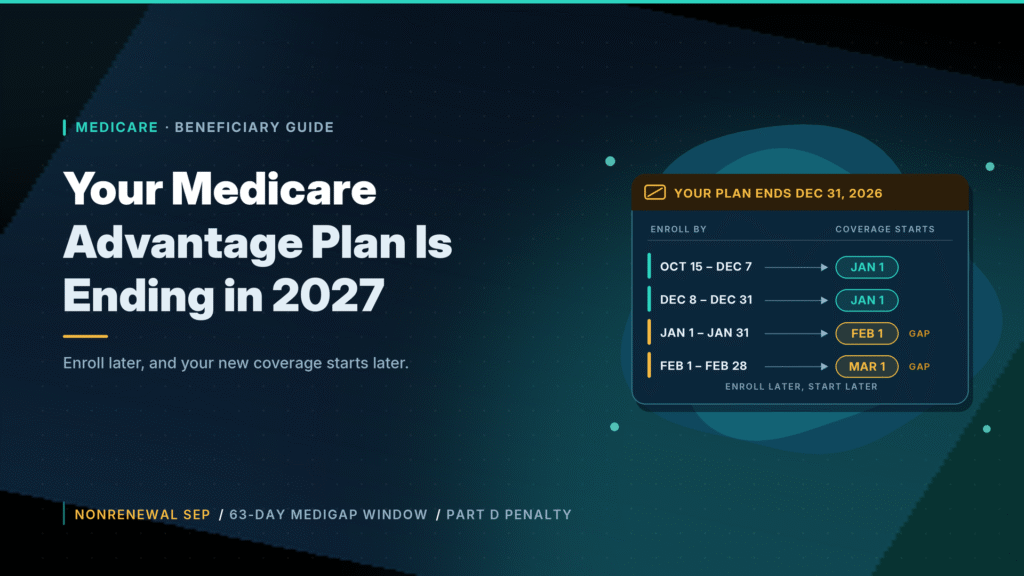
For coverage ending December 31, 2026, the annual fall enrollment period provides the first opportunity to arrange January coverage. Eligible beneficiaries also have a separate nonrenewal Special Enrollment Period.
| When the replacement plan receives your enrollment request | Enrollment opportunity | New coverage starts |
|---|---|---|
| October 15–December 7, 2026 | Annual Medicare Open Enrollment | January 1, 2027 |
| December 8–December 31, 2026 | Nonrenewal Special Enrollment Period | January 1, 2027 |
| January 1–January 31, 2027 | Nonrenewal Special Enrollment Period | February 1, 2027 |
| February 1–February 28, 2027 | Final month of the nonrenewal Special Enrollment Period | March 1, 2027 |
The annual enrollment dates come from Medicare.gov’s Open Enrollment guidance. The nonrenewal window and corresponding effective dates appear in CMS’s 2027 enrollment guidance, Section 30.6.10.
February 28 is an enrollment deadline, not a guarantee of uninterrupted replacement coverage. For example, an eligible January enrollment starts February 1; it does not make the new plan responsible for January expenses.
For a broader preparation checklist, see our guide to Medicare Open Enrollment for 2027.
3. Compare your two main coverage options
A plan exit gives you an opportunity to reconsider how you receive Medicare benefits.
| Option | How coverage works | What to check before choosing |
|---|---|---|
| Another Medicare Advantage plan | A private Medicare-approved plan provides Part A and Part B benefits, usually with Part D prescription coverage | Doctors, hospitals, prescriptions, referral requirements, prior authorization and total costs |
| Original Medicare with separate drug coverage | Part A and Part B provide medical coverage; a standalone Part D plan can provide prescription coverage | Provider participation, drug costs and whether Medigap or another supplement is available |
Original Medicare generally allows you to use providers nationwide that accept Medicare. Medicare Advantage plans generally have network rules, although some offer covered out-of-network care at a higher cost.
Original Medicare alone has no annual limit on your spending for covered Part A and Part B services. Medicare Advantage plans have an annual medical out-of-pocket limit, subject to the plan’s coverage and network rules. Medicare.gov’s coverage comparison.
Our Medicare Advantage vs Original Medicare comparison for 2027 explains the broader differences.
4. Investigate Medigap protections before the deadline passes
If your Medicare Advantage plan leaves Medicare or stops serving your area, returning to Original Medicare may give you a guaranteed-issue right to buy certain Medigap policies.
For policies covered by that protection, an insurer cannot deny you coverage or charge more because of past or present health problems. The protection does not necessarily apply to every Medigap policy available in your state.
State rules can provide additional rights. People under 65 should check their options carefully because federal law generally does not require insurers to sell them Medigap policies. Medicare’s official Medigap guide.
The application deadline is generally no more than 63 days after your Medicare Advantage coverage ends. Applications can be arranged before coverage ends; check your termination notice and confirm the applicable dates. Medigap coverage cannot begin while your Medicare Advantage enrollment continues. Medicare.gov’s Medigap enrollment guidance.
Ask a prospective insurer:
- Which policies can I buy using my guaranteed-issue right?
- What documentation proves that my current plan is ending?
- What is my application deadline?
- Can the policy begin January 1, 2027?
- What premium will I pay?
Keep the termination notice with your application records. For background, read our guide to Medigap vs Medicare Advantage.
5. Arrange prescription coverage explicitly
If your current Medicare Advantage plan includes Part D, that drug coverage ends when the plan ends.
Your replacement may be another Medicare Advantage plan with drug coverage or a standalone Part D plan alongside Original Medicare. Do not assume returning to Original Medicare automatically replaces your existing prescription benefit. Medicare’s guide to Medicare Advantage coverage.
Prepare a medication list showing each drug’s name, strength, dosage and refill frequency. For every replacement option, check:
- Whether each medication is covered.
- Your preferred pharmacy’s participation.
- Estimated annual prescription spending.
- Prior authorization, quantity limits or step therapy requirements.
If you receive Medicaid or Extra Help, ask Medicare to confirm what drug coverage will be in place and whether you need to take action.
Going 63 days or longer without Part D or other creditable prescription coverage can lead to a late enrollment penalty. Exceptions apply, including for people who qualify for Extra Help. Medicare.gov’s penalty guidance.
6. Check ongoing treatment and the full annual cost
Before enrolling, contact both the replacement plan and your healthcare providers about the exact plan, rather than asking only whether the office accepts the insurance company.
Give particular attention to scheduled surgery, cancer treatment, rehabilitation, home health services, medical equipment and recurring specialist visits. Ask what records or approvals the replacement coverage will require.
Then compare costs beyond the advertised premium:
| Expense | What to include |
|---|---|
| Medicare premiums | Part B and any applicable Part A premium |
| Additional coverage premiums | Medicare Advantage, standalone Part D and Medigap, as applicable |
| Medical treatment | Deductibles, copayments and coinsurance |
| Prescriptions | Your medications at the pharmacies you expect to use |
| Services outside coverage | Expenses beyond covered benefits or benefit limits |
| An expensive medical year | The applicable spending protections and remaining financial exposure |
A $0 Medicare Advantage plan premium does not mean all care is free. Beneficiaries generally continue paying their Part B premium, and treatment costs can still apply. Medicare’s official Medicare Advantage guide.
A useful comparison includes two scenarios: your expected healthcare needs and a year involving substantially more treatment.
7. Confirm enrollment before considering the transition complete
Keep a simple coverage record:
| Coverage item | Confirmation to obtain |
|---|---|
| Medical coverage | Coverage arrangement and effective date |
| Prescription coverage | Drug plan name and effective date |
| Medigap, if selected | Policy approval, premium and start date |
| Doctors and ongoing care | Provider participation and any required coordination |
| Enrollment request | Confirmation number, submission date and copy of the application |
If January coverage is your goal, confirm January 1, 2027 explicitly. Follow up if the insurer has not acknowledged your application.
What happens if you do nothing?
For a genuine year-end nonrenewal, you generally return to Original Medicare if you do not join another Medicare Advantage plan before your existing plan ends. However, the ending plan’s prescription coverage and supplemental benefits do not simply continue under Original Medicare. Medicare.gov’s nonrenewal guidance.
Also, do not assume the January 1–March 31 Medicare Advantage Open Enrollment Period lets everyone join Medicare Advantage. That period is for people already enrolled in Medicare Advantage. Someone who returns to Original Medicare after a nonrenewal should check their nonrenewal Special Enrollment Period or another applicable enrollment right. Medicare’s enrollment-period fact sheet.
Where to get help
Compare available options through Medicare Plan Finder. For help understanding your notice and enrollment rights, call 1-800-MEDICARE (1-800-633-4227). TTY users can call 1-877-486-2048.
Your State Health Insurance Assistance Program can also help you understand coverage options and costs. Find assistance through Medicare’s contact and counseling resources.